
AI Coding Agent Skills and Workflow Orchestration
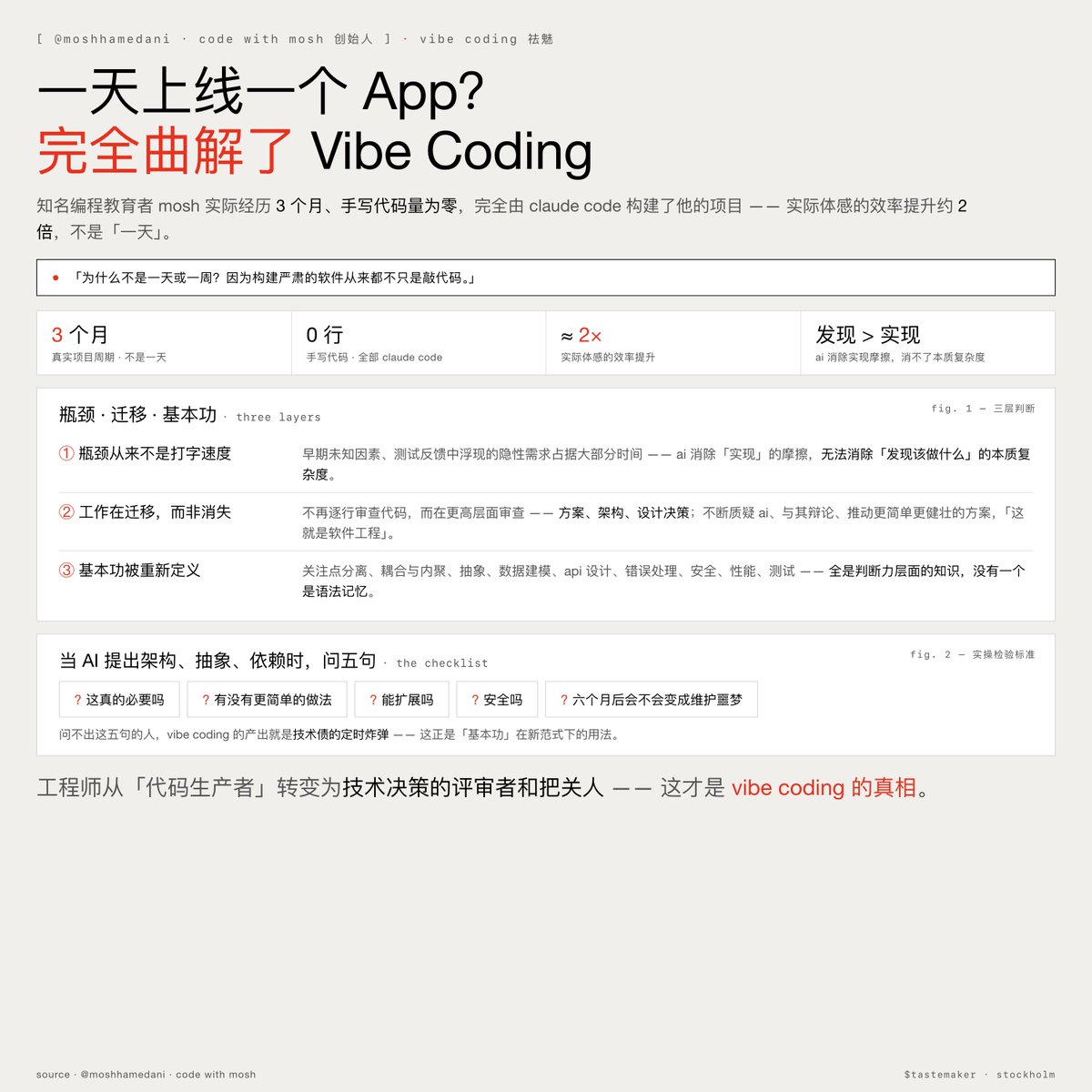
Multiple analyses from industry practitioners converge on a fundamental redefinition of software engineering in the AI coding era. Code with Mosh founder Mosh Hamedani reported three months of zero manual coding using Claude Code, with actual efficiency gains of approximately 2x rather than exaggerated claims, noting that the bottleneck in serious software development was never typing speed but discovering what to build. A Microsoft AI employee assessed that harness quality accounts for 60% of outcomes versus 40% for model capability, and predicted 65-70% of development cycles will be fully automated within 3-5 years while experienced judgment becomes more valuable. OJO Design Skills introduced structured design decision protocols for coding agents with mandatory workflow steps and evidence-based style confirmation gates. An analysis of 300 GitHub Skills repositories identified 12 noteworthy agent skills spanning humanization, engineering discipline, design taste, and cognitive research categories. A Grok Bot team operator demonstrated a 5-agent engineering team with independent memory systems, shared task boards, automated CI/CD pipelines, and a dedicated operations bot handling daily standups and postmortems. The consensus holds that AI amplifies output variance because code generation cost approaches zero, making technical judgment and conscientiousness the decisive differentiators.
Key insights
AI Eliminates Implementation Friction but Cannot Reduce Discovery Complexity
Mosh Hamedani emphasized that three months of exclusively AI-generated code yielded approximately 2x efficiency, not the unrealistic timelines marketing content suggests. The fundamental bottleneck shifts from implementation speed to the inherent complexity of discovering what to build through testing, feedback, and surfacing hidden requirements. AI removes syntax lookups, documentation searches, and boilerplate writing, but the exploratory work of understanding requirements and validating designs still dominates project timelines. The engineer's role migrates from code production to higher-level review of proposals, architecture, and design decisions.
Harness Quality Outweighs Model Selection by 60/40 Margin for Practical Outcomes
A Microsoft AI employee asserted that all models are becoming commoditized, with 60% of effective outcomes determined by harness quality versus 40% by the underlying model. Claude Code's native pairing experience delivers approximately 20-30% higher first-pass rates than GitHub Copilot, and though Claude's unit pricing may appear higher, OpenAI models require more rework iterations on complex tasks, leading to 20-30% higher actual total costs. The analysis predicts pricing will shift from token-based to result-based models due to enterprise budget predictability requirements.
Agent Output Quality Variance Increases Because Code Generation Cost Approaches Zero
With manual coding, daily output was naturally constrained to hundreds of lines. AI enables thousands or tens of thousands of lines daily, multiplying quality variance. The decisive differentiator becomes technical judgment—knowing what to build, what constitutes good work, and how to verify—combined with conscientiousness in reviewing AI-generated output before submission. The worst outcome occurs when developers perform only the intermediate generation step, skipping requirements analysis and verification, effectively using AI to mass-produce technical debt for their teams.
Design Decision Protocols Encode Aesthetic Judgment into Agent-Executable Rules
OJO Design Skills introduced a design decision protocol requiring coding agents to follow mandatory steps: product type judgment, forced inspiration search, brand perception mining for innovation track, 2-3 visual direction proposals with mandatory human selection checkpoint, then token-to-component generation using atomic Tailwind classes with complete state coverage. The protocol enforces pre-style domain definition across five axes with cited evidence, prohibits common combinatorial color defaults, and elevates real imagery and honest copywriting to rules at the same level as color specification. This represents moving design taste from implicit human judgment to explicit agent-enforceable constraints.
Agent Engineering Teams Require Organizational Structure Mirroring Human Teams
A Grok Bot team operator demonstrated a 5-agent engineering team with domain-specific ownership, independent memory systems, and a shared Notion task board. Bots poll every 30 minutes for bug reports, security alerts, CI failures, and merge conflicts, then auto-triage and auto-merge when review confidence is high and impact is minimal. The dedicated operations bot 'Jenny' conducts daily 5 AM standups, performs root-cause postmortems, updates playbooks, and handles new bot onboarding—replicating human organizational knowledge management in an agent system. Nightly audits generate improvement PRs across code cleanup, performance, security, and i18n alignment.
Fundamentals Knowledge Becomes More Valuable as Implementation Detail Burden Shifts to AI
Mosh Hamedani listed the knowledge areas that remain critical: separation of concerns, coupling and cohesion, abstraction, data modeling, API design, error handling, security, performance, and testing—all judgment-level concepts, none involving syntax or API memorization. The practical test is whether an engineer can challenge AI proposals by asking if an abstraction is truly necessary, if a simpler approach exists, if the design scales, if it's secure, and if it will become a maintenance burden in six months. Junior developer hiring has measurably decreased, and those hired must possess agentic skills, with hiring standards shifting from hardcore coding ability to judgment about what constitutes good output.