
Andrej Karpathy's 2025 LLM Year-in-Review
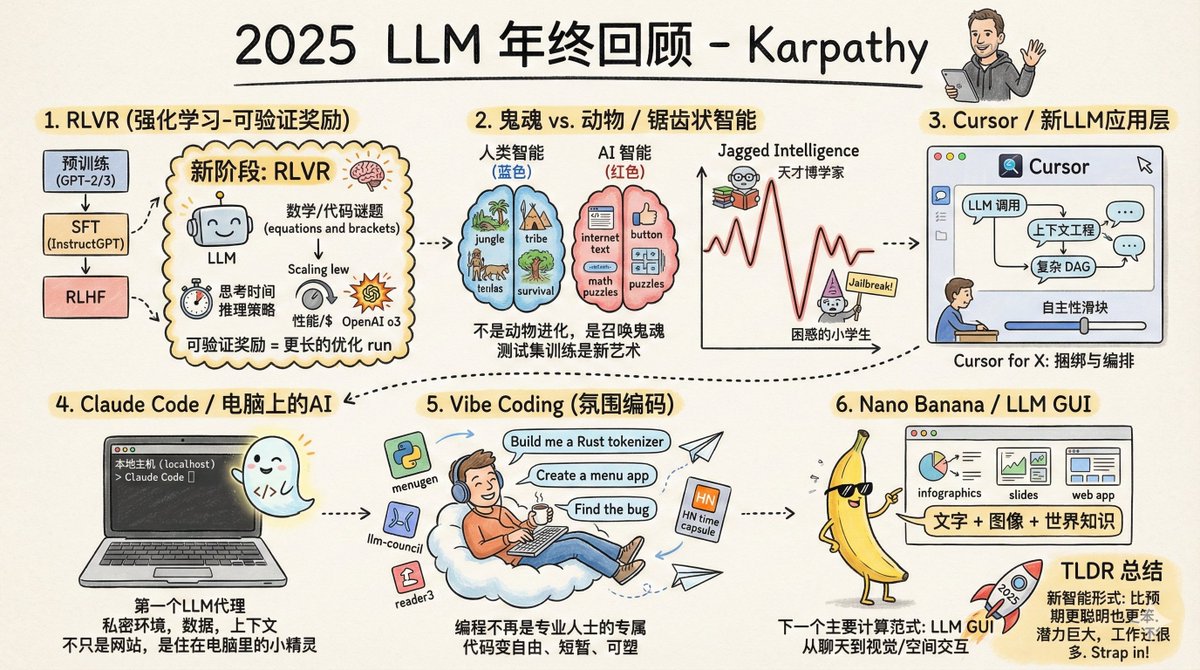
Karpathy published a 2025 LLM year-in-review describing six paradigm shifts. - RLVR added as fourth training stage (Reinforcement Learning from Verifiable Rewards). - RLVR trains models in verifiable-answer environments like math and code. - RLVR drives emergent multi-step reasoning and reallocates compute to RL phases. - LLM intelligence is “jagged” (ghosts vs animals) with high skills in verifiable domains. - Benchmark trust declined because tests are verifiable and optimizable. - Cursor proves a new LLM application layer: context engineering and multi-model orchestration. - Claude Code shows locally running agents that use user environment and tools. - Vibe coding: natural-language-driven coding democratizes programming. - Gemini Nano Banana signals a graphical GUI era for LLMs with fused text+image capabilities. - Karpathy: current models both smarter and dumber than expected; large unexploited potential remains.
Key insights
RLVR becomes a new standard training stage
Karpathy identifies Reinforcement Learning from Verifiable Rewards (RLVR) as an added fourth training stage after pretraining, supervised finetuning, and RLHF. RLVR trains models in environments with objective correctness (e.g., math problems, runnable code) where correct outputs yield verifiable rewards. He states RLVR enables models to practice, discover problem-decomposition strategies, and self-correct through long optimization runs, producing emergent-looking multi-step reasoning. Karpathy attributes much of 2025 capability gains to compute reallocation from pretraining into long RL runs and references OpenAI o1→o3 progress as examples of perceptible capability jumps.
LLM intelligence is unevenly distributed: 'ghosts' not 'animals'
Karpathy frames LLM intelligence as ‘jagged’—not evolved biological competence but optimization-produced behavior he likens to 'summoned ghosts'. Models excel in domains with verifiable rewards (math, code) and can simultaneously fail on trivial commonsense or social tasks. He argues optimization objectives differ from human evolution, producing domain spikes and making benchmarks unreliable because models can optimize for test suites. He states this unevenness explains high performance on measurable tasks and surprising vulnerability to simple prompts.
LLM application layer emerges; Cursor exemplifies new software paradigm
Karpathy describes Cursor as proof of a new LLM application layer that organizes base models into verticalized, production-capable systems. He lists four application responsibilities: context engineering, multi-model orchestration, domain-specific UIs allowing human intervention, and autonomous-control sliders for user autonomy. He argues model providers train generalist ‘graduates’, while application-layer teams convert them into domain specialists via data, sensors, execution, and feedback loops.
Local agents demonstrated by Claude Code shift agent deployment
Karpathy highlights Claude Code as a convincing demonstration of an LLM agent running locally on users’ machines. He notes Claude Code can call tools, perform looped reasoning, and operate within a user’s private environment and data. Karpathy asserts local deployment better supports developer collaboration and context use than cloud-container-first approaches, which he characterizes as a misjudgment if prioritized over local integration during this transitional phase of uneven model capabilities.
Vibe coding democratizes programming via natural-language intent
Karpathy coins and describes 'vibe coding' as programming by describing intent in natural language without caring about code form. He states 2025 crossed a threshold enabling non-programmers to request and obtain working code, while professional developers can cheaply generate throwaway utilities. He provides examples of using vibe coding to write a Rust tokenizer and ad-hoc tools; he emphasizes code becomes low-cost, disposable, and shifts software shape and developer roles.
LLM GUIs appear; Gemini Nano Banana previews visual-first interfaces
Karpathy cites Google Gemini Nano Banana as an underestimated, paradigm-signaling product that generates images, infographics, animations, and visual outputs tied to dialog. He argues LLM interactions will evolve from text-only chat toward graphical user interfaces that combine text, images, video, and app-like outputs, analogous to the historical shift from command-line to GUI. He emphasizes integration of text, image generation, and world knowledge in model weights as a key capability.