
Engram: Conditional Memory Paper and Reactions
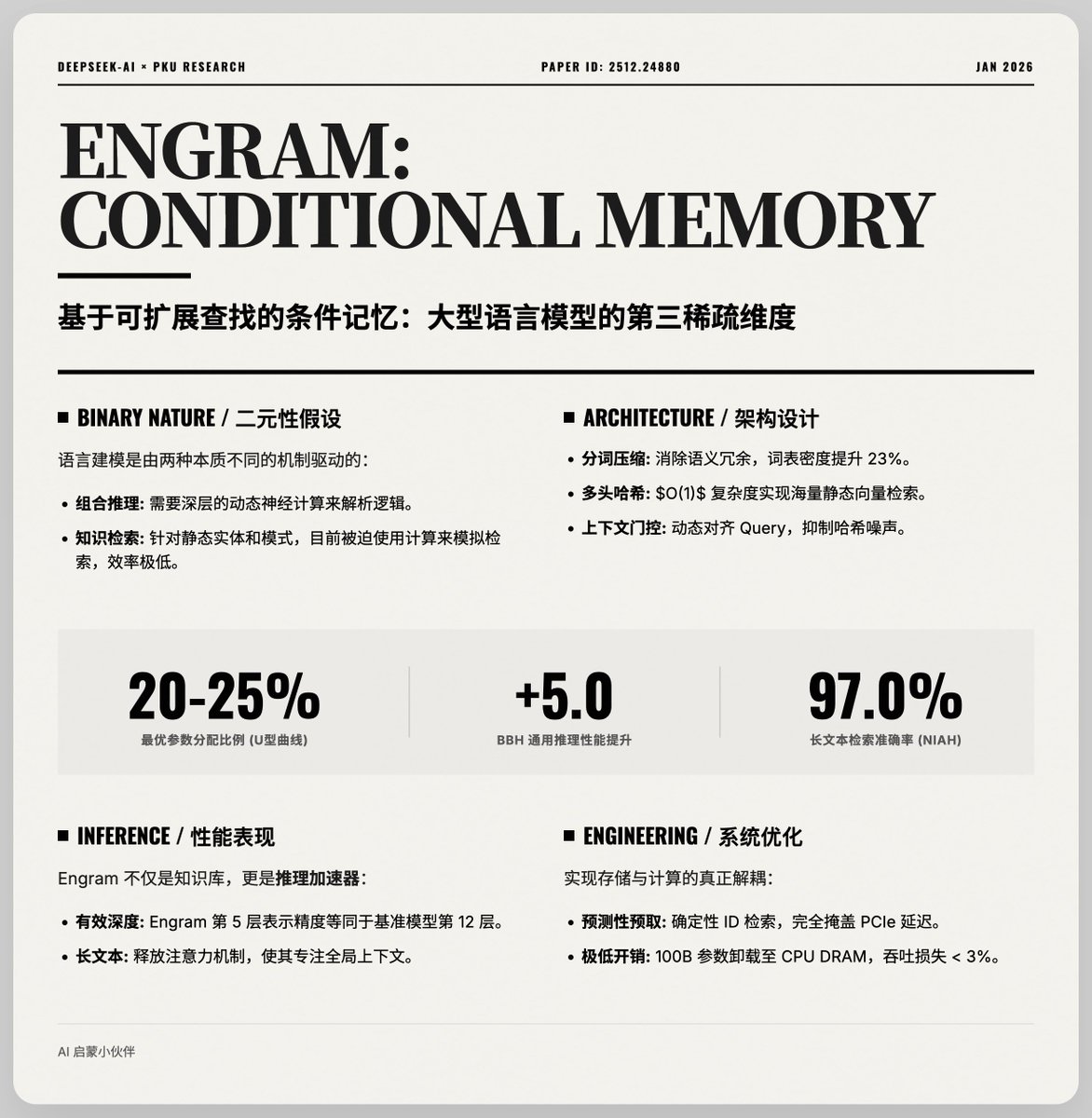
DeepSeek and Peking University published Engram conditional memory.
Key insights
Engram separates static knowledge from dynamic computation
The Engram paper argues language modeling splits into two distinct tasks: combinational reasoning requiring deep, dynamic neural computation, and knowledge retrieval for static entities and patterns. Engram implements a conditional memory module that removes static pattern storage from runtime neural computation by using O(1) lookups into a large embedding table keyed by local N-grams. The module includes tokenizer compression, multi-head hash retrieval, and a context-aware gating mechanism to suppress conflicting hashed values.
Tokenizer compression and multi-head hashing drive storage efficiency
Engram applies a precomputed mapping to fold semantically equivalent tokens (e.g., 'Apple' and 'apple') into a single identifier, reducing effective vocabulary size by about 23%. It uses local-context N-grams as lookup keys with multi-head hash retrieval into a large embedding table. The architecture shares embedding and value projections across branches while keeping key projections independent to balance capacity and compute efficiency.
Context-aware gating mitigates hash collision noise
Engram’s key innovation is a gating mechanism that uses the current layer hidden state as a query to semantically match retrieved memory values; if retrieved items contradict context the gate approaches zero, suppressing noise from hash collisions. This gating allows large, sparse memory retrieval without corrupting downstream representations.
Sparse allocation law: mix Engram with MoE for best scaling
The paper formulates a sparse allocation problem under fixed parameter and compute budgets (Iso-FLOPs) and reports a U-shaped scaling law: pure MoE is not optimal, and allocating roughly 20–25% of sparse parameter budget to Engram memory yields best model performance. When memory budget grows, validation loss scales logarithmically with embedding slot count, indicating predictable gains from enlarging Engram tables without extra compute.
Empirical gains: Engram improves reasoning, code, math, and long-text tasks
In a 27B-parameter comparison, Engram-27B outperformed an MoE baseline on knowledge tasks (MMLU +3.0) and showed larger gains on general reasoning (BBH +5.0), code (HumanEval +3.0), and math (MATH +2.4). For long-text retrieval (Multi-Query NIAH) accuracy improved from 84.2% to 97.0%. Authors highlight that freeing attention capacity from local pattern reconstruction improves global reasoning.
Mechanistic analyses show earlier predictive readiness and equivalent depth gains
LogitLens and CKA analyses indicate Engram variants reach predictive-ready states earlier (lower early-layer KL divergence) and produce shallow-layer representations equivalent to deeper layers in MoE baselines (e.g., Engram layer 5 aligns with MoE layer 12). These findings support the claim that Engram increases effective model depth without adding compute-heavy layers.
System engineering: predictive prefetch and low host-memory overhead
Engram’s indices depend only on input tokens, enabling asynchronous host-memory prefetch to hide PCIe latency, unlike MoE’s runtime routing. Experiments show offloading a 100B-parameter table to host memory reduces inference throughput by under 3%, demonstrating practical scalability with low runtime cost.
Practical framing: 'dictionary lookup' yields improved reasoning
Commentary notes Engram's functional analogy to 'dictionary lookup' provides near-infinite memory for static patterns while reducing the model’s memory burden, which not only improves knowledge retrieval but counterintuitively yields larger gains in computational reasoning by reallocating neural capacity to deeper inference.