
Agent architecture, MCP design & monitoring
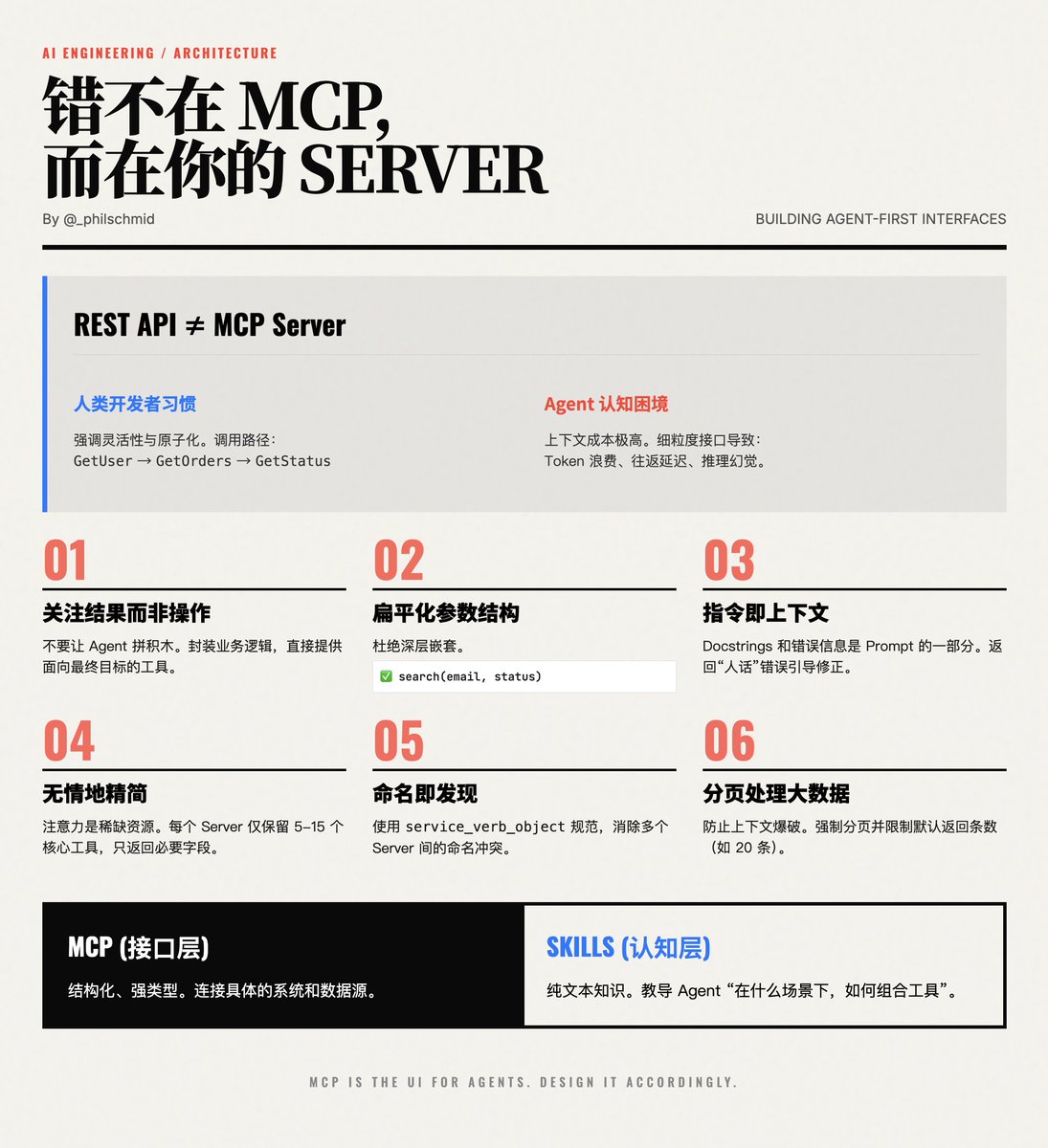
MCP server design and agent monitoring best practices and an Agentic AI Handbook outline patterns for safe, efficient agent architectures.
Key insights
MCP servers require high-level, result-focused tools rather than REST-style endpoints
Best-practice guidance argues REST-style fine-grained endpoints impose high token and reasoning costs on agents; MCP servers should expose high-level tools (e.g., track_order(email)) with flat parameter schemas, human-readable docstrings and sanitized error messages. Recommendations include limiting tool counts per server (5–15), role-based servers, naming conventions to avoid collisions, and pagination to prevent context overload.
Agentic AI Handbook catalogs 113 production patterns across eight categories
The Agentic AI Handbook compiles 113 agent design patterns grouped into Brain (orchestration), Hands (tool use), Memory, Growth, Collaboration, Quality, Evolution and Safety. It highlights Plan-Then-Execute and Inversion of Control as core patterns, prescribes breaking the 'lethal trifecta' (sensitive data + untrusted inputs + external comms), and recommends architectural separations to reduce security risk.
Monitoring agent behavior requires new analytics beyond traditional metrics
LangChain founder analysis states deterministic metrics and manual log review fail at scale; LangSmith Insights Agent applies unsupervised clustering and pattern discovery to tens of thousands of traces to reveal usage modes, failure clusters and emergent behaviors, enabling dynamic exploration and on-the-fly custom property computation for root-cause analysis.
Agent frameworks (LangGraph, LangSmith) provide tooling for safe enterprise access
Tutorials and notebooks demonstrate end-to-end agent development, MCP tool calling, MLflow tracking and evaluation metrics. These resources emphasize secure data and tool access patterns, evaluation harnesses and deployment practices for enterprise-grade intelligent agents.
New agent products integrate deeply into developer environments
Products like Runcell (JupyterLab agent) and Cursor integrations show agents executing code, running cells, and performing on-environment debugging, reducing copy-paste cycles between chat and development environments, while enabling agents to perceive runtime state like DataFrame structures and visualization outputs.