
Agent architectures, tool use and context engineering
Agent architectures, tool use, and context engineering evolve for production agents.
Key insights
RAG systems still face deployment gaps despite strong lab results
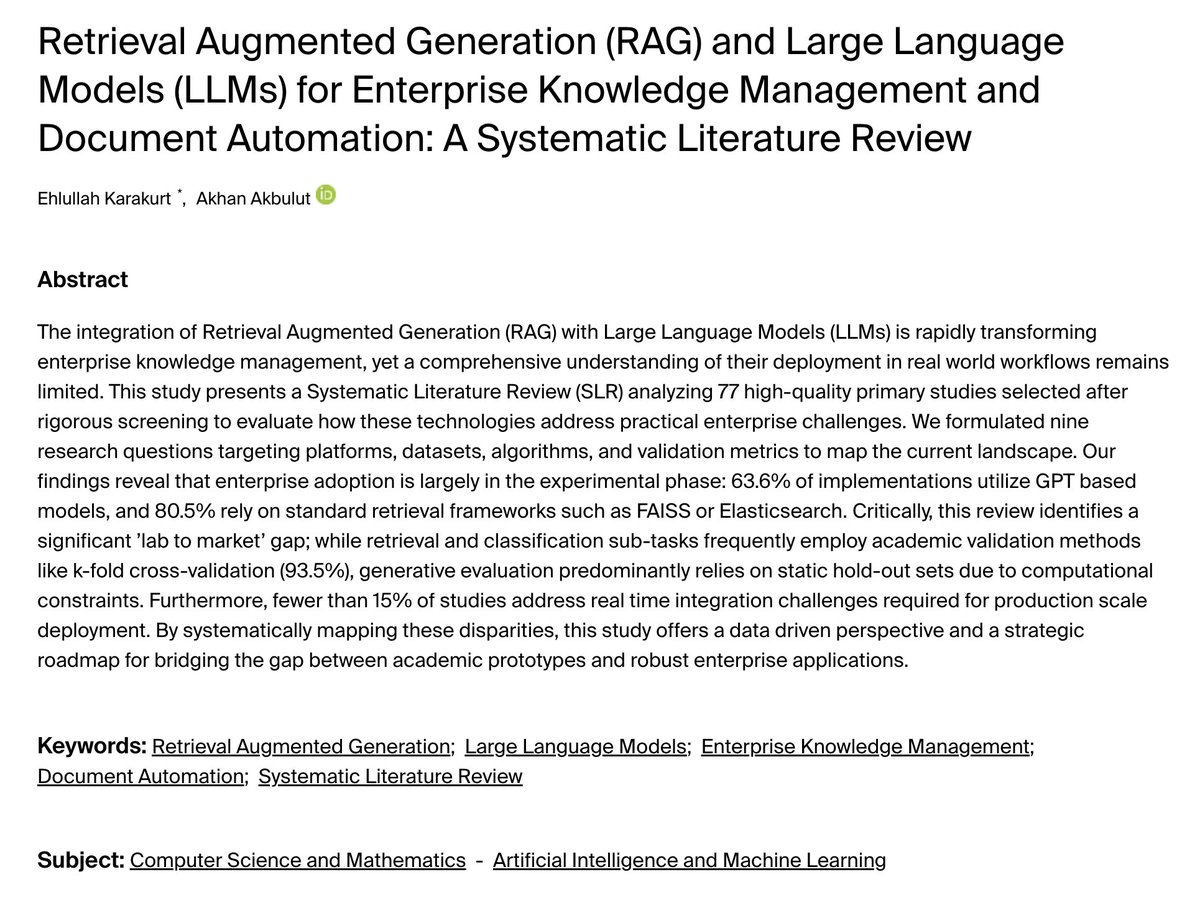
A systematic review of 77 RAG+LLM studies (2015–2025) shows RAG prototypes perform well in controlled settings but only 13% were deployed in real enterprises. Common challenges include hallucination control (48.1%), data privacy/security (37.7%), latency and scalability (31.2%), domain adaptation (23.4%), and difficulty measuring business impact (15.6%). Standard stacks use GPT models (63.6%), FAISS/Elasticsearch (80.5%), and cloud scaling (66.2%); mixed retrieval and domain fine‑tuning yield 10–20% facticity gains.
Anthropic’s advanced tool use reduces token costs and improves tool selection
Anthropic introduced Advanced Tool Use on Claude with three techniques: a Tool Search Tool for on‑demand tool loading (reducing token cost by ≈85%), Programmatic Tool Calling where the model emits sandboxed code to coordinate multi‑tool workflows (cutting tokens ≈37%), and Tool Use Examples that provide structured JSON examples to improve parameter accuracy. Internal benchmarks show overall accuracy gains of 10–20% and token/latency reductions in complex tool workloads.
Claude skills are prompt‑driven dynamic behaviour modifiers, not code tools
Claude Skills are system‑level prompt packages (SKILL.md) that inject prioritized instructions, pre‑authorize specific tools, and change model behavior asynchronously. Skills are discovered at runtime by a Skill meta‑tool, injected as high‑priority context, and can predefine allowed tool lists and model choices. This design supports hot updates, least‑privilege tool access, and complex workflows without direct code execution.
PromptBridge automates cross‑model prompt transfer without retraining
PromptBridge proposes a zero‑training framework that calibrates using a small set of paired optimal prompts between source and target models, then learns mappings to translate source prompts to target‑optimized prompts. This reduces manual prompt reengineering when switching models and supports unknown downstream tasks after a lightweight calibration phase.
Context‑Driven Development and Conductor connect local codebases to models
Google’s Gemini Conductor CLI integrates local repositories with Gemini, scanning project structure, packaging relevant files by config, and sending focused context so the model can produce more accurate code assistance. Conductor addresses manual copy/paste, context loss, and information overload by automating relevant context selection based on a .conductor.yaml configuration.
Agentic RAG projects and open toolkits show production patterns
Open‑source Agentic RAG templates (LangGraph‑based) implement dialogue memory, hierarchical indexes, small‑slice then large‑slice retrieval callbacks, intent clarification, multi‑agent parallelism, and operator intervention UIs. These projects include deployment notebooks, Docker flows, PDF→Markdown toolchains, and Gradio demos to ease productionization.