
Agent & Coding-Agent Engineering and Developer Impact
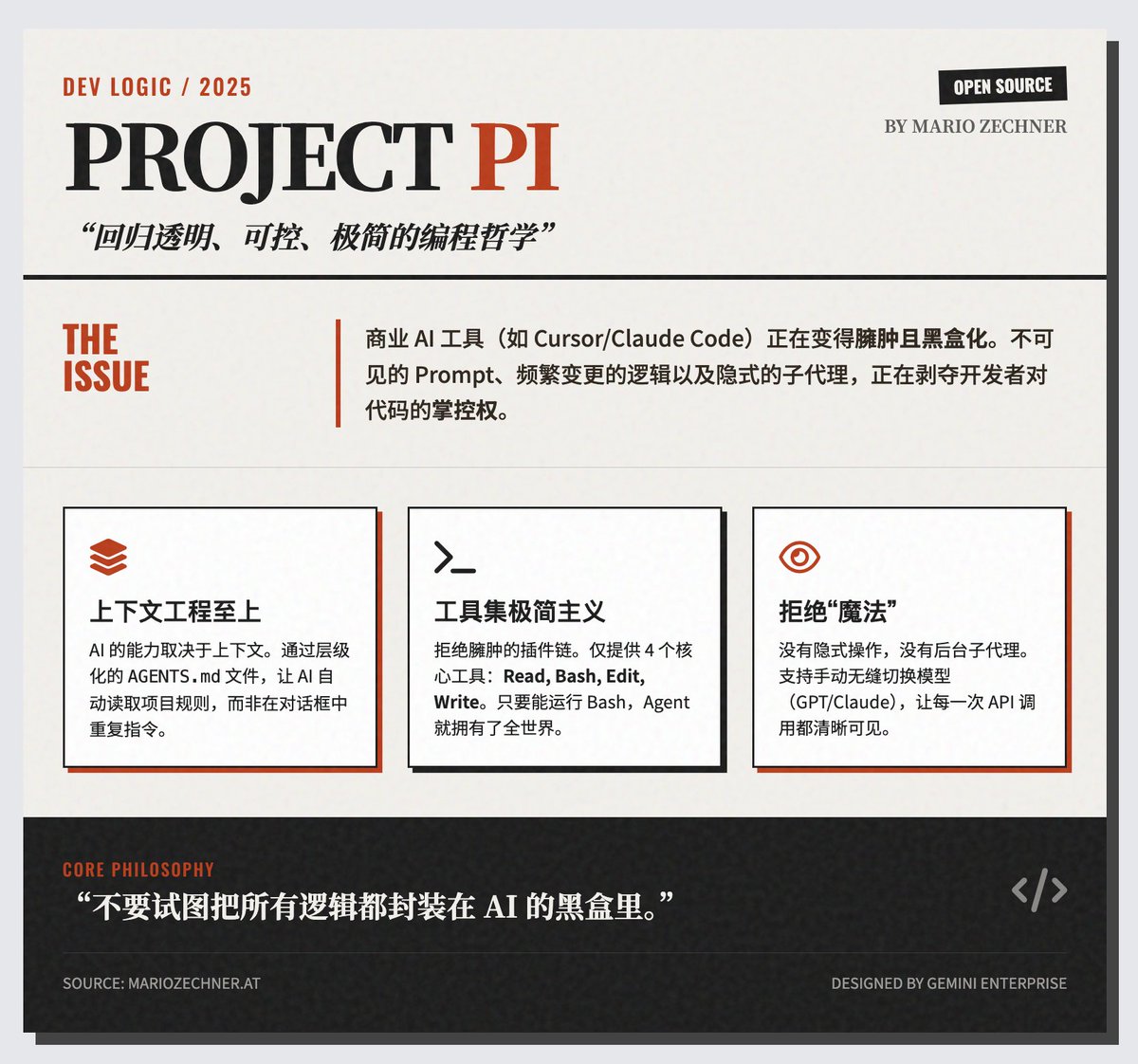
Developments in AI coding agents and their effects on engineering roles. - OpenAI Codex reduced development effort: Sora team (2–3 engineers) built an app in 18 days and released in 28 days; Atlas team cut a 3-week multi-engineer task to one week for a single engineer. - Codex relies on model compression when near context limits to run continuously over long tasks. - Engineers must audit AI-generated code; emphasis shifts to systems engineering and architecture decisions. - 'pi' is an open-source, minimal CLI coding Agent prioritizing transparency: four tools (read, bash, edit, write), hierarchical context files, explicit step visibility. - Developers build agents for control and explainability instead of opaque commercial tools. - LLM-engineer-handbook open-source repo collects best practices for training, deployment, RAG, agents, LLMOps and prompt optimization for production-grade apps. - DeepCode (HKUDS) is an open-source multi-agent programming framework that simulates a dev team (orchestrator, analysts, architects, testers) and claims high Paper2Code performance (75.9% reproduction in PaperBench). - Multi-agent architectures mitigate long-context forgetfulness by dividing tasks and roles. - Job market predictions: junior coding roles decline; engineers must become 'T-shaped' with broad system knowledge and deep domain expertise (AI engineering, cloud, or mobile).
Key insights
AI coding agents materially reduce development time
Reports cite concrete time-savings: a 2–3 person team built Sora Android in 18 days and released publicly in 28 days; another team reduced a multi-engineer 3-week task to one week of single-engineer work using Codex. Codex's ability to compress and manage context is noted as a factor enabling continuous task execution over long runtimes.
Transparency and context engineering are central to developer adoption
Open-source 'pi' demonstrates a minimal, transparent agent model: a CLI Agent with four tools (read, bash, edit, write) and hierarchical AGENTS.md context rules. 'pi' prioritizes visibility into each agent step and allows model swapping, embodying a trend where developers prefer controllable, debuggable agent stacks over opaque commercial tools.
Multi-agent frameworks scale coding tasks into team-like workflows
DeepCode (HKUDS) proposes a multi-agent architecture that assigns roles (orchestrator, analyst, architect, coder, tester) to produce full, runnable codebases from complex inputs (papers, specs, links). It claims strong Paper2Code performance (75.9% reproduction) and supports localization via local models, enabling enterprises to run agentic coding on-premises.
Practical guide and tooling for production-grade LLM applications are consolidating
The LLM-engineer-handbook open-source project aggregates best practices across pretraining, fine-tuning, model serving, RAG, agent frameworks, and LLMOps. It targets the gap from toy demos to production, emphasizing monitoring, versioning, and prompt management to run stable enterprise services.
Engineer roles are evolving: fewer junior coding positions, more AI-systems and domain experts
Predictions indicate a decline in junior-level coding roles. Employers will favor engineers who can orchestrate AI, make architecture decisions, audit AI outputs, and own cloud/infrastructure or domain depth (mobile, AI engineering). Recommended developer strategy: become T-shaped — broad systems knowledge plus deep specialty.