
Agent Engineering & Autonomous Coding Best Practices
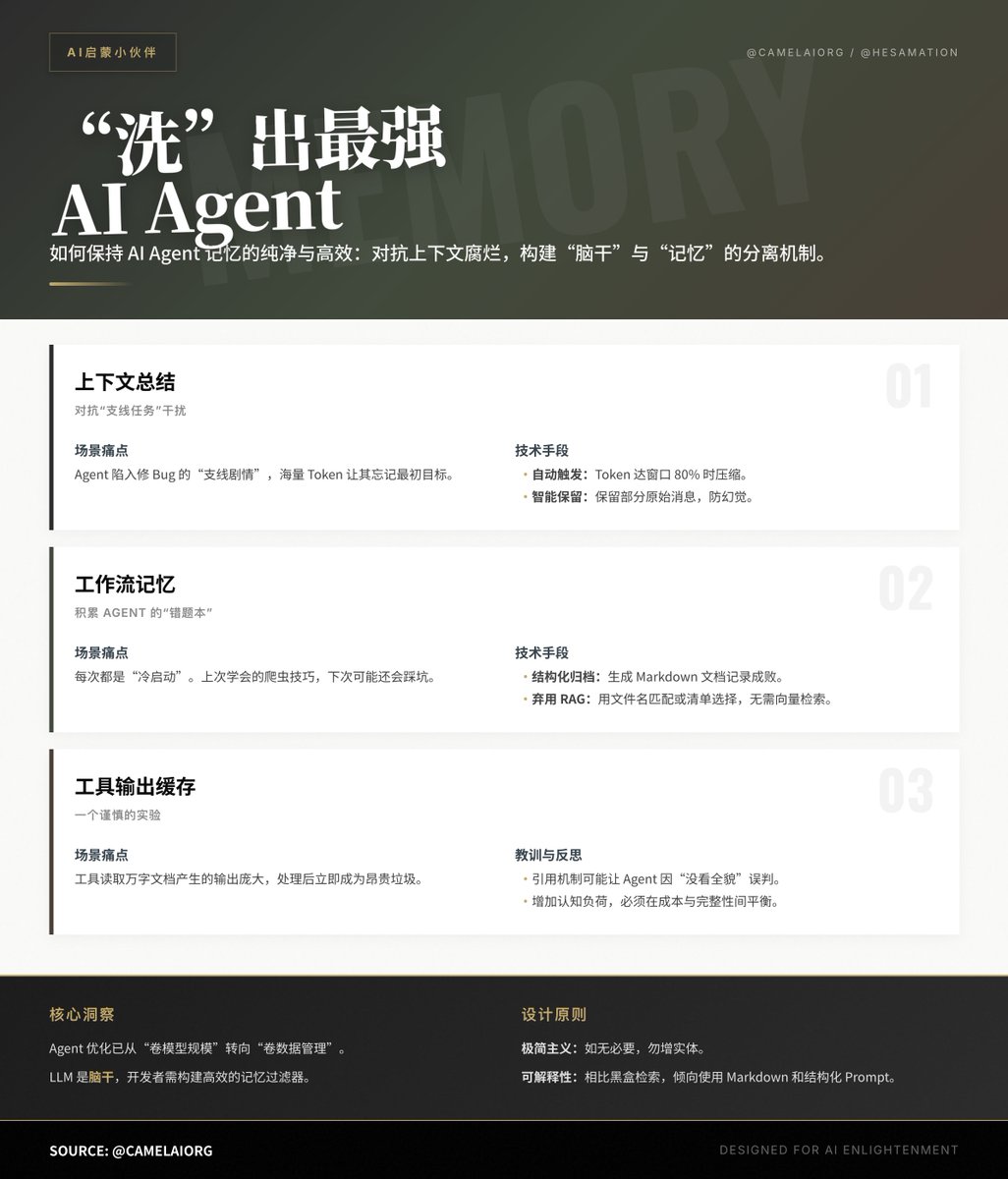
Agent engineering emphasizes clean context and iterative autonomy. - CAMEL recommends context compression at 80% token use. - Preserve key user instructions when summarizing context. - Store structured workflow memory as Markdown archives. - Tool outputs above threshold saved on disk with ID+preview. - Gemini 3 integrates with six open agent frameworks for orchestration. - Gemini use cases include retail site selection, multi-agent studios, visual web automation, enterprise CRM automation, long-term social agents, and memory layers. - Ralph Wiggum advocates iterative autonomous coding loops with progress.txt and CI gates. - Ralph guidelines: small-step iterations, strict tests, Docker sandboxes, and clear finish criteria. - Sentry internal memo encourages company-wide LLM adoption and tracks token usage with Abacus tool. - Companies should monitor AI-derived code share and token-to-value ratios.
Key insights
Context engineering is central to agent IQ
CAMEL and related posts argue that agent performance degrades when context becomes noisy; recommended practices include automatic context summarization when token usage reaches defined thresholds, retaining a portion of original user messages to avoid hallucination, and structured archival of workflow results in Markdown. These measures convert transient dialog into stable process knowledge and reduce repeated cold starts.
Workflow memory and tool-output management improve repeatability
Posts document techniques for workflow memory: generating structured task archives (task description, steps, tools used, failure modes) and saving large tool outputs to disk with IDs and previews. Implementers found trade-offs—saving outputs reduces token load but can increase cognitive load if previews are insufficient—so careful retrieval semantics are required.
Gemini 3 serves as an orchestrator for open agent frameworks
Gemini 3 is presented as a core orchestrator integrated with six open agent frameworks for complex automation: Google ADK for retail site reports, AgnoAgi multi-agent creative studios, visual webpage automation, enterprise workflow automation (Salesforce), long-lived social agents with memory, and dedicated memory layers via MCP servers. The integrations emphasize state management, multimodal native support, and browser-visual automation.
Ralph Wiggum loop enables autonomous coding with CI enforcement
Ralph uses iterative loops where the agent self-selects tasks, implements code, runs tests, and fixes failures until defined completion criteria are met. Best practices include starting with human-in-the-loop runs, constraining iteration counts, enforcing CI/test gates for each commit, keeping change granularity small, and running in Docker sandboxes for safety.
Enterprise adoption requires monitoring, budget and training
Sentry’s internal memo signals enterprise-scale adoption: teams are empowered with budget and relaxed IP constraints to experiment with LLMs, backed by monitoring (Abacus) to track usage. The approach is bottom-up adoption with cross-department education rather than top-down mandates.
Organizational metrics should track AI productivity and cost
Posts recommend companies measure AI code contribution, token consumption per value created, and create workflows that optimize human+AI collaboration to ensure token costs align with output quality and business value.