
Agent Harness Design and Cost Efficiency
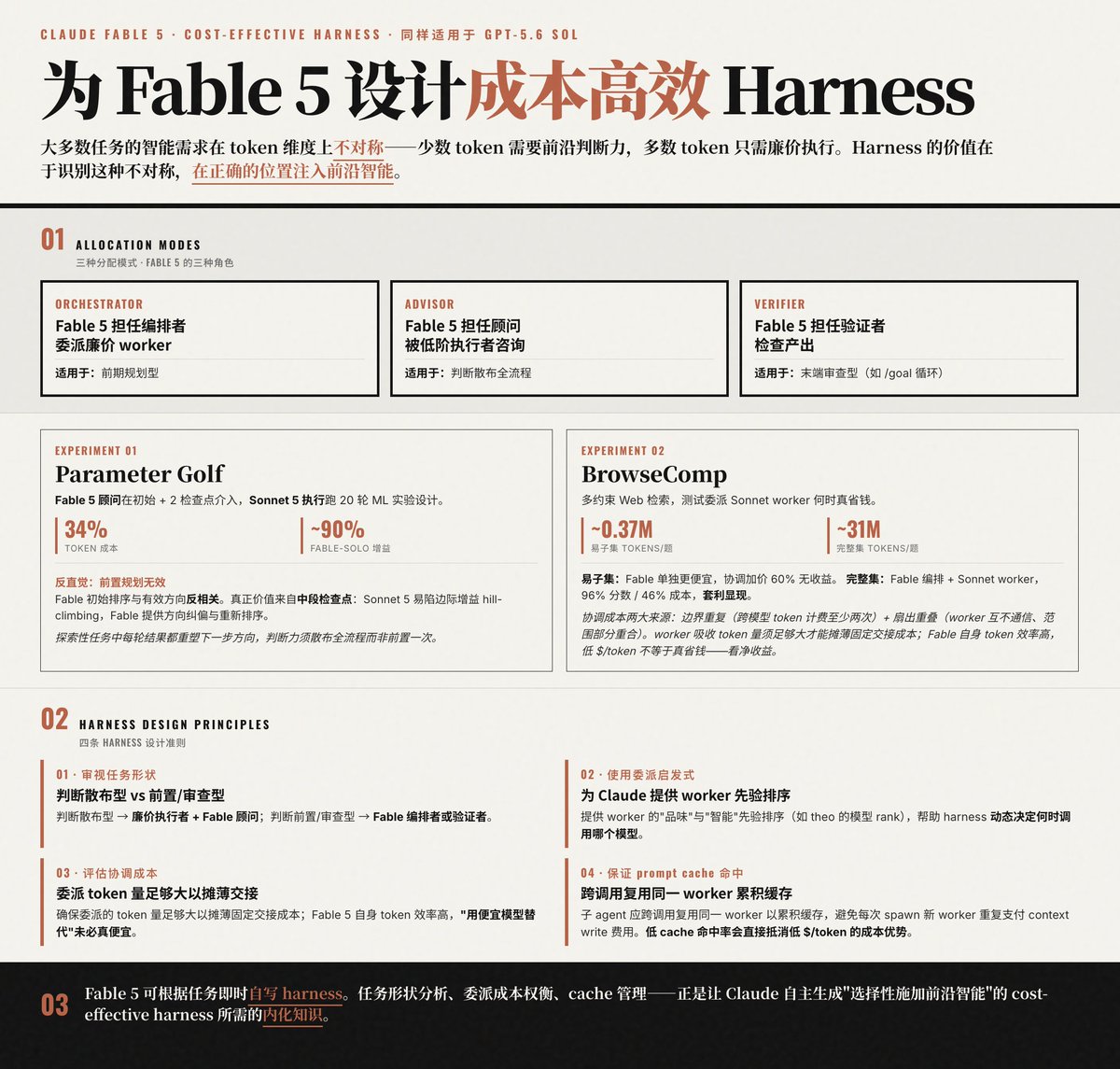
Multiple analyses on agent infrastructure highlight that harness design, context quality, and model economics are now the primary bottlenecks, not raw model capability. Cost-efficient harness patterns (orchestrator, advisor, verifier) allocate frontier intelligence only where needed, achieving up to 46% cost savings by using cheap models for execution bulk. Anthropic's platform team notes agent scaffolding is thinning as models improve, shifting focus to agent collaboration and measuring ROI per individual. Context quality is critical: while MCP connects systems, fragmented context forces models to do data engineering; Glean's unified index and knowledge graph pre-join data, improving context preference 2.5x and reducing token use 30%. Cursor's agent swarm experiment shows a tree-structured planner-worker architecture with frontier models only for high-entropy decisions can reduce costs from $20,057 (all-Fable 5) to $1,339 (Opus planner + Composer worker) for complex tasks, with context efficiency being the key scaling factor. Coordination costs, prompt cache hit rates, and governance are essential design considerations.
Key insights
Cost-Efficient Harness Patterns Exploit Task Asymmetry to Save Money
Three patterns—Orchestrator (frontier plans, cheap executes), Advisor (frontier consulted at checkpoints), Verifier (frontier reviews output)—allow expensive models to be used only where high judgment is needed. Experiments showed 34% token cost for ~90% of Fable-solo gains in ML experiment design, and 46% cost at 96% score on BrowseComp. The key is identifying where judgment is truly required.
Agent Scaffolding Is Thinning as Models Improve
Anthropic's platform team observed that the orchestration layer around agents is shrinking because models can now handle task decomposition and tool use more autonomously. Developers are shifting from controlling every step to designing how multiple agents collaborate, and measuring success by individual productivity gains before scaling to teams.
Context Quality, Not Just Connectivity, Is the Real Bottleneck
MCP solves connectivity but leaves context fragmented across systems, forcing models to perform data joins and deduplication at runtime. Glean's approach pre-builds a unified index and knowledge graph, delivering pre-joined, ranked context. In tests, Glean's context was preferred 2.5x more and used 30% fewer tokens than raw MCP tool outputs.
Swarm Architecture with Planner-Worker Tree Cuts Costs by an Order of Magnitude
Cursor's experiment implementing SQLite from documentation showed that a tree-structured system with a strong planner and cheap workers could achieve 100% test pass rate at $1,339 (Opus planner + Composer worker) versus $20,057 for all-Fable 5. The main cost lever is limiting frontier model usage to high-entropy decisions like root decomposition and design choices.
Coordination Costs and Cache Management Are Critical for Efficiency
Harness design must account for boundary repetition (tokens counted multiple times across models), fan-out overlap (workers duplicating research), and prompt cache hit rates. Low cache reuse can negate the savings from cheaper models. Cursor's swarm also revealed failure modes like split-brain and merge conflicts that required a custom agent-aware version control system.
Context Engineering and Governance Become Central to Enterprise Agent Deployment
Glean's MCP Gateway not only improves context quality but also enforces source-level permissions, OAuth-based credential handling, and prompt injection checks. This addresses the governance challenges of scaling MCP in enterprises, where security and data access control are paramount.
The Shift from Model Capability to Infrastructure Design Marks a Maturing AI Engineering Discipline
Across all posts, the consensus is that model intelligence is no longer the limiting factor. The focus has moved to harness design, context integration, multi-agent coordination, and economic optimization. This reflects a transition from building AI models to building AI systems.