
Agent infrastructure: memory, context compression, retrieval & prompt bridges
Multiple projects advance agent memory, retrieval latency, context compression and prompt portability for reliable long-running agents.
Key insights
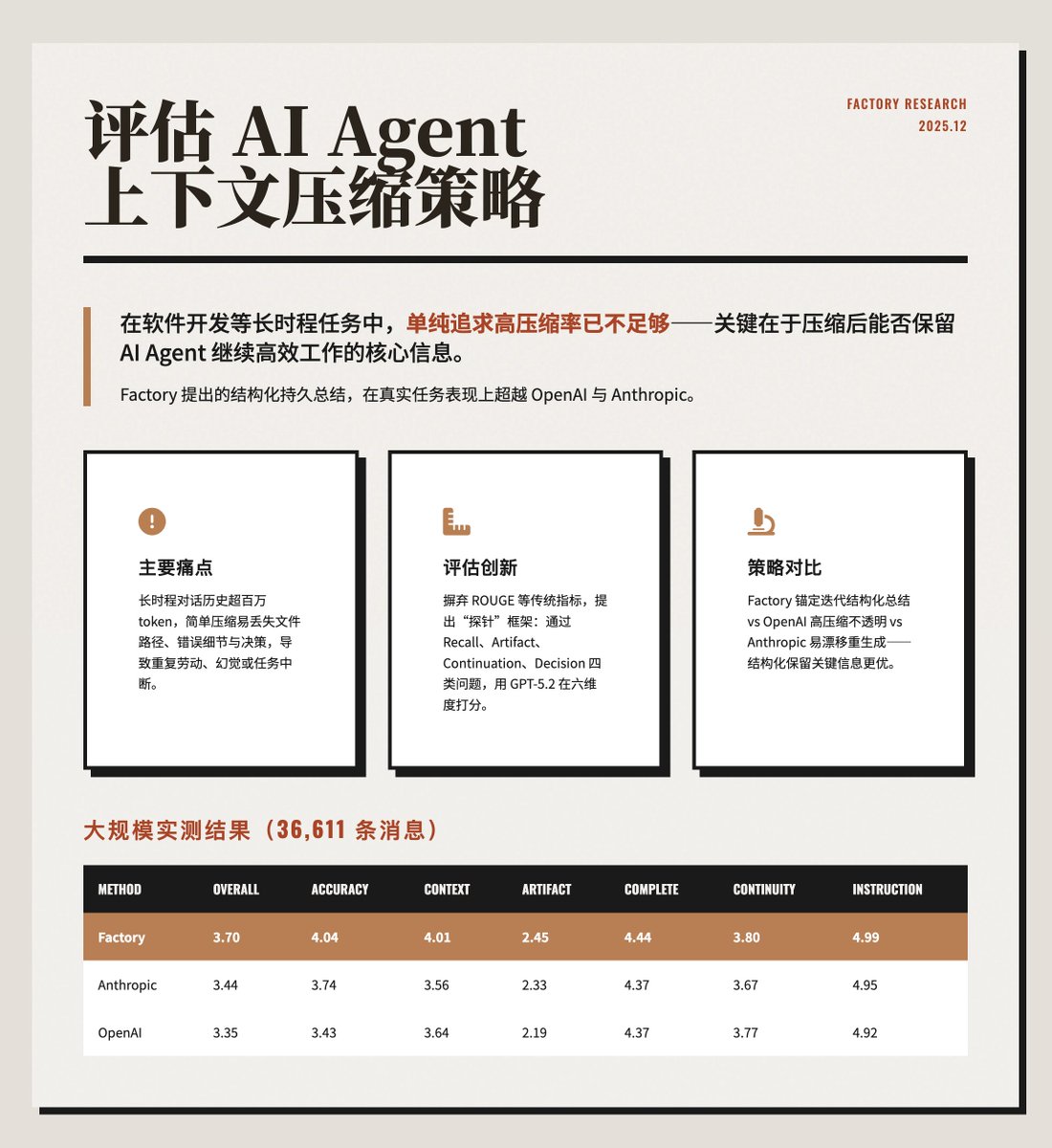
Context compression must preserve actionable artifacts
Evaluation of agent compression strategies shows extreme compression can lose task-critical low-entropy details (file paths, error strings). Factory's anchored iterative summarization that maintains structured persistent summaries (intent, file changes, decisions, next steps) outperformed OpenAI's highest-compression method and Anthropic's full re-summary approach on probe metrics like recall, artifact tracking and continuation.
Index builds millisecond-level retrieval tailored to agents
Index is a dynamic, millisecond-scale retrieval system tailored for agent use over personal knowledge bases. It uses Postgres with pgvector/pg_trgm, global edge runtime on Cloudflare, chunked ingestion with change hashing, and a three-tier cache invalidation to achieve P99 < 300ms with robust filtering, mixed semantic/keyword ranking, and live updates for multi-tenant dynamic data.
Memori provides SQL-native, auditable persistent memory
Memori is an open-source SQL-native memory engine that persists agent memories in standard SQL databases, extracts entities and memory types (facts, preferences, skills) and supports conscious/auto/combined modes with periodic background distillation. Integration requires one-line calls and aims to make memory auditable and owned by users rather than opaque vector stores.
PromptBridge translates prompts across models without retraining
PromptBridge introduces a zero-training framework to map high-performing prompts from one model to another. It calibrates with a small paired-sample set using MAP-RPE reflection techniques, then learns a mapping that generates target-model-compatible prompts for unseen tasks, reducing the manual cost of porting prompt engineering across model changes.