
Agent Memory, Retrieval, Context Compression & Prompt Transfer
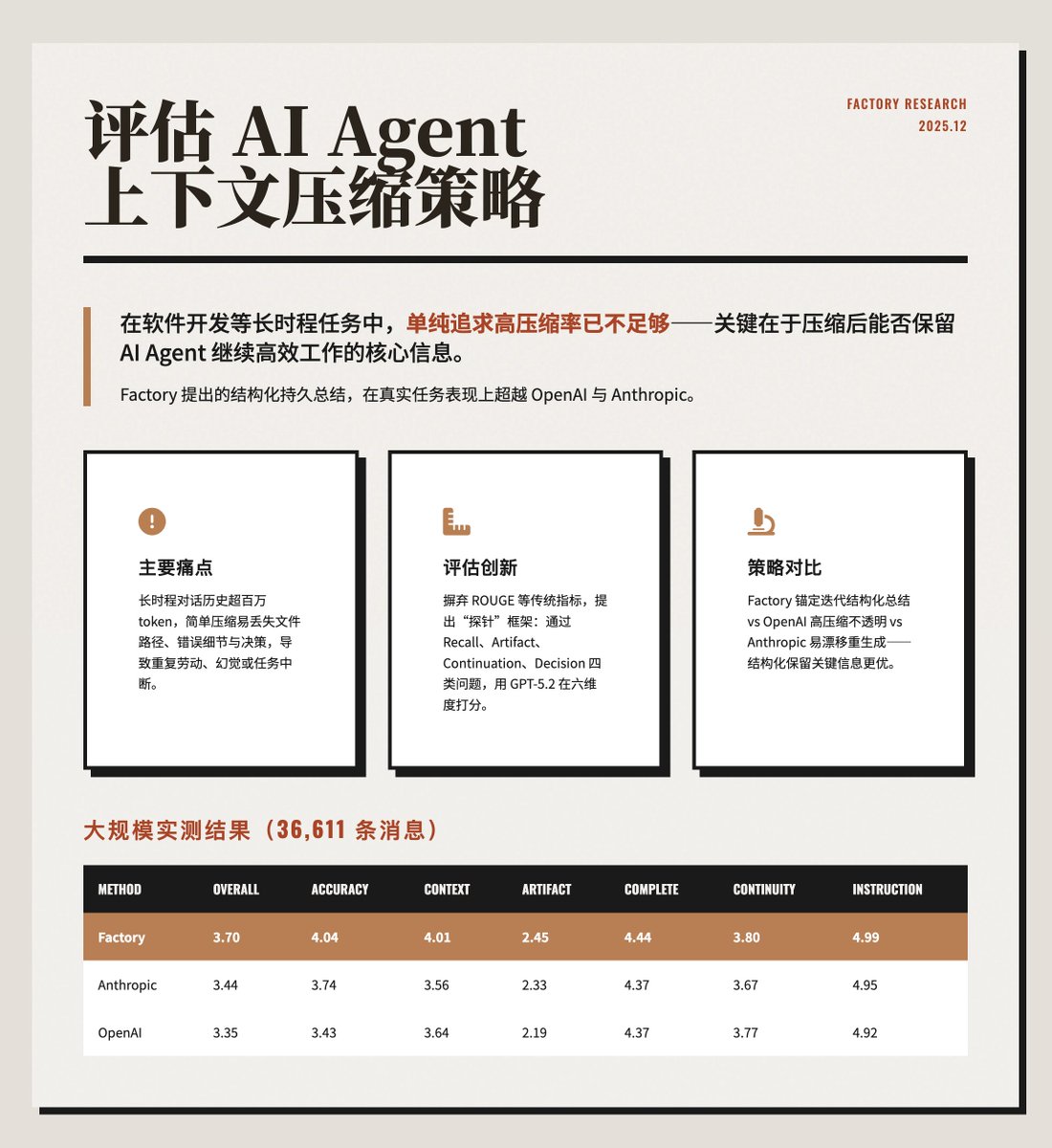
Multiple projects advanced agent memory, retrieval, context compression and prompt portability for long-running agents. • FactoryAI evaluation compared three context compression strategies (Factory anchored iterative summaries, OpenAI /responses/compact, Anthropic structured summaries); Factory approach preserved debugging artifacts and decision continuity. • Evaluation used probe framework (Recall, Artifact, Continuation, Decision) with GPT-5.2 as judge and six scoring dimensions. • Opennote published 'Index', a millisecond-level dynamic document retrieval system built on Postgres+pgvector and Cloudflare Workers; P99 latency ~209–300ms and hybrid retrieval mixing metadata, keyword and vector search. • Index uses chunked ingestion, UPSERT diffs, three-layer caching and precise cache invalidation to support dynamic edits and multitenancy. • Memori released an open-source SQL-native memory engine; one-line integration enables persistent, queryable memories across LLMs; modes: Conscious, Auto, Combined; periodic 'conscience' distillation runs every 6 hours. • PromptBridge (Accenture paper) proposes zero-training mapping to translate prompts across models using small paired calibration tasks (MAP-RPE) and learned mapping to transfer prompt engineering between models.
Key insights
Structured, anchored summaries retain agent context better than raw compression
An evaluation contrasted FactoryAI's anchored iterative summarization with OpenAI's compact endpoint and Anthropic's structured summaries. Factory's approach maintained structured persistent summaries (intent, file changes, decisions, next steps) and preserved low-entropy technical artifacts (e.g., file paths, error traces) that enabled continuity for long debugging sessions. The study used probing tests across Recall, Artifact, Continuation and Decision categories, scored by GPT-5.2 across six criteria and applied to production message logs.
Opennote Index: production-grade, low-latency retrieval optimized for agents
Opennote presented Index, a retrieval stack for agent workloads delivering P99 <300ms via Postgres (pgvector, pg_trgm, tsvector) plus Cloudflare edge workers. Key design choices: metadata pre-filtering to shrink candidate sets, chunk-level hashing and partial re-embedding to reduce recompute, hybrid keyword+vector scoring with alpha blending, and three-tier caching (exact query, semantic, reverse-index invalidation). Benchmarks vs Chroma showed recall and ranking parity with superior multi-tenant and dynamic-edit handling.
Memori offers SQL-native persistent memory for LLM agents
Memori introduced an open-source SQL-native memory engine that stores agent memories in standard databases (SQLite/Postgres/MySQL etc.). Integration is a single-line SDK call; Memori extracts entities and classifies memory types (facts, preferences, skills), supports Conscious/Auto/Combined modes, and runs a background 'conscience' process periodically (every 6 hours) to distill long-term patterns into short-term memory. The architecture intercepts LLM calls for pre-injection retrieval and post-call extraction.
PromptBridge automates prompt transfer across models without retraining
PromptBridge proposes a zero-training framework for translating optimized prompts from a source model to a target model. It requires small calibration sets to build paired prompt mappings using MAP-RPE (Model-Adaptive Reflective Prompt Evolution), then learns a mapping enabling future unseen tasks to be converted. The approach reduces manual prompt re-engineering and is reported to generalize across single- and multi-agent scenarios with low sample cost.