
Agentic AI Systems — Agent Architectures, Skills, and Context Management
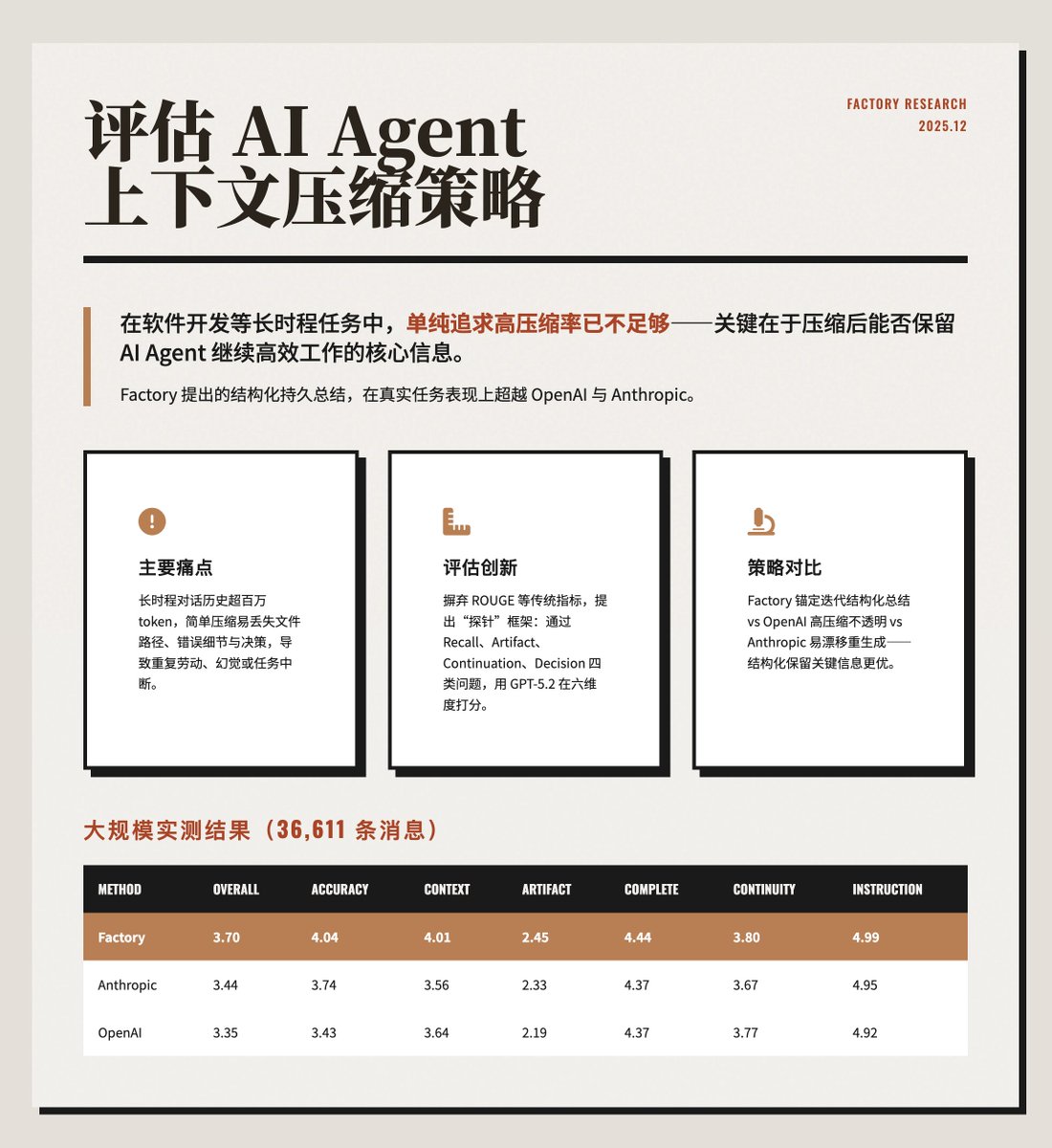
Collected posts describe agent-first product strategies and tooling: Manus built a cloud-based 'digital employee' (cloud browser) that avoids training base models, uses multi-model orchestration and preserves user privacy, and controlled invite launches due to compute limits (20028). Research shows structured anchored summaries (Factory method) outperform aggressive compression for long-running agents; probe-based evaluation (Recall, Artifact, Continuation, Decision) better measures task continuity (18687). Opennote's Index uses Postgres + Cloudflare edge for millisecond dynamic retrieval with P99 ~209ms and hybrid search; ingestion pipeline dedupes chunks and incremental embeddings (13530). Claude's Skills are prompt-driven skill folders with SKILL.md, dynamic discovery and pre-authorized tools enabling safe, hot-updatable domain experts without code execution (13316). Anthropic introduced advanced tool use: Tool Search, programmatic calls, and examples to reduce token use and scale tool sets (13534).
Key insights
Manus chooses cloud-based general agents and avoids training base models
Manus founders moved from a local AI-in-browser prototype to a cloud-hosted 'browser-in-the-air' model where agents run in persistent sandboxed VMs. They intentionally avoid training foundation models in-house to prevent product iteration lock-in and instead orchestrate best-of-breed models (Anthropic, OpenAI, Gemini) for different tasks. Manus treats agent usage as a compute-constrained ‘Agentic Hours’ metric, capped early via invite system to avoid immediate cloud overload and to prioritize prosumer customers.
Structured, anchored summarization preserves task continuity better than maximal compression
An evaluation comparing three compression strategies (Factory anchored iterative summarization, OpenAI /responses/compact, and Anthropic structured summaries) found Factory's persistent structured summary maintained intent, file edits, decisions and next steps more accurately. The study used probe-based evaluation (Recall, Artifact, Continuation, Decision) with GPT-5.2 judge and scored Factory highest on accuracy and context awareness despite lower raw compression ratios.
Index: a millisecond-level dynamic retrieval stack for agents using Postgres and edge runtime
Opennote's Index is optimized for agent consumption of personal knowledge: it uses Postgres (pgvector, pg_trgm, tsvector) for hybrid filtering and vector search, Cloudflare Workers/Hyperdrive for a globally distributed runtime, chunk-hash ingestion that re-embeds only changed chunks, and a three-layer cache (precise, semantic, reverse-index invalidation). Results: P99 ~209ms, competitive recall metrics vs ChromaDB while supporting dynamic multi-tenant filtering.
Claude Skills implement safe, prompt-driven, hot-updatable domain experts
Claude's skills are folder-based artifacts centered on SKILL.md with YAML metadata (name, allowed-tools, model) plus Markdown instructions. A Skill meta-tool dynamically discovers available skills and injects the SKILL.md content into the convo as high-priority system prompts; skills can pre-authorize limited external tools and force a specific model. This design provides safety (no arbitrary code execution) and immediate hot updates without restarts.
Anthropic's advanced tool use reduces token cost for large tool sets
Anthropic introduced three techniques: a Tool Search meta-tool to defer loading unused tool definitions, programmatic tool calling (generate sandboxed code to orchestrate multi-tool workflows), and Tool Use Examples to clarify parameter formats. These reduce token consumption dramatically (e.g., token savings 85% in tests) and improve tool selection accuracy for agents handling hundreds to thousands of tool definitions.
Practical agent design requires multi-model orchestration and careful resource control
Across posts the recurring design pattern is a 'thin orchestrator' agent that routes intents to specialized models and tools, stores structured persistent summaries for continuity, and controls resource use via curated model selection and deferred tool loading. Engineering trade-offs include token cost, latency, privacy (local models for sensitive tasks), and the need for probing-based evaluation to validate compressed context for long-running workflows.