
AI Agent Engineering: Skills, Plan Mode, and Practicals
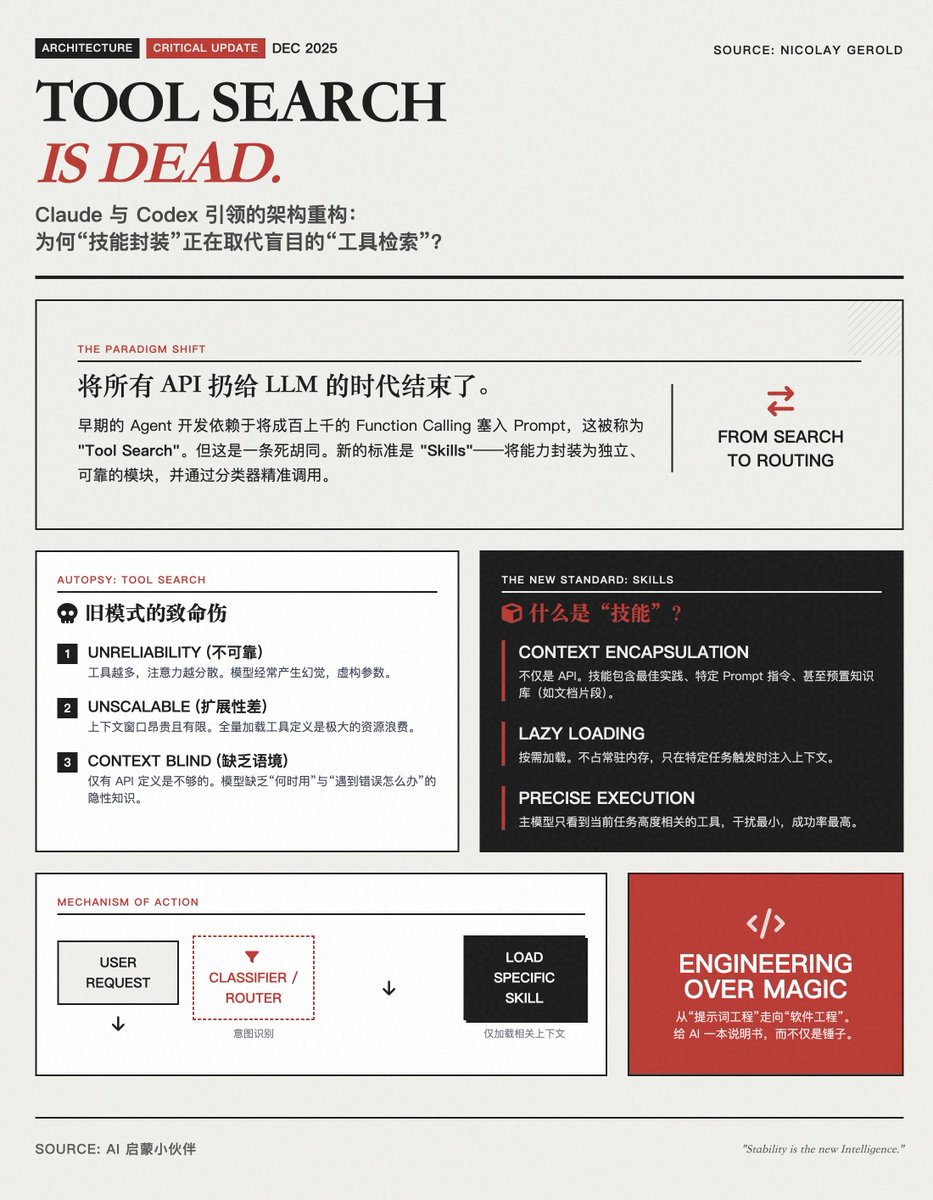
AI agent engineering shifts to modular skills. - 'Tool search' embeds many functions in prompts - Tool-search is unreliable as tools scale - Tool-search wastes tokens and lowers reasoning - Tools lack usage/when-to-use information - 'Skills' package tool, usage, prompts, KB - Skills are loaded on demand, not always present - Intent classifier or router selects skills - Plan Mode requires AI to produce blueprints - Native Plan Mode ties to IDE file system state - Plan Mode enables permissioning and rollbacks - Greptile 2025 report: code lines +76% - PR median size rose 57→76 lines - Anthropic SDK downloads grew 1547x since 2023 - OpenAI Sora Android: 85% AI-written code - Sora saw >1M videos in 24h and 99.9% crash-free - Best practice: design architecture, then use AI - Save plans to files for session continuity
Key insights
Skills replace indiscriminate tool search
The 'tool search' pattern of embedding many function definitions in prompts is described as unreliable, non-scalable, and lacking usage knowledge; the proposed replacement is modular 'skills' that package tools with usage instructions, best practices and knowledge, and are loaded on demand rather than always in context. The workflow advocates intent classification or routing to select relevant skills and therefore reduce hallucinations and token waste. (Supports posts: 18455).
Plan Mode decouples intent from execution in AI IDEs
Plan Mode is defined as an explicit thinking phase before code edits: AI generates a blueprint listing files to read, files to change, and step-by-step actions; this plan serves as external memory and allows permissioning, selective execution, and clearer rollback and debugging. Native Plan Mode integrates with IDE toolchains and file system state, and is presented as superior to simulating planning via prompts. (Supports posts: 18463).
AI increases code output but quality metrics are unclear
Greptile’s 2025 report shows developer monthly code output rose from 4,450 to 7,839 lines (76% increase) and PR median size rose from 57 to 76 lines; medium teams saw an 89% increase. The report notes that code volume growth does not equate to quality improvement and that AI benefits concentrate in projects with good tests and clear module boundaries. (Supports posts: 18544).
Model ecosystem and performance comparisons reported
Greptile data shows Weaviate leads vector DB market with 25% share; mem0 holds 59% in AI memory packs; CLAUDE .md adopted at 67%. SDK downloads: OpenAI 130M monthly, Anthropic 43M (1547x growth since 2023), Google GenAI SDK 13.6M. Model timing: Anthropic models have <2.5s first-token latency; throughput varies (OpenAI 60–70 tks/s median, Anthropic 17–20, Gemini 4–5). Cost baseline uses GPT-5 Codex at 1x; Claude variants cost 2x–3.3x. (Supports posts: 18544).
OpenAI Sora Android case: architecture, planning, and agent orchestration
OpenAI reported Sora Android had ~85% of code authored by Codex; in launch day users generated >1M videos in 24 hours and app crash-free rate was 99.9%. The development process emphasized human-defined architecture, example implementations, extensive style/spec files, AI planning before coding, review of AI-generated understanding, saving plans to files for session continuity, and reuse of iOS code as reference for cross-platform generation. (Supports posts: 18546).
Practical engineering guidance for AI-assisted development
Practical recommendations include: design architecture first and provide AI with team-specific style and CI rules; require AI to produce an understanding and plan before edits; use modular sessions and saved plans to manage parallel agent tasks; treat engineers as decision-makers and reviewers rather than primary coders; and leverage AI for translation between language-specific implementations. (Supports posts: 18546, 18463, 18455).