
AI Agent Self-Evolution: WikiSkill and LoopArena Benchmarks
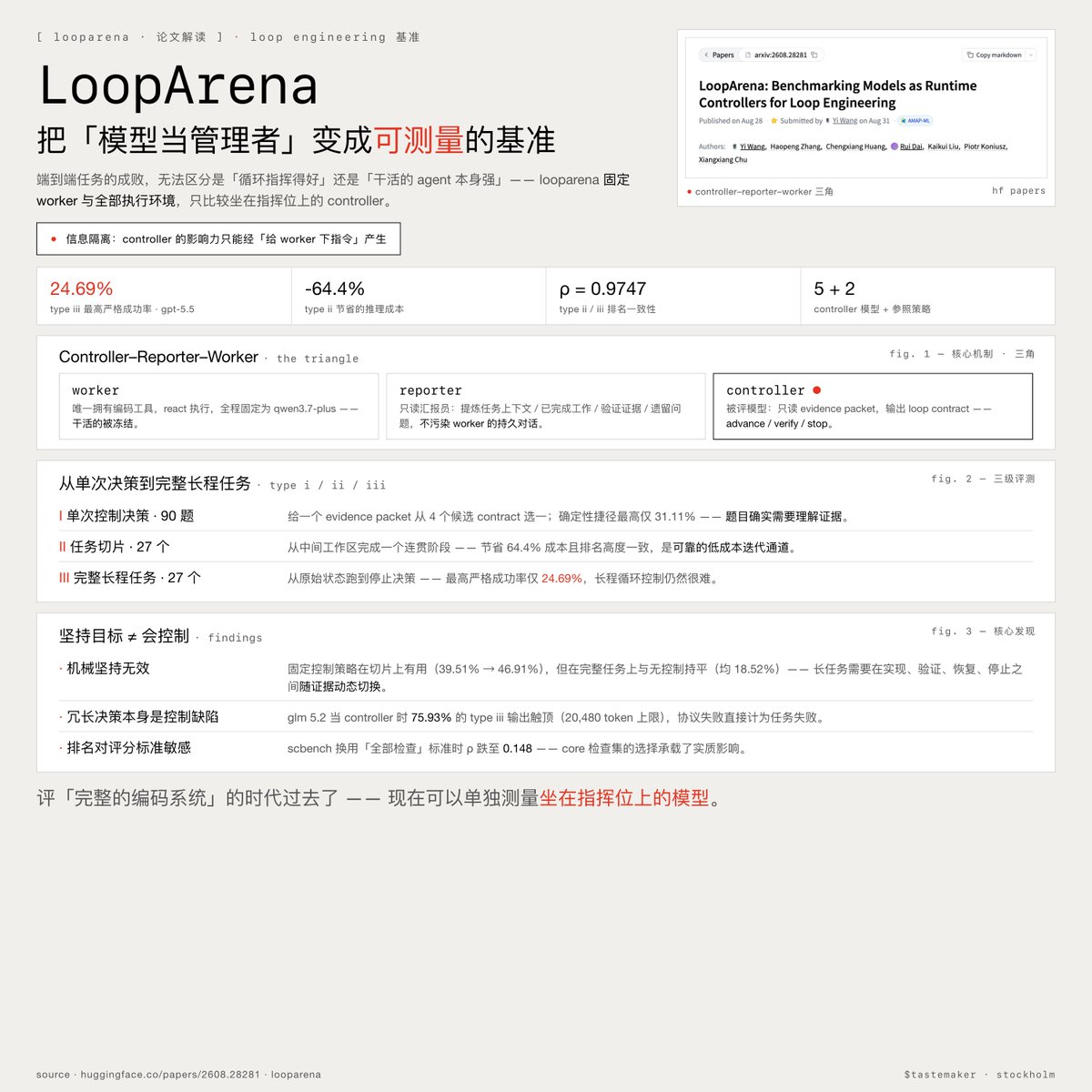
Google Research proposed WikiSkill, a framework enabling AI agents to accumulate task execution experiences into persistent, Wikipedia-like knowledge bases that evolve into stronger executable skills. The framework studies how agents learn from individual tasks and consolidate fragmented experiences into reusable capabilities. Separately, LoopArena introduced a benchmark isolating controller model capability from worker execution quality by fixing the worker to a single model across all tests and evaluating only the controller's runtime decision-making. Results showed long-range agent control remains difficult, with GPT-5.5 achieving only 24.69% strict success rate on full-length tasks. Type II task slices demonstrated 64.4% average inference cost savings while maintaining high rank correlation with full tasks.
Key insights
Agent Skill Accumulation Requires Explicit Knowledge Persistence Mechanisms Beyond Model Weights
WikiSkill addresses the gap between agents successfully completing tasks and retaining that experience for future tasks. The framework creates persistent knowledge bases akin to Wikipedia where experiential lessons become structured executable skills rather than ephemeral context. This represents a departure from treating each agent task as independent toward building cumulative capability through explicit knowledge extraction and storage mechanisms.
Current Frontier Models Perform Poorly at Long-Range Agent Control Despite Strong Single-Step Reasoning
LoopArena results showed the best controller model achieved only 24.69% strict success rate on full-length coding tasks, with all tested controllers ranging from 16.05% to 24.69%. The benchmark's design isolates controller quality by fixing the worker model, eliminating system-level confounding. GLM 5.2 exhibited output truncation in 75.93% of Type III evaluations, indicating that verbose decision-making itself constitutes a control defect. Fixed-control strategies improved Type II performance but performed identically to no-control on Type III tasks, proving that mechanical goal reiteration fails on full tasks requiring dynamic evidence-based switching between implementation, verification, recovery, and stopping.