
AI Coding Agents & App-Layer Opportunities (Cursor, a16z views)
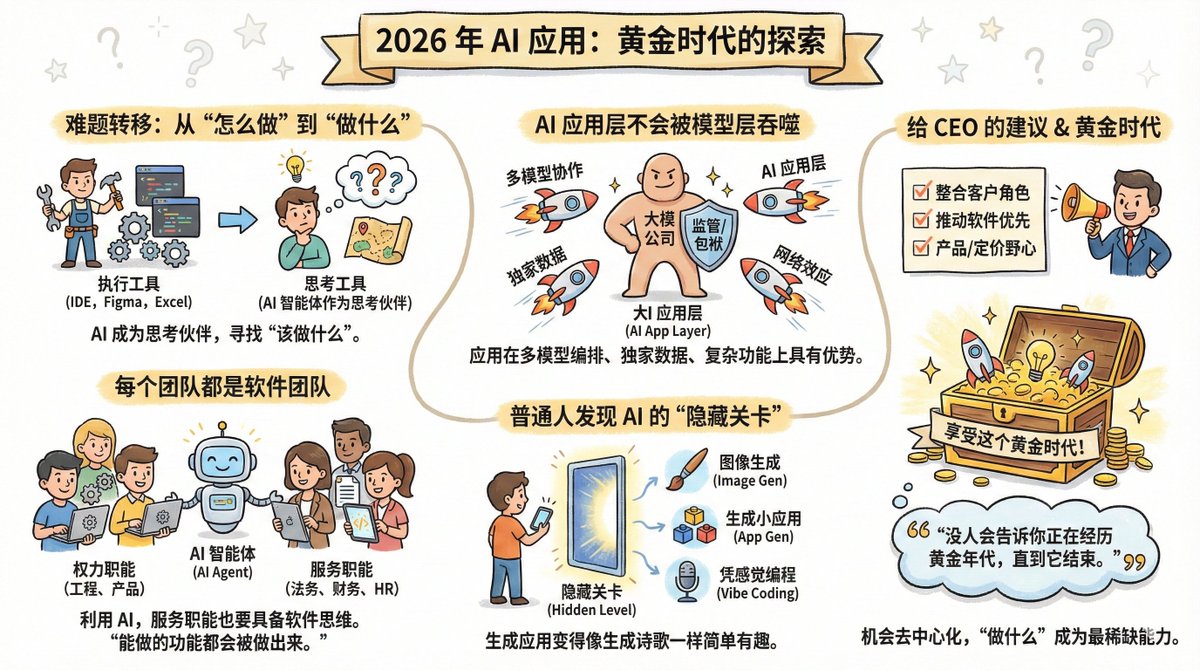
a16z and industry commentary predict 2026 product opportunity shifts: AI apps will help teams decide 'what to build' rather than only 'how to build.' - Anish Acharya (a16z) argues the next wave of AI apps will prioritize exploration and ideation tools over execution tools. - Every business function should adopt a 'software-first' mindset; non-technical teams need to become software teams. - AI coding agents (Cursor, Claude Code) transform engineering: coding becomes cheaper and many transient scripts become viable. - Cursor’s growth exemplifies investor confidence in coding-agent startups with rapid ARR expansion and hiring dynamics. - Developers experience 'vibe coding' and form quasi-social relationships with agents; new infrastructure is needed (versioning that logs prompts, agent attempts, and failures). - TRAE and other product reports show AI Coding moved from completion to collaboration: multi-agent coordination, persistent context and observability are new platform needs. - 2025 saw massive VC interest and big D rounds for coding-agent companies; the space prompts rethinking of code review, provenance and governance.
Key insights
AI apps must move from execution to helping users decide what to build
a16z partner Anish Acharya argued the primary product opportunity in 2026 is tools that help users explore, ideate and prioritize 'what to build' rather than only tools that execute tasks. He suggests existing execution-focused tools (IDEs, Figma) will be complemented by systems that synthesize context, propose product concepts, and present concrete, testable experiments. This shift requires new UX paradigms for ideation and human-in-the-loop selection. (supporting_posts: [20207])
Every organizational function must adopt software-first thinking
Acharya urges non-technical departments (legal, HR, finance) to approach problems with software solutions enabled by coding agents. He foresees a cultural change where teams default to building software-assisted workflows before hiring additional headcount. This transition will require management alignment, new product and pricing strategies, and internal capability building to integrate AI into routine operations. (supporting_posts: [20207])
AI coding agents catalyze a new software engineering stack and personal entrepreneurship
Reports and community posts show coding agents (Cursor, Claude Code) enabled rapid prototyping and individual entrepreneurship; developers increasingly use agents for both single-use scripts and full features. This transforms software economics: code becomes cheaper and disposable, prompting rethinking of version control, code review, observability and the provenance of AI-generated contributions. Founders and engineers are reorganizing workflows to treat agents as persistent teammates requiring new governance and monitoring tools. (supporting_posts: [19679, 18945, 20207])
Investor evidence: coding-agent startups reached rapid ARR and high valuations
Industry reports cite Cursor's explosive growth—ARR increasing from $0.1M in 2023 to $100M+ by 2025 and a D-round raising $2.3B with post-money valuation near $29.3B in one cited analysis—illustrating investor conviction in coding-agent economics and enterprise adoption. The capital surge reflects belief that coding agents create durable enterprise value by increasing developer throughput and lowering time-to-market. (supporting_posts: [19679, 20207])