
AI Coding Agents, Programmer Adoption and Context Strategies
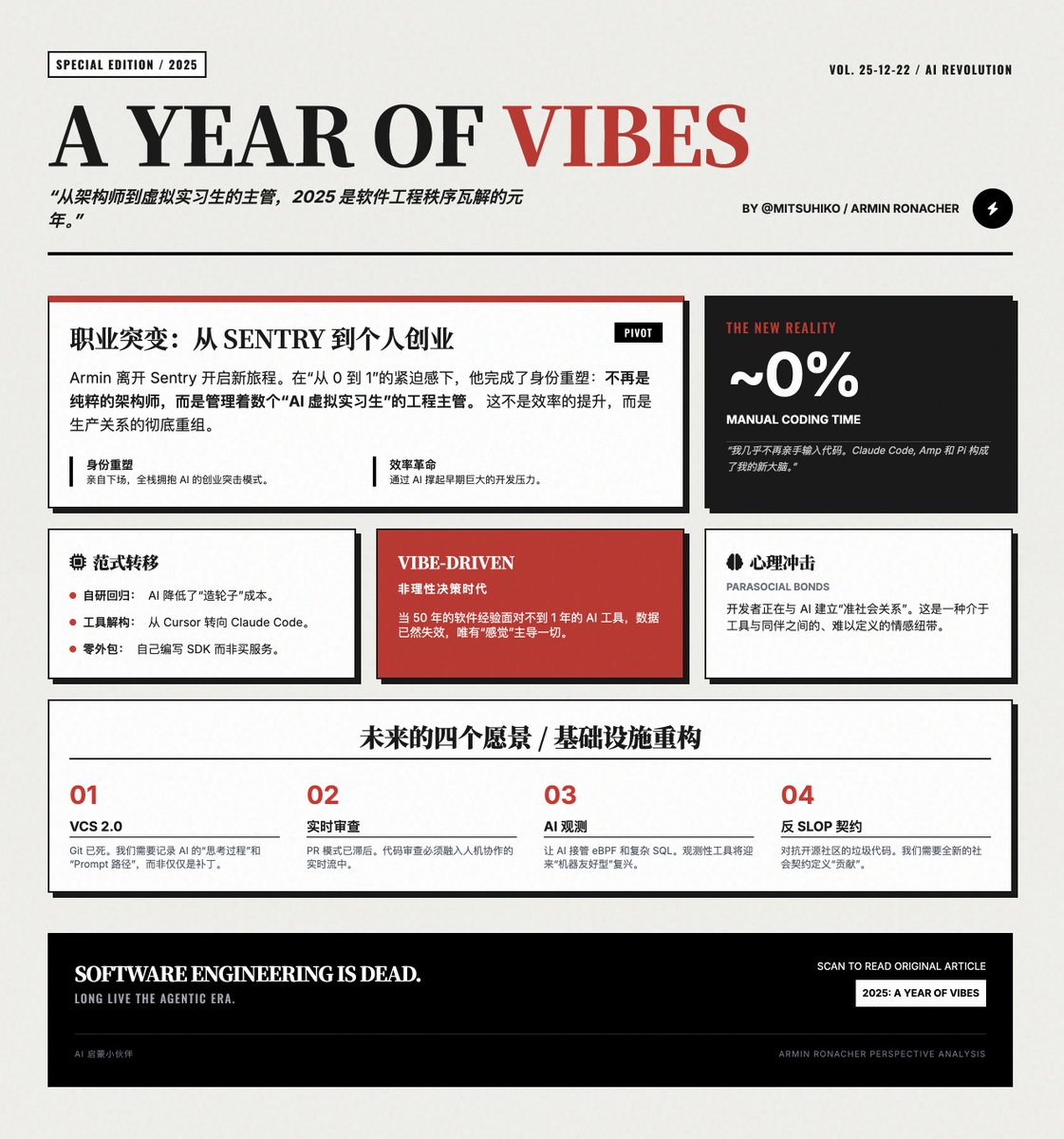
2025 marked a major shift in software development: AI coding agents and 'vibe coding'—describing intent in English to generate programs—became mainstream. Developers adopted tools such as Cursor and Claude Code, enabling founder‑level productivity and new startup formation. Workflows changed: engineers rely more on agents as virtual interns or autonomous executors, exposing gaps in versioning, code review and observability practices. Salvatore Sanfilippo noted that LLMs now show internal representations, praised chain‑of‑thought and verifiable RL directions, and observed a broad shift among programmers toward accepting AI as productive collaborators while flagging long‑term existential risks.
Key insights
Vibe coding and agents democratize programming
Developers report that 'vibe coding'—describing tasks in natural language—plus agent‑driven pipelines allow non‑specialists to produce code and let experienced developers treat many small tasks as throwaway artifacts. Toolchains cited include Cursor, Claude Code, Amp and Pi, enabling higher productivity and solo founder workflows.
Software engineering processes require redesign for AI collaboration
Practitioners note that existing tools like Git and PR workflows do not capture AI reasoning traces; new versioning, code review and observability tools are needed to record prompts, model outputs, failed attempts and agent decision rationale when AI participates in coding and operations.
Programmers form quasi‑social relationships with AI tools
Longitudinal usage causes emotional projection onto AI collaborators; engineers report treating models as colleagues while recognizing responsibility boundaries and vocabulary gaps for this intermediary tool/partner role.
Senior engineer reflections: LLMs exceed 'random parrot' criticisms
Salvatore Sanfilippo summarized eight reflections: LLMs show internal concept representations, chain‑of‑thought is a major advance, RL from verifiable rewards unlocks continual self‑improvement in some domains, transformer may still suffice, and long‑term existential risk remains the fundamental challenge.