
AI Developer Tools, Agentic Coding and LLM Engineering Resources
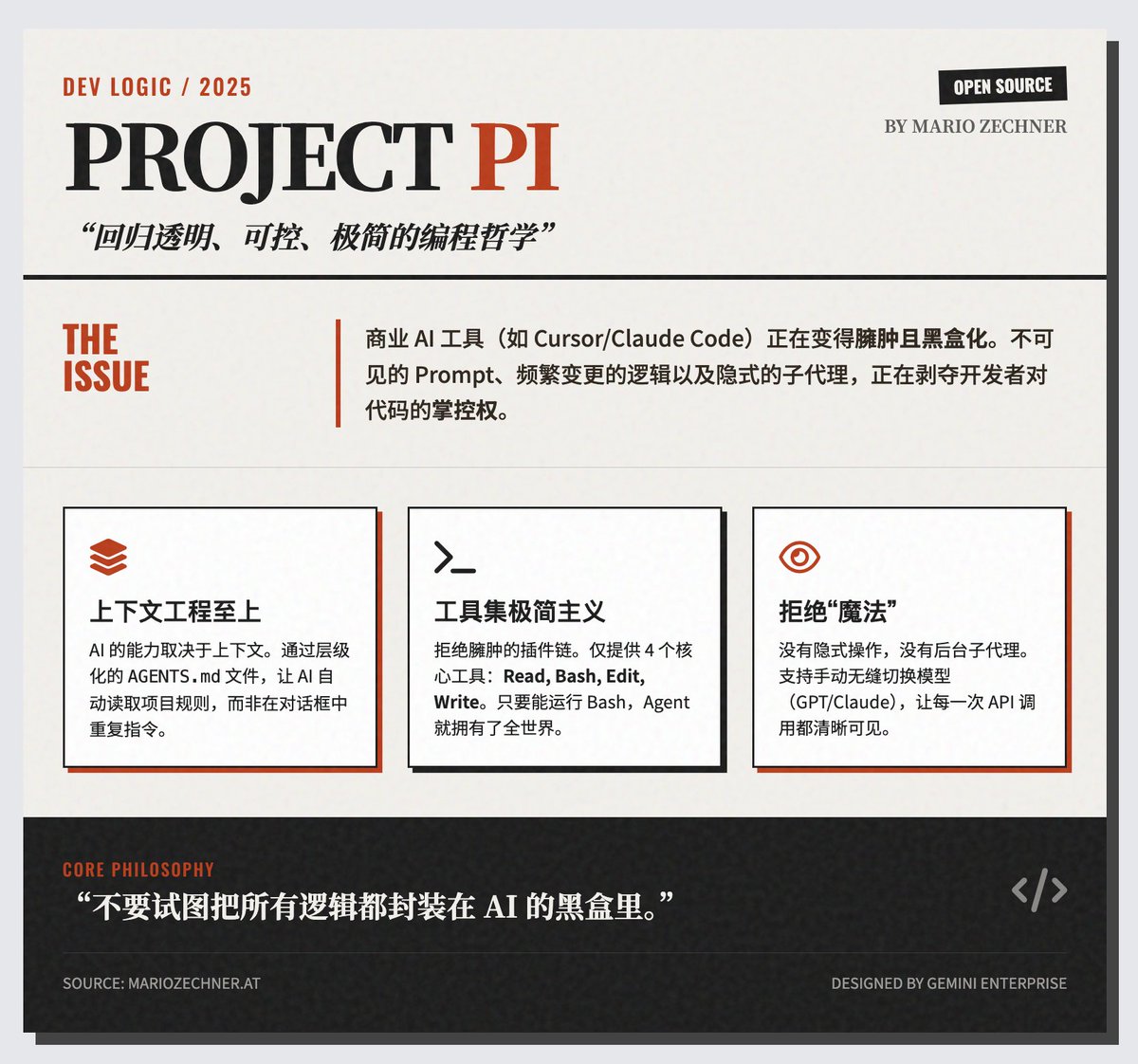
Open-source LLM tooling and developer upskilling resources expanded. • 'pi' CLI agent emphasizes transparency • Pi exposes read/bash/edit/write tools • Pi uses AGENTS.md for hierarchical context • Commercial tools criticized for bloat and hidden prompts • DeepCode simulates multi-agent engineering teams • DeepCode Paper2Code claims 75.9% reproduction rate • DeepCode supports local models via Ollama • LLM-engineer-handbook curates production best practices • Vibe Coding CN frames Dao/Method/Technique/Tools • Google Skills offers Gemini and Vertex AI courses • Google Skills includes hands-on cloud labs and badges • 2026 career guide: shift to T-shaped AI engineers • High-value roles: AI engineering, cloud, mobile dev • Emphasis: architecture, context engineering, LLM-Ops
Key insights
Pi: a minimalist, transparent coding agent
An open-source project 'pi' implements a terminal-first, minimal AI coding agent focused on transparency and control. Pi provides four core tools—read, bash, edit, write—and uses hierarchical AGENTS.md for context engineering. The author left commercial tools due to bloat, hidden prompts, and non-interpretable subagents; pi emphasizes visible steps, manual control over model selection, and reproducible CLI workflows.
DeepCode: multi-agent framework for paper-to-code and full-stack delivery
DeepCode is an open-source multi-agent programming framework that simulates an engineering team with orchestrator, analysts, architects, coders, and testers. Its standout Paper2Code feature extracts algorithms from PDFs and reproduces runnable code; benchmark claims show a 75.9% reproduction success rate. The framework supports local model hosting via Ollama and targets end-to-end project delivery rather than snippet completion.
LLM-engineer-handbook and Vibe Coding collect production best practices
An open-source LLM-engineer-handbook aggregates resources for training, deployment, RAG, prompt optimization, LLM-Ops, and production practices to help bridge demos to enterprise applications. A Chinese Vibe Coding fork frames AI pair-programming across Dao/Method/Technique/Tools and provides system prompts and glue-coding guidance for modular development and Cursor+Claude/GPT workflows.
Google Skills: integrated learning for AI and cloud
Google Skills launched an integrated learning platform focused on generative AI, Google Cloud, and DeepMind topics. It provides learning paths, skill badges, certifications, cloud-based labs, and up-to-date content for Gemini and Vertex AI. The platform targets individuals and teams seeking practical, hands-on training with real cloud environments.
Career shift: engineers must become AI-savvy system designers
A 2026 career guide forecasts fewer junior coding roles and rising demand for T-shaped engineers: broad system knowledge plus deep domain expertise. Recommended paths include AI engineers (RAG, Agents, prompts), cloud engineers, and specialized mobile dev. Advice emphasizes architecture, decision-making, and supervising AI-generated code rather than pure syntax skills.