
AI industry shift and 2026 outlook
AI in 2026 shifts from models to operational systems. - Value shifts from interface to infrastructure (orchestration, governance, data prep). - Operability matters more than model capability; revenue and compliance depend on system reliability. - Governance is a prerequisite; runtime constraints and authorization are required for safe agent deployment. - Data quality is the main failure mode for AI in production; agents cannot compensate for poor data. - Orchestration layers that convert intent into multi-tool actions capture significant value. - Vertical AI sells integrated systems: integration, control and outcomes outweigh raw models. - Distribution becomes continuous operations; AI recommendation + social fragmentation increase demand. - On-device/local inference restores speed, cost advantages and software-like margins. - Sovereignty (prompts, workflows, proprietary context) determines competitive leverage. - Memory/personal knowledge systems become durable differentiators with compounding value. - Training environments (simulations/games) become critical and defensible assets beyond model scale. - Autonomous systems fit bounded, repeatable operations; ambiguous or high-exception domains remain risky. - Pricing power migrates to governance, data prep and deeply embedded vertical systems, not general copilots. - Predictions: agents may surpass hiring costs for enterprises; vector DBs re-emerge; agent observability and new data platforms (context graphs) become central; local inference and hardware/cloud shifts reshape economics.
Key insights
Operational Reliability Supersedes Model Benchmarks
Multiple posts argue that the primary commercial test for AI in 2026 is not what models can generate but what systems can reliably operate under real constraints. Value is moving from user-facing interfaces to infrastructure layers—specifically orchestration, governance, and data preparation—that enable AI to be embedded in revenue and compliance paths. Systems that convert intent into coordinated actions across fragmented tooling are most valuable, while raw model capability alone is insufficient for enterprise deployment.
Governance and Runtime Controls Become Deployment Preconditions
Posts emphasize that governance is a prerequisite for deploying agentic systems at scale: agents without runtime constraints constitute operational risk. Emerging control-plane products provide task- and context-aware authorization, auditing, financial execution controls (approvals, limits, tracking), and observability. Trust shifts from being a model property to being an attribute of the surrounding system and control infrastructure.
Data Quality and Context Graphs Are Core to Agent Effectiveness
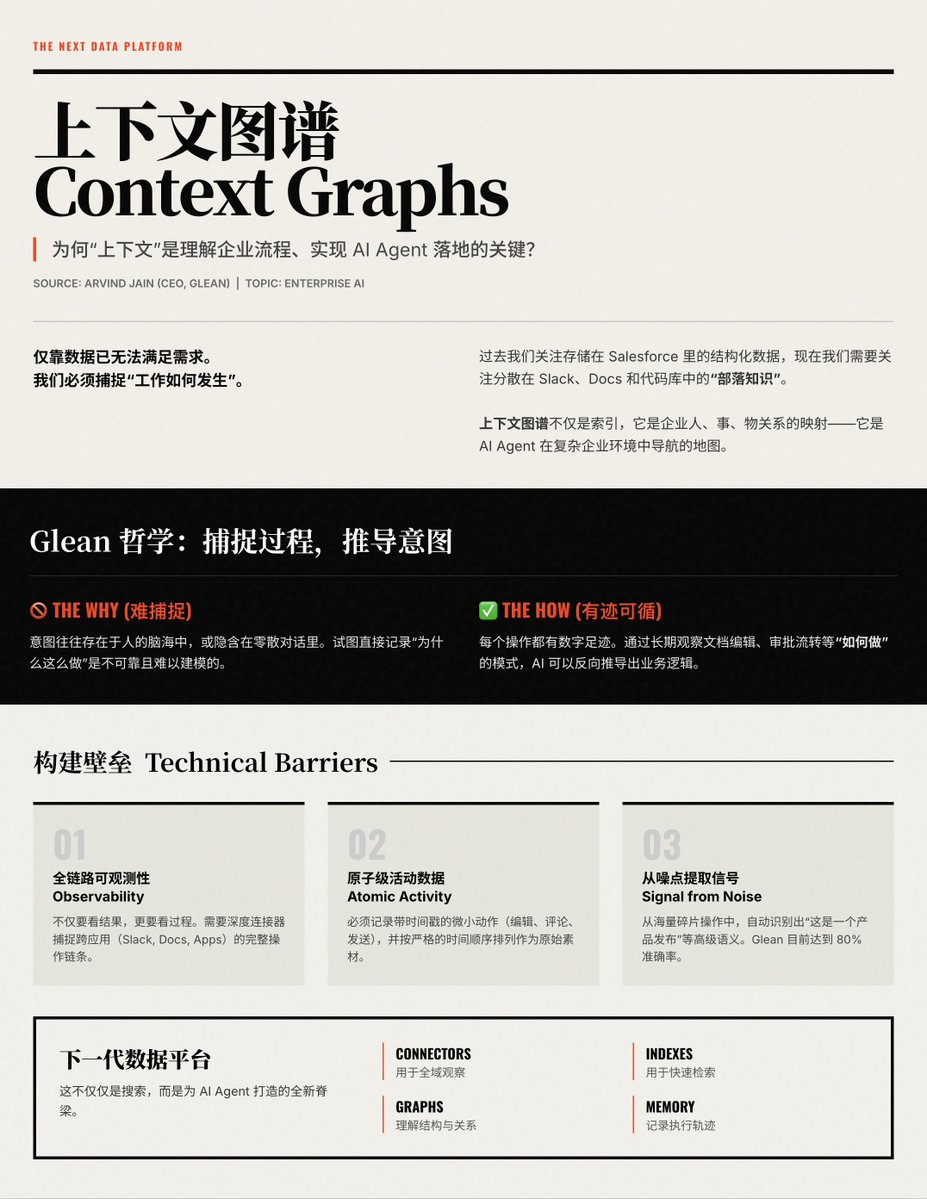
Authors state that most production AI failures trace to stale, fragmented or missing data rather than model deficits. Enterprise adoption requires new data platforms: connectors for full-path observability, atomic activity logs, semantic/graph layers that map people/processes/things, and memory stores that record agent actions. Context graphs enable agents to reason about who owns accounts, approvals, and operational flows and are necessary for automation inside enterprises.
Vertical Systems and Embedded Automation Capture Durable Value
The cluster asserts that as general copilots commoditize, durable revenue will accrue to vertical AI systems that embed automation with accountability into domain workflows. Examples include legal drafting with lawyer review, accounting automation shifting accountants to advisory, occupational health triage, and K–12 IT orchestration. In these cases the product is integration, control and measurable outcomes rather than model novelty.
Local Inference and Training Environments Reshape Economics
Posts note that local or hybrid inference reduces latency, cost and privacy exposures, restoring software-like margins when possible. Separately, training and simulated environments—games, simulators, world models—are identified as strategic, hard-to-replicate assets that will constrain future capability development more than raw parameter counts.
Capital and Market Predictions for 2026
One post lists 11 predictions for 2026 including: enterprise agent spend exceeding hiring costs in some cases; a major IPO wave from SpaceX, OpenAI, Anthropic, Stripe, Databricks; vector databases reasserting central infrastructure roles; agents completing multi-hour workflows; stricter AI budget scrutiny favoring task-optimized smaller models; Google pulling ahead via multi-domain investments; agent observability consolidating monitoring disciplines; stablecoin usage in international payments reaching 30%; surges in database load and data-center investment growth.