
AI Interview Questions and Developer Tools: Open-Source Resources
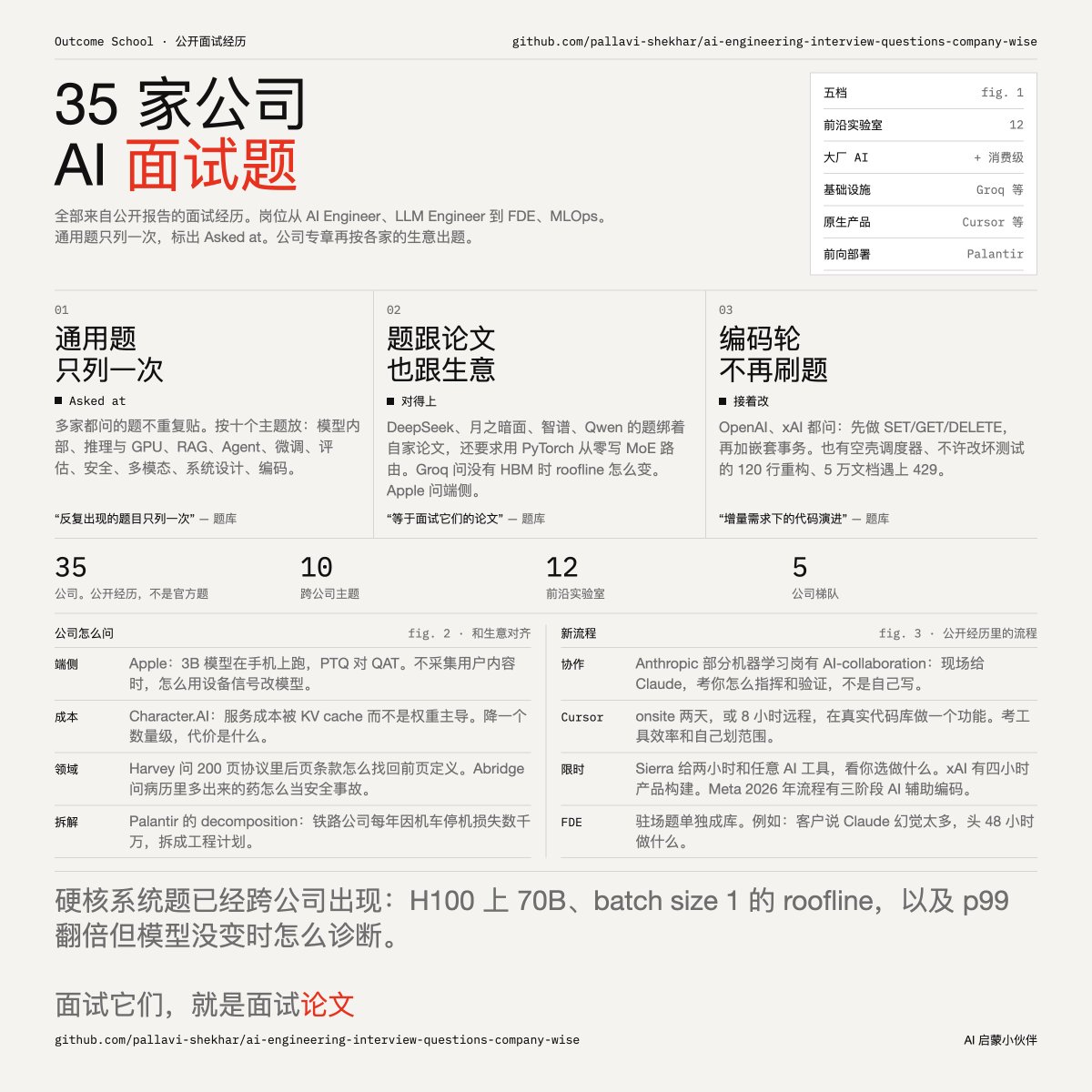
A new open-source project systematically organizes AI engineer interview questions from 35 companies, including OpenAI, Anthropic, DeepMind, and others. It covers 10 topic areas from LLM internals to system design, and includes company-specific sections. The repository reveals industry trends like AI collaboration rounds and FDE roles becoming standard.
Key insights
Comprehensive Interview Question Repository
The open-source project by outcome_school compiles AI engineer interview questions from 35 companies, including frontier labs (OpenAI, Anthropic, DeepMind), big tech (Microsoft, Amazon, Apple), AI infrastructure (Databricks, Groq), AI-native products (Cursor, Cognition), and enterprise AI (Palantir). It covers 10 topic areas: LLM internals, inference/serving, RAG, agents, fine-tuning, evaluation, safety, multimodal, system design, and coding.
Company-Specific Questions Reflect Business Models
The repository shows that companies' questions align with their business: DeepSeek and Kimi ask about their own papers (MLA, load balancing); Groq focuses on SRAM-only architecture; Apple asks about on-device models; CharacterAI about KV cache economics; Harvey and Abridge about domain-specific constraints. This indicates that interview preparation should be tailored to the company's technology stack.
New Interview Formats: AI Collaboration and FDE Roles
The repository reveals emerging interview formats: Anthropic and Meta have AI collaboration rounds where candidates use Claude or AI tools to solve problems. Cursor's onsite involves building a feature on the actual codebase. FDE (Forward-Deployed Engineer) roles are now a distinct category at multiple companies, with scenarios like 'customer says Claude hallucinates too much, what do you do in the first 48 hours?'
Devframe: Framework for Building Developer Tools
Anthony Fu released Devframe, a framework for building developer tools that can run as Vite plugins, CLI, static reports, or MCP servers from a single definition. It uses a handler-first model with Web standard Request/Response. It is designed for both humans and AI coding agents, with RPC functions that can be exposed to agents. The repository includes skills for coding agents and documentation in agent-friendly formats.