
AI Recursive Self-Improvement and Autonomous Research
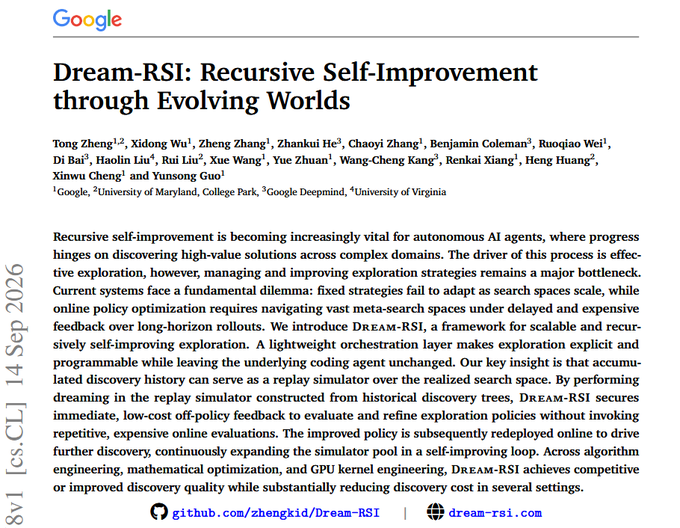
Google DeepMind introduced Dream-RSI, an AI recursive self-improvement loop that reduces agent calls by up to 162x. Separately, GPT-6 Astra autonomously trained a dexterous manipulation policy over 1.5 days. Jason Wei presented frameworks on AI commoditization, the Verifier's Law, and the jagged edge of intelligence.
Key insights
Dream-RSI recursive self-improvement loop
Google and DeepMind demonstrated Dream-RSI, an AI system that replays past discovery processes to test thousands of exploration strategies at low cost, then applies the best strategies to the next round. It maintained or improved result quality in algorithm design, mathematical optimization, and GPU kernel engineering while reducing agent calls by up to 162x.
GPT-6 Astra autonomous research in robotics
A single prompt to GPT-6 Astra led it to autonomously train a policy for a dexterous hand to perform a pen spinning task. Over 1.5 days, it used Isaac Lab for reinforcement learning, created a 3D mesh of the pen, searched the web for papers, downloaded materials, and delivered a trained policy and visualization video.
Jason Wei's three frameworks for AI progress
Jason Wei (Meta Superintelligence Labs, formerly OpenAI and Google Brain) gave a talk outlining three mental models: (1) Intelligence as a commodity—costs drop as adaptive compute scales; (2) Verifier's Law—AI improves on tasks proportional to their verifiability, exemplified by AlphaEvolve; (3) The jagged edge of intelligence—AI's capability landscape is uneven, with tasks like math and coding near-peak while physical tasks like plumbing remain distant. He predicts AI research automation by 2027.
Claude Code Projects enables parallel autonomous development
Anthropic released a new Projects feature for Claude Code, allowing a single conversation to spawn multiple cloud-based threads that work in parallel on independent sandboxes and git branches. Threads continue running even when the laptop is closed, share project memory and instructions, and can be configured for recurring routines. This extends autonomous coding workflows.
OpenAI Astra for Law targets legal industry
OpenAI launched Astra for Law, a legal AI infrastructure based on GPT-6 Astra, with a 230 million URL legal retrieval index covering U.S. case law, statutes, and regulations. It includes customized legal analysis instructions and privacy governance. In benchmarks, it achieved 54.0% correctness on legal research questions vs. 38.7% for base GPT-6 Astra with web search, a 40% improvement.
Jina AI releases fast and accurate document OCR model
Jina AI fine-tuned DeepSeek-OCR to produce jina-ocr-v1, a 3.4B parameter model with 5.7B active parameters per token. It processes 2.57 pages per second on a single L4 GPU, vastly faster than competitors like chandra-ocr-2 (0.38 p/s). It uses speculative decoding for speed and achieves 83.4 on olmOCR-Bench and 91.14 on OmniDocBench, with a focus on production deployment via vLLM and Docker.
Verifier's Law predicts automation of verifiable tasks first
Jason Wei's Verifier's Law states that AI's ability on a task is proportional to how easily the solution can be verified. Factors include objective correctness, verification speed, parallelizability, noise level, and reward signal continuity. This framework explains why benchmarks are quickly conquered and suggests that inventing new measurement methods for hard-to-verify tasks is a promising startup direction.
AI capability jagged edge: digital tasks lead, physical tasks lag
Jason Wei argued against a rapid takeoff scenario, showing AI's ability spectrum is jagged. Digital tasks with fast iteration cycles (like math and coding) advance quickly, while physical tasks like plumbing or haircuts remain difficult. Tasks with abundant data and objective metrics are easiest to automate; tasks with low digitization and scarce data, like handmade carpet weaving, are least likely to be automated.