
AI recursive self-improvement: new evidence and debate
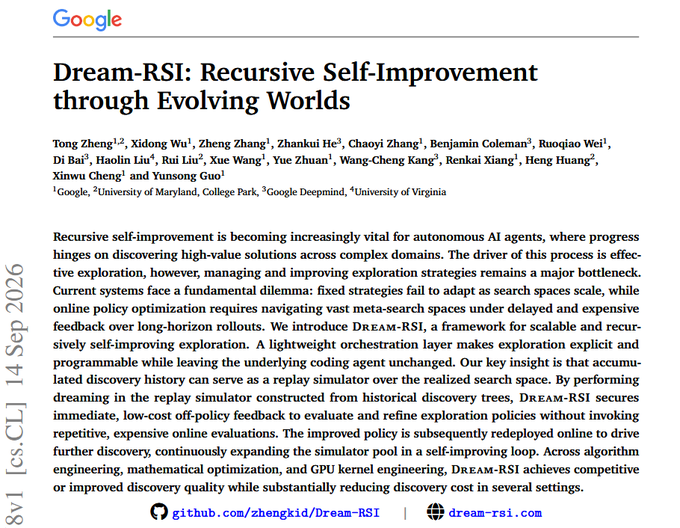
Multiple reports show AI systems are increasingly involved in their own development. Google DeepMind's Dream-RSI reduced agent calls by 162x in algorithm design. OpenAI reported AI can now automate training experiments over weeks. Anthropic's internal dashboard shows AI leads 26% of its R&D work, though full recursive improvement remains distant.
Key insights
Dream-RSI demonstrates a closed-loop improvement cycle
Google and DeepMind's Dream-RSI replays past discovery processes to cheaply test thousands of exploration strategies, then feeds better strategies into the next round. In algorithm design, mathematical optimization, and GPU kernel engineering, it maintained or improved result quality while reducing agent calls by up to 162x.
OpenAI's internal AI systems automate training pipeline tasks
According to The Information, OpenAI's AI models can now automate the training pipeline for new experimental models, including writing GPU kernel code and optimizing training code. Researchers provide an optimization example, and AI spends weeks implementing similar improvements. Multiple AI agents collaborate without human involvement, and experiments that previously took years now complete in about a week.
Anthropic's internal dashboard quantifies AI's role in R&D
Anthropic publicly shared metrics as of July 2026: AI leads 26% of AI R&D work (AL4 level), over 90% of R&D involves deep AI collaboration (AL3+). No subset reaches AL5 (full autonomy). At any moment, 30,000 agents work on R&D and engineering. About 6% of compute for AI R&D goes to safety. The dashboard sets a baseline for tracking acceleration.
Paper proposes 5-level scale for AI self-improvement
A 75-page paper by over 30 researchers classifies AI self-improvement into 5 levels, from human-determined changes (Level 1) to AI rewriting the process for building the next AI (Level 5). Reviewing 491 papers, 75% remain at Level 1-2, and fewer than 6% reach Level 5.