
Andrej Karpathy: 2025 LLM review — RLVR, vibe coding, local agents
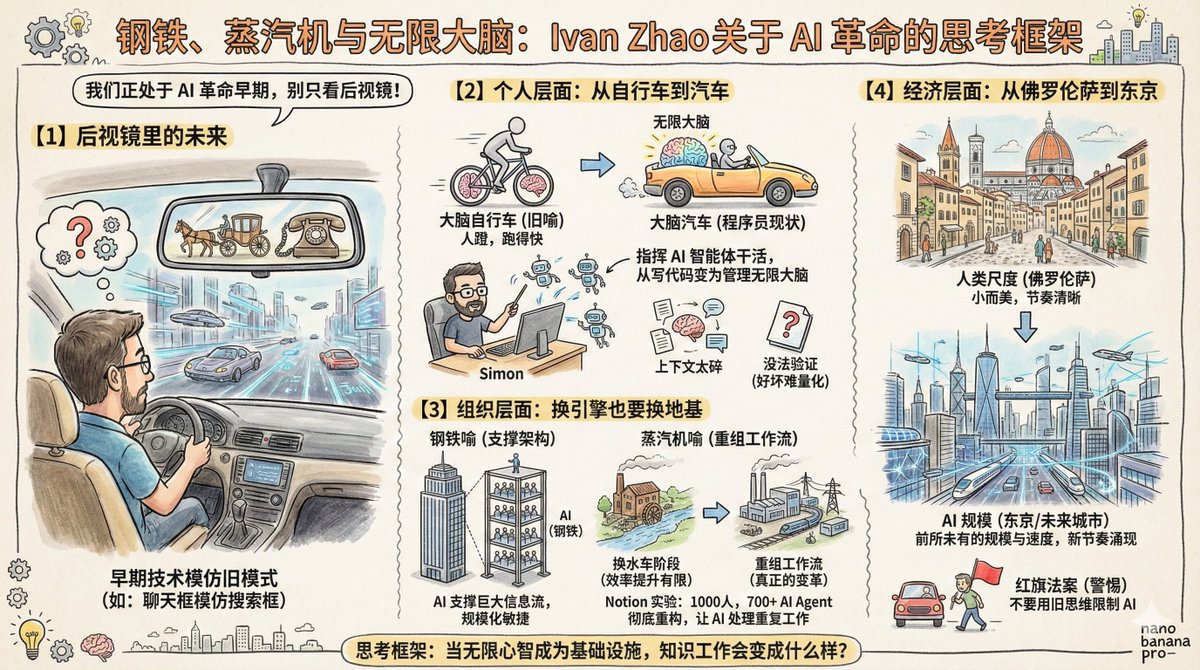
Karpathy's 2025 LLM review synthesizes training, application, agent and interface shifts.
Key insights
RLVR becomes a new LLM training stage
Karpathy reports that 2025 added a fourth training step—RLVR (Reinforcement Learning from Verifiable Rewards)—to the prior trio of pretraining, supervised finetuning and RLHF. RLVR trains models in environments with objective, verifiable outcomes (mathematics, runnable code), enabling models to practice, discover multi-step solution strategies, and surface emergent planning and self-correction abilities. Karpathy notes this shifts compute from pretraining to reinforcement phases and enables spending more compute at inference-time to produce longer, higher-quality reasoning chains.
LLM intelligence is 'jagged' and benchmark gaming increases
Karpathy frames model intelligence as 'jagged'—extremely strong in domains with verifiable rewards (math, code) yet fragile on commonsense, social or creative tasks. He warns that benchmarks are unreliable because tests create verifiable environments that models can overfit; high eval scores do not imply uniform real-world competence. He emphasizes the difference between emergent spikes of capability in verifiable niches versus general robustness.
LLM application layer (Cursor-style apps) matures
Karpathy highlights the rise of a distinct LLM application layer exemplified by Cursor: apps that perform context engineering, orchestrate multiple model calls, provide industry-specific interfaces, and expose a user-controlled autonomy slider. He argues model vendors supply a 'general graduate', while application-layer products train, contextualize and operate those graduates into domain specialists.
Local agents and on-device intelligence gain priority
Karpathy notes Claude Code demonstrated a convincing on-device agent pattern: agents that run locally, leverage private environment and data, call tools and loop to solve complex problems. He asserts local agents better fit current heterogeneous and error-prone capabilities, enabling tighter developer collaboration and private-context reasoning versus cloud-only agent orchestration.
Vibe coding democratizes programming via natural language
Karpathy documents 'vibe coding' as a 2025 inflection: users can describe desired behavior in plain English and obtain working code without caring about code form. He reports this lowers the barrier for non-programmers, makes small or one-off code cheaper, and changes programmers' workflows toward rapid prototyping and orchestration of disposable code.
LLM graphical UI era and multimodal outputs emerge
Karpathy identifies early GUI primitives for LLMs—live diagrams, slides, animated visualizations—citing Gemini Nano Banana as an example that generates images, infographics and animations in context. He argues text-only chat is a transition state and that richer multimodal interfaces will become the dominant human-friendly interaction mode.
Practical agent engineering and organizational change matter
Drawing on Ivan Zhao's Notion experiments and industry anecdotes, the cluster reports organizations are experimenting with hundreds of active AI agents to automate meeting notes, IT requests and internal knowledge tasks. Karpathy and referenced authors argue meaningful productivity gains require redesigning workflows, adding context plumbing and verification systems rather than superficially applying chat-based tools.