
Anthropic & Claude: Agent Evaluation, Harness Design and Strategy
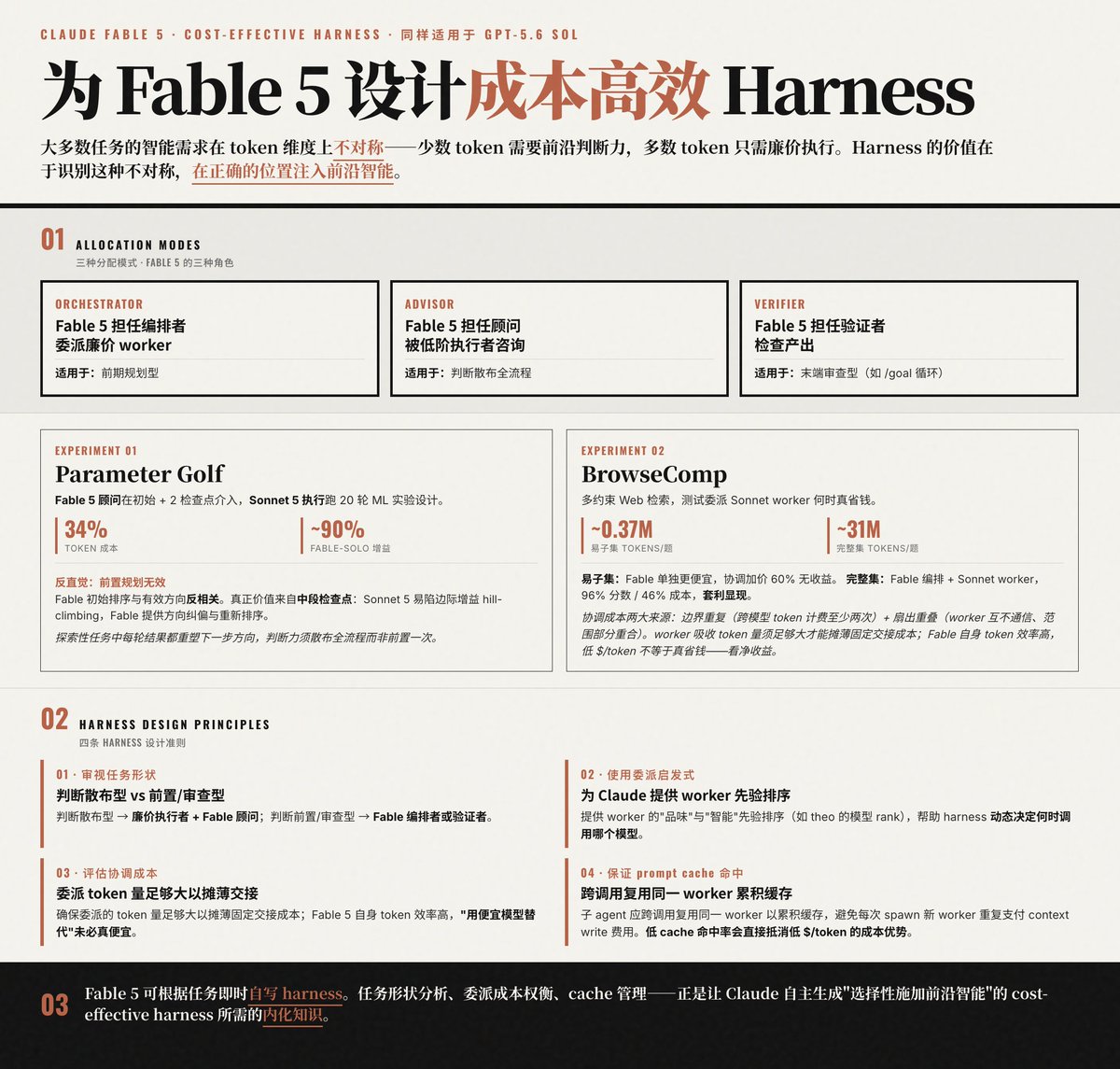
Anthropic and related posts explained harness design, agent evaluation, and policy interviews. - Claude Fable 5 harness strategies: Orchestrator, Advisor, Verifier patterns allocate frontier model tokens where judgment is needed. - Parameter Golf test: Fable-as-advisor plus Sonnet executor achieved ~90% of Fable-alone performance at ~34% token cost. - BrowseComp test: for large web retrieval (~31M tokens), Fable orchestrator + Sonnet worker achieved 96% score at 46% cost. - Harness design rules: analyze task shape, use delegation heuristics, evaluate coordination cost, ensure prompt cache hits. - Anthropic published an agent evaluation methodology: structured tasks, graders, transcripts, harnesses, pass@k and pass^k metrics, and an 8-step roadmap to build evaluation systems. - Dario Amodei (Anthropic CEO) Davos interview: extreme technical optimism, risk vigilance, index tracking of Claude usage, policy stances on chips and employment, and security emphasis (mechanistic interpretability work cited). - Anthropic’s engineering notes emphasize agents’ non-determinism, pass@k metrics, and layered evaluation (CI, production monitoring, A/B, user feedback).
Key insights
Cost-efficient harnesses optimize token allocation
Anthropic described three harness patterns—Orchestrator, Advisor, Verifier—that place high-cost frontier models at judgment points while delegating majority token work to cheaper workers. Experiments showed substantial cost-performance tradeoffs: in Parameter Golf, Fable-as-advisor plus Sonnet executor reached ~90% of Fable-alone performance at ~34% token cost; in BrowseComp, orchestrator + worker saved cost (46%) while preserving 96% of score on large retrieval tasks. Design rules include task-shape analysis, delegation heuristics, coordination-cost evaluation, and prompt cache optimization.
Anthropic provides an operational agent evaluation framework
Anthropic published an agent evaluation methodology that structures evaluation into Task, Grader, Transcript, and Harness layers. It prescribes deterministic scoring where possible, usage of pass@k and pass^k to capture non-determinism, transcription auditing, and an 8-step implementation path from manual tests to stable CI/CD evaluation. Anthropic emphasizes combining automated tests, production monitoring, A/B testing, and human review to avoid blind spots.
Anthropic’s leadership stresses simultaneous optimism and safety vigilance
In a Davos interview, Anthropic CEO Dario Amodei characterized model capability growth as exponential and imminent, warned of large economic disruption (including possible job displacement), opposed certain chip-export policies to China, and described Anthropic’s approach of mechanistic interpretability and extreme stress-testing to detect deceptive or instrumentally harmful model behaviors. Anthropic uses internal usage indices to quantify automation vs. augmentation effects.
Evaluation must reflect agentic complexity and non-determinism
Anthropic argued that agent systems’ multi-step, tool-using, stateful behaviors require layered evaluation: deterministic programmatic checks (e.g., code runs), simulated user interactions, sandboxed tool usage recording, and post-hoc transcript audits. Metrics like pass@k and pass^k are recommended to capture single-run reliability vs. at-least-one success in multiple attempts, and evaluation harnesses must be robust to environment noise and repeated runs.