
Anthropic / Claude: Agent Skills, Advanced Tool Use and Opus 4.5
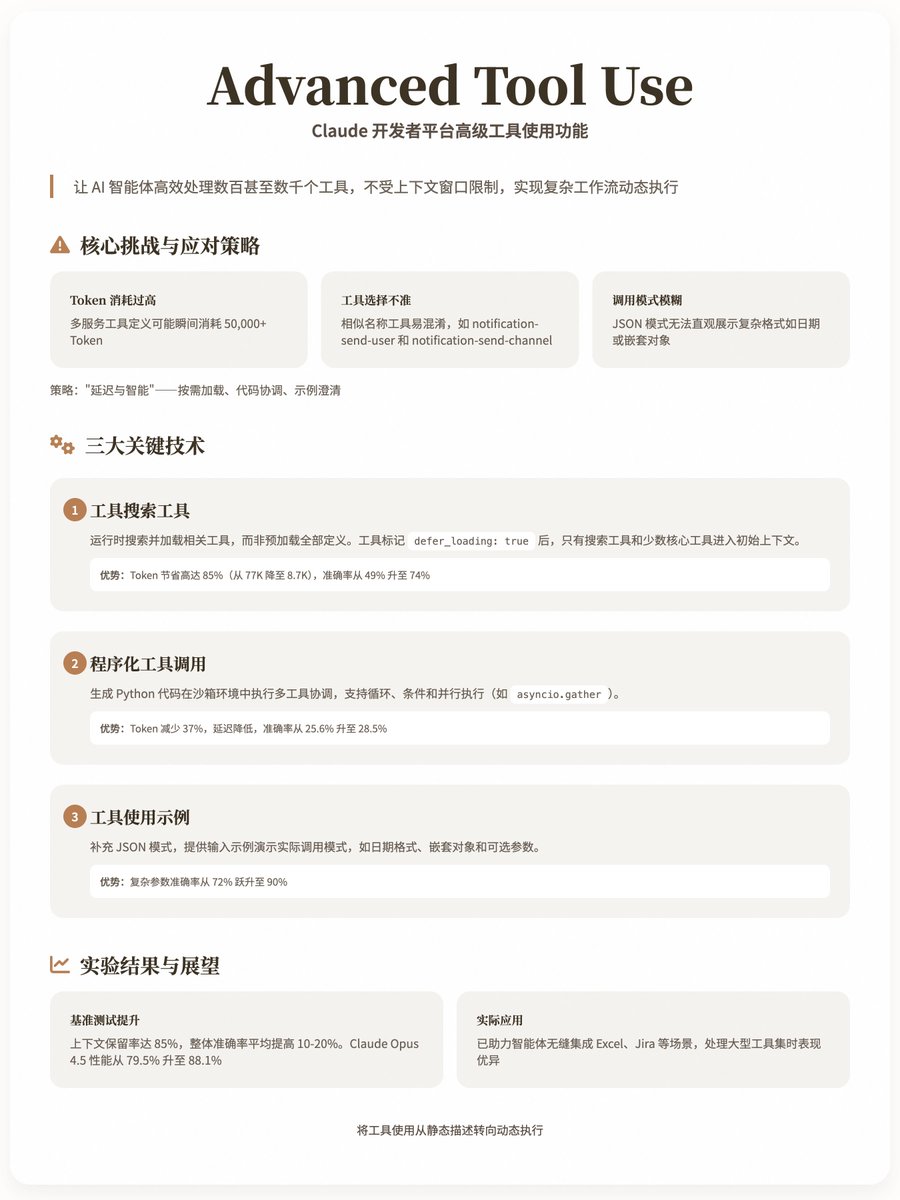
Anthropic announced Claude Opus 4.5 plus advanced tool-use features to scale agent workflows and reduce token costs. - Opus 4.5 claims SWE-bench Verified >80 and improved OSWorld agent performance. - Anthropic reports token consumption reductions up to 65% for long coding tasks and price cuts to one-third of Opus 4.1. - Opus 4.5 pricing: $5 per million input tokens, $25 per million output tokens; available across Claude app and major cloud providers. - Anthropic introduced three advanced tool-use primitives: Tool Search Tool (deferred loading), Programmatic Tool Calling (code-based multi-tool orchestration) and Tool Use Examples (call examples to reduce ambiguity). - Tool Search Tool deferral can cut token overhead from 77K to ~8.7K in tests and raised accuracy (Opus 4 → Opus 4.5 improvements cited). - Programmatic calling returns structured code (e.g., Python async) executed in sandboxes to coordinate parallel API calls and minimize intermediate context pollution. - Skills/Skill system described: prompt-driven modular skills with YAML metadata, allowed-tools and versioning enabling dynamic injection and hot updates. - Anthropic claims Opus 4.5 broad availability and improved safety/anti-jailbreak measures.
Key insights
Opus 4.5 improves coding and agent performance while reducing token costs
Anthropic's Opus 4.5 positions itself as a high-end coding and agent model with significant efficiency gains. Claimed metrics include SWE-bench Verified score of 80.9 and OSWorld agent performance improvements; Anthropic reports token usage reductions up to 65% on long coding workflows versus previous Opus versions. Price per million tokens was lowered (input $5 / output $25) relative to Opus 4.1. Anthropic emphasizes integrated deployment across Claude apps and major cloud marketplaces, targeting software engineers, financial analysts and enterprise agent workflows where cost and latency are critical. (supporting_posts: [13538, 13534, 13536])
Advanced tool-use primitives reduce context bloat and enable scalable tool orchestration
Anthropic introduced three engineering primitives for large tool sets: a Tool Search Tool that defers tool definitions until needed (reducing initial token cost from ~77K to ~8.7K in their example); Programmatic Tool Calling, where the model emits sandbox-executable code to coordinate parallel API calls, lowering token roundtrips; and Tool Use Examples that supply concrete JSON call examples to clarify parameter formats. Combined, these reduce token consumption, lower latency and improve accuracy in multi-tool agent workflows. (supporting_posts: [13534, 13538])
Skills system enables dynamic, prompt-driven specialization without code-level privileges
Anthropic documents a 'skill' architecture: a skill is a markdown folder containing SKILL.md with YAML metadata (name, description, allowed-tools, model) and detailed instructions. A Skill meta-tool scans available skills, injects selected SKILL.md content into conversation as high-priority context, and enforces minimal tool authorization. Skills act as hot-swappable, prompt-driven domain experts that can be created, discovered and updated without granting direct code execution privileges, enabling rapid specialization and safer extensibility for enterprise agent deployments. (supporting_posts: [13316, 13534])
Programmatic tool calling and deferred loading address token and correctness bottlenecks
Anthropic’s Programmatic Tool Calling lets the model produce code for orchestrating tool calls (including asynchronous parallel fetches), which runs in a sandboxed execution environment and returns condensed results to the model, avoiding intermediate token bloat. Deferred tool loading via Tool Search Tool avoids preloading thousands of tool definitions into context, saving tokens and improving tool-selection accuracy in large tool registries. Together these features increase agent scalability and reduce common failure modes where context limits or ambiguous tool signatures cause errors. (supporting_posts: [13534, 13538])