
Anthropic / Claude: Agent Skills, Advanced Tool Use and Opus 4.5
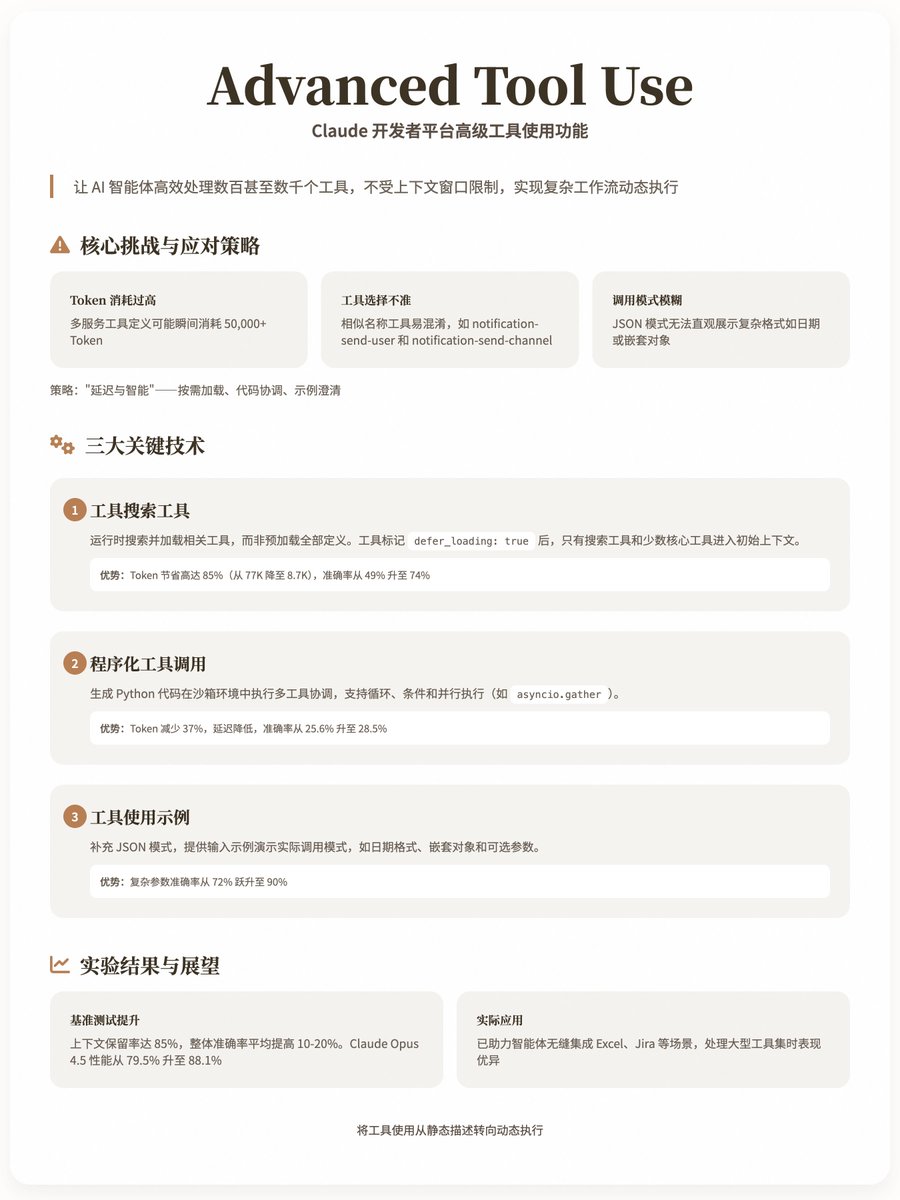
Anthropic announced Claude Opus 4.5 and advanced tool-use features to scale tool invocation, reduce token use and improve agent orchestration.
Key insights
Claude Opus 4.5 targets high‑end coding and agent workloads
Anthropic published Opus 4.5 claiming a SWE‑bench Verified score of 80.9% and improved computer-usage benchmark results. The release emphasized large efficiency gains—token usage down up to 65% in long coding tasks—and a price reduction: $5 per 1M input tokens and $25 per 1M output tokens (1/3 of Opus 4.1 pricing per the report). Opus 4.5 was made available across Anthropic’s Claude product and major cloud platforms.
Advanced tool-use features improve large toolset accuracy and token efficiency
Anthropic introduced advanced tool-use capabilities: a Tool Search Tool for on-demand dynamic loading, Programmatic Tool Calling to emit code for multi-tool orchestration, and Tool Use Examples to clarify parameter formats. Internal benchmarks showed Tool Search reduces token consumption dramatically (e.g., from 77K to 8.7K) and improves tool-selection accuracy, with Opus 4.5 accuracy metrics improving across MCP/GIA benchmarks.
Anthropic frames 'skills' as prompt-driven, pre-authorized behavior modules
Anthropic’s published material described 'skills' as metadata-defined prompt modules (SKILL.md) that inject prioritized system instructions, pre-authorized tool lists and procedural guidance. The skills system enables dynamic discovery, hot-loading and constrained tool permissions without direct code execution, designed to balance capability and safety.
Opus 4.5 marketed for professional knowledge workers and heavy agent flows
Anthropic positioned Opus 4.5 for software engineers, financial analysts, consultants and other knowledge workers requiring long-context agentic workflows. The model supports mixed response modes and memory improvements to serve as a primary orchestrator in multi-agent systems.
Architectural choices focus on safety, memory and mixed inference modes
Opus 4.5 features mixed 'instant+extended' reasoning modes and memory management improvements intended to improve long-context agent tasks and to reduce susceptibility to prompt injection; Anthropic included improved anti-prompt-injection features in their safety claims.
Skills system supports meta-tool creation and hot deploy of new capabilities
Anthropic demonstrated a self-bootstrapping skill-creator skill that guides users through creating new SKILL.md entries, illustrating the platform’s ability to let agents author and install new skills within controlled permissions.