
Anthropic: Claude Opus 4.5 and Advanced Tooling for Agents
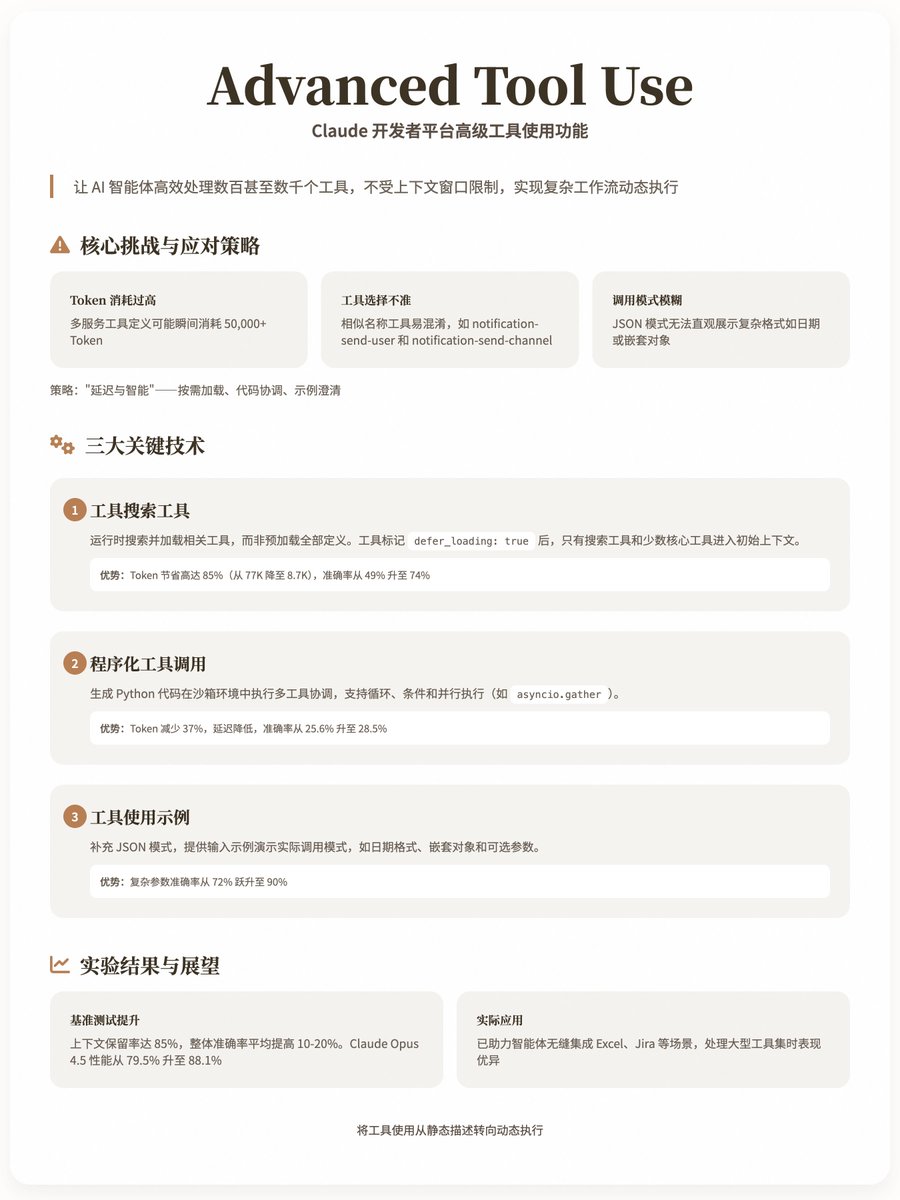
Anthropic announced advanced tool‑use capabilities for agents—Tool Search Tool (deferred, on‑demand tool loading), Programmatic Tool Calling (agent‑generated sandboxed code) and Tool Use Examples—which together reduce context token usage and improve tool selection and parameter accuracy. Internal benchmarks reported token savings (up to ~85% on tool definitions; ~37% via programmatic calling) and accuracy gains. Anthropic also released Opus 4.5 with SWE‑bench Verified 80.9, broad cloud availability, mixed reasoning modes and lower token pricing ($5/$25 per million tokens). Separately, Memori, an open SQL‑native memory engine, was released to provide persistent, queryable LLM memory.
Key insights
Advanced tool use reduces token overhead and improves agent accuracy
Anthropic’s advanced tool‑use features combine a Tool Search Tool for deferred loading, programmatic tool calling via sandboxed code, and illustrative tool use examples. Internally measured benefits include token savings (e.g., 85% reduction for tool definitions), improved tool selection rates (Opus accuracy gains), and higher complex‑parameter accuracy (72% → 90%) when examples are provided.
Opus 4.5 targets coding and agent workflows with improved efficiency
Anthropic released Opus 4.5, reporting a SWE‑bench Verified score of 80.9, OSWorld agent performance metrics, and internal claims of up to 65% token reduction on long tasks. The model supports mixed immediate and extended reasoning, improved memory management, and is cross‑listed on major cloud platforms with a lower price point.
Programmatic tool calling enables multi‑API orchestration
Programmatic Tool Calling allows agents to emit sandboxed Python code that coordinates multiple API calls, conditionals and parallel fetches, returning condensed results to the agent and avoiding incremental multi‑round context growth. This reduces latency and avoids exposing intermediate data in the LLM context.
Memori provides an open SQL‑native memory layer
Memori is an open‑source SQL‑native memory engine that integrates with LLMs via one line of code, storing persistent memories in SQL databases, offering conscious/auto/combined memory modes, and integrating with agent frameworks for long‑term memory extraction and retrieval.
Opus 4.5 pricing and cloud availability lower barriers
Opus 4.5 pricing is reported at $5 per million input tokens and $25 per million output tokens—about one‑third the prior Opus 4.1 pricing—and the model is available across Anthropic’s app, API and major cloud marketplaces.