
Anthropic Implements Global Content Watermarks for Claude
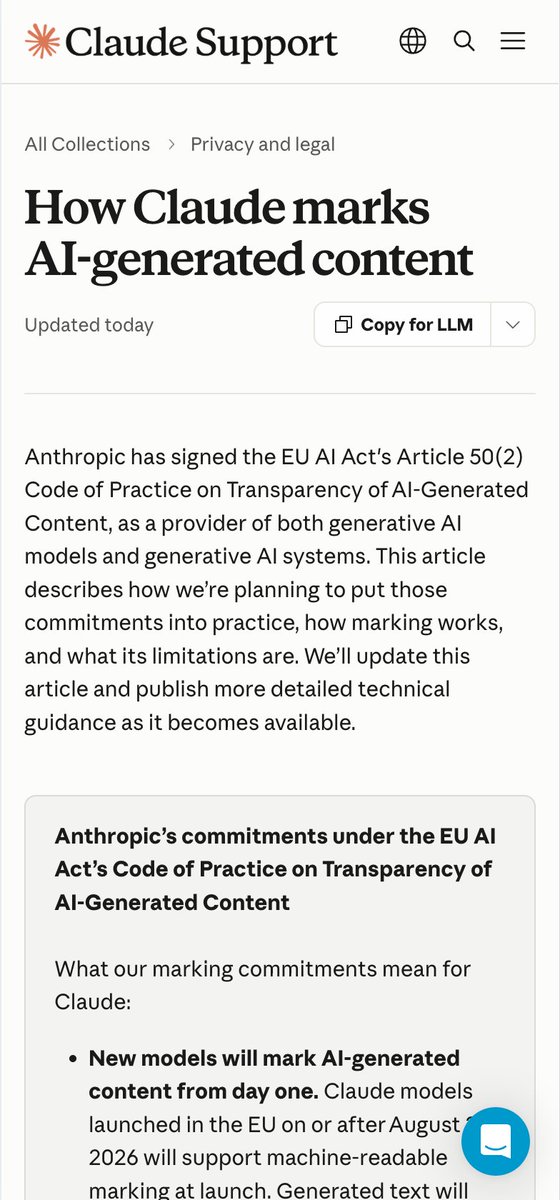
Anthropic began embedding machine-readable markers into all Claude outputs starting August 2, 2026, to comply with the EU AI Act’s transparency requirements. - All new Claude models now include invisible text watermarks that persist through copy-paste and partial editing, plus C2PA-signed metadata on generated files (SVG, PNG, JPG). - The marking applies worldwide across API, claude.ai, Claude Code, Claude Cowork, Claude Tag, and cloud partnerships (AWS, Google Cloud, Microsoft Foundry), though file metadata availability depends on the cloud platform. - Anthropic is the first major AI lab to publicly deploy text watermarks at scale; OpenAI previously developed but did not release similar technology. - Detection indicates content may have passed through Claude, but cannot confirm sole authorship, and heavily edited or very short text may evade detection. File metadata can be lost through format conversion or screenshots. - Pre-existing Claude models will be retrofitted with marking features, with timeline to be announced. Anthropic advises API builders to independently assess EU AI Act compliance.
Key insights
Transparency Compliance Drives Adoption of Content Marking
Anthropic’s move is directly tied to the EU AI Act Article 50. By extending the policy globally and across all Claude surfaces, the company sets a precedent for mandatory AI output tagging, even though detection currently remains probabilistic.
Watermarks Are a Probabilistic, Not Absolute, Solution
The text watermark can survive some editing but vanishes with heavy rewriting; short texts provide unreliable signals. File metadata can be stripped by format conversion. Detection indicates Claude involvement, not original authorship, so the marking does not solve all authenticity problems.
Anthropic Becomes First Major Lab to Deploy Text Watermarks at Scale
While C2PA adoption is growing among image generators (OpenAI, Google), Anthropic is the first to embed watermarks directly into generated text across all products. This gives it a first-mover position in AI content provenance infrastructure.