
Anthropic's Claude Opus 4.5 and advanced tool-use
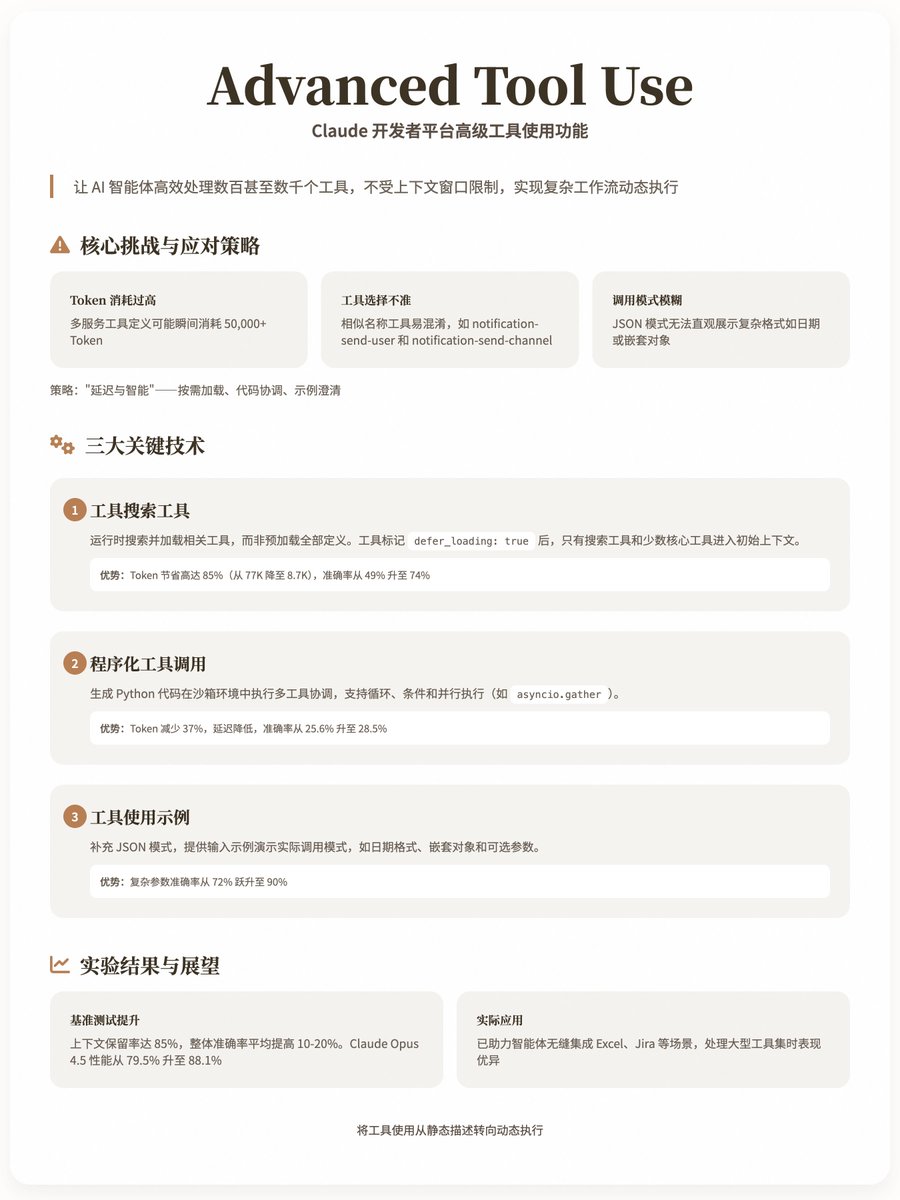
Anthropic announced Claude Opus 4.5 and an Advanced Tool Use suite to improve large-scale tool integration and efficiency. - Opus 4.5 targets coding, agents, and computer-usage tasks with significant efficiency and safety gains. - SWE-bench Verified score: 80.9%, surpassing Gemini 3 Pro (76.2%) and GPT-5.1 Codex variant (77.9%). - Opus 4.5 reduces token usage by up to 65% on long coding runs and cut pricing to $5/1M input tokens and $25/1M output tokens (one-third of Opus 4.1 price). - Opus 4.5 is available via Claude app, API, and major cloud marketplaces with model id claude-opus-4-5-20251101. - Advanced Tool Use adds: Tool Search Tool (deferred loading), Programmatic Tool Calling (code orchestration), and Tool Use Examples (examples to disambiguate inputs). - Tool Search Tool reduced token usage from ~77K to ~8.7K and raised accuracy (Claude Opus 4 baseline 49% → 74%). - Programmatic calls output runnable Python for multi-tool coordination, reducing tokens by 37% and lowering latency. - Tool Use Examples improved complex-parameter accuracy from 72% to 90%. - Claude "skills" architecture provides a prompt-driven meta-tool system that injects SKILL.md files to change model behavior and preauthorize tools without code execution. - Skills discovery process: scan SKILL.md YAML headers, present <available_skills>, and inject skill markdown under meta role when invoked. - Anthropic reports improved long-context and agent reliability with these mechanisms.
Key insights
Claude Opus 4.5 raises coding and agent benchmarks
Anthropic released Opus 4.5 emphasizing coding, agent reliability, and compute efficiency. Internal results report SWE-bench Verified at 80.9%, exceeding Gemini 3 Pro (76.2%) and GPT-5.1-Codex-Max (77.9%). The model reduces token usage up to 65% on long coding tasks and improved computer-use benchmark OSWorld to 66.3%. Anthropic priced Opus 4.5 at $5 per 1M input tokens and $25 per 1M output tokens—one-third of Opus 4.1—while making the model available across Claude app, API, and major cloud providers with identifier claude-opus-4-5-20251101.
Advanced Tool Use reduces context token bloat and increases accuracy
Anthropic detailed an Advanced Tool Use package combining a Tool Search Tool, Programmatic Tool Calling, and Tool Use Examples. Tool Search Tool defers loading of tool definitions and achieved token savings from ~77K to ~8.7K and improved tool-selection accuracy (example: Opus 4 from 49% to 74%). Programmatic Tool Calling emits sandboxed Python to coordinate multiple tools in parallel, cutting token use by 37% and reducing latency. Tool Use Examples raised complex-parameter accuracy from 72% to 90% by providing concrete invocation examples.
Claude skills system uses prompt-injected SKILL.md for safe, dynamic behavior
Claude's 'skills' are prompt-driven meta-tools: SKILL.md folders contain YAML metadata and a Markdown instruction body that, when invoked via the Skill meta-tool, injects high-priority system instructions and pre-authorized tool permissions. Skills change model behavior without granting code execution, enforce least privilege via allowed-tools, and support hot updates. Discovery occurs via an internal Skill meta-tool that lists available skills and injects the selected skill as a meta user message, enabling domain specialization and controlled tool access.
Programmatic tool calling enables multi-tool orchestration and fewer reasoning rounds
Anthropic described Programmatic Tool Calling where Claude emits Python code to orchestrate multiple tool calls (with allowed_callers markers) and parallelizes fetches (e.g., asyncio.gather). This approach reduces multi-round reasoning, lowers token consumption (example reduction from 43,588 to 27,297 tokens), and improves end-to-end task accuracy by avoiding intermediate context pollution.
Tool design patterns target large tool sets and enterprise integration
Anthropic's combination of deferred tool loading, code orchestration, and examples targets scenarios with hundreds to thousands of tools (IDE, Git, Slack, Jira, DBs). The approach addresses three enterprise pain points: token bloat from preloading tool definitions, ambiguous tool selection among similarly named APIs, and difficulty expressing complex parameter formats in JSON-only schemas. Reported MCP/GIA benchmark improvements indicate better context retention and practical utility in multi-tool workflows.