
Armin's 2025 AI coding agents review & open-source agent resources
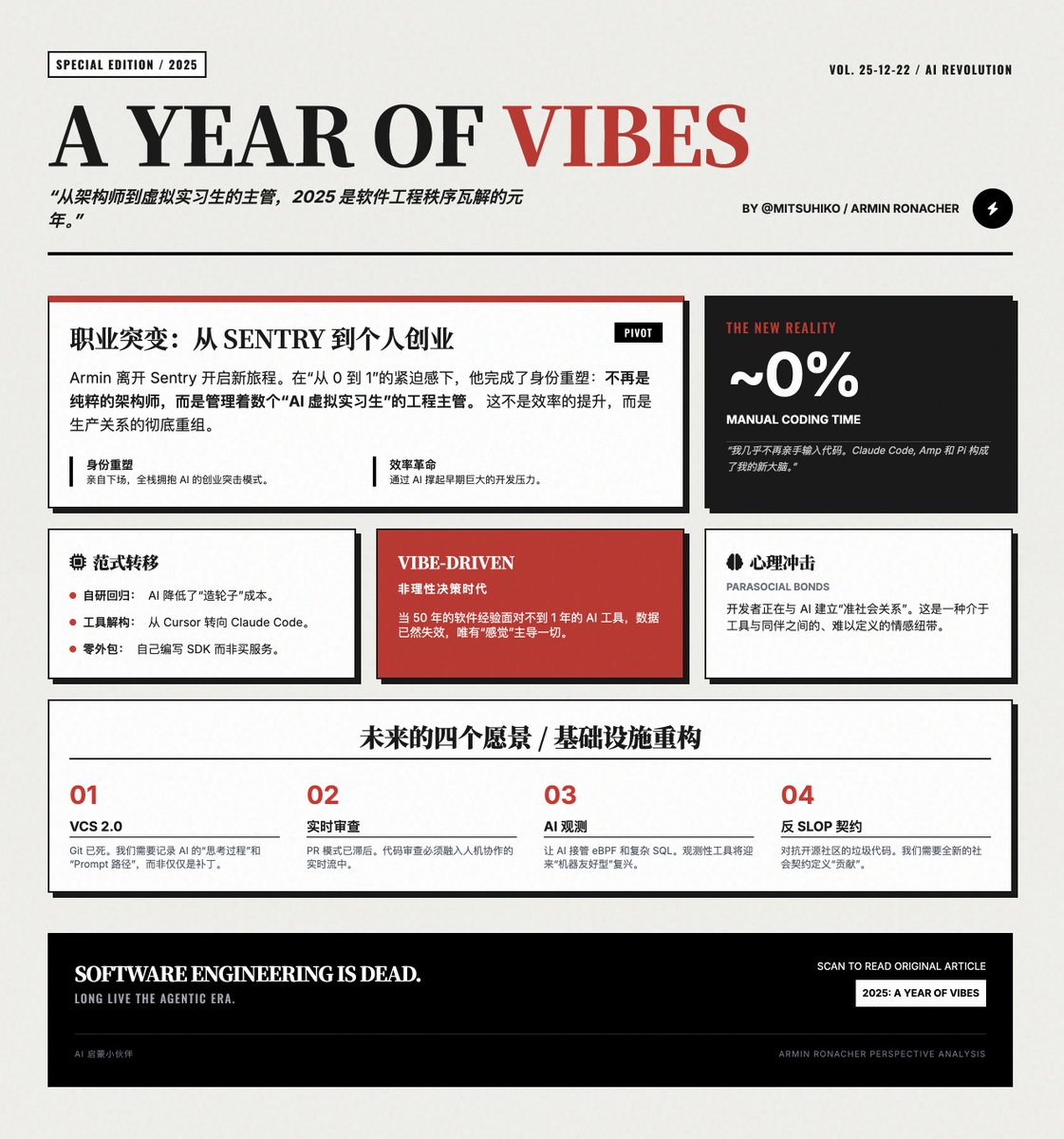
Armin reviewed 2025 as a turning point for AI coding agents. - Armin left Sentry and founded a new company. - He reframed his role as an engineering lead coordinating 'virtual interns'. - He reported rarely typing code manually anymore. - He migrated toolchains from Cursor to Claude Code, using Amp and Pi. - He built an AI-generated Python and TypeScript SDK generator. - He prefers building internal solutions over outsourcing. - He described forming quasi-social relationships with AI tools. - He rejected the term 'agent' for responsibility reasons. - He identified four infrastructure gaps: version control, code review, observability, and community norms. - Open-source resources highlighted: Agent Skills for Context Engineering. - Open-source project Auto‑Claude provides autonomous multi-session coding. - Anthropic's 'Skills' repo offers production examples and best practices.
Key insights
Armin's career shift drove full embrace of AI agents
Armin left Sentry in 2025 and founded a new company, describing the year as a major career transition. He shifted from a stable enterprise architect role to hands-on founder responsibilities, adopting AI agents extensively to meet early-stage development demands. He reframed his role as an engineering lead to coordinate 'virtual interns' rather than writing most code personally. These changes are presented as central to how he sustained initial product development workload and speed.
Coding paradigm moved from manual coding to tool combinations
Armin reported that he rarely types code manually anymore and described a toolchain evolution: he migrated from Cursor to Claude Code and combined Amp and Pi for development workflows. He preferred building internal solutions over outsourcing, citing an example where he used AI to create a Python and TypeScript SDK generator instead of buying commercial tooling. The narrative emphasizes reliance on assembled AI tools and custom generators to perform coding tasks.
AI agents induced quasi-social relationships and emotional responses
Armin described experiencing a 'quasi-social' relationship with AI tools, noting emotional projection onto models despite understanding they are probabilistic systems. He expressed discomfort with the term 'agent' because it obscures responsibility boundaries, while also acknowledging difficulty finding a better descriptor for tools that behave between assistant and collaborator.
Existing engineering infrastructure lags AI agent workflows
Armin identified four infrastructure gaps: (1) Git cannot record AI 'thought processes' or prompt histories, (2) pull request and code review models are designed for humans and miss invisible AI iterations, (3) observability tools need to allow AI to perform deep system analysis like SQL and eBPF, and (4) open-source ecosystems contain unvetted AI-generated code requiring new contribution norms. He proposed the need for new versioning and review paradigms.
Open-source Agent Skills and Auto-Claude resources published
Several open-source Agent Skills projects and resources were highlighted: an 'Agent Skills for Context Engineering' collection focused on context engineering principles, Auto‑Claude—a Claude Code based autonomous multi-session coding agent that can plan, write, test, and validate code while protecting the main branch—and Anthropic's official 'Skills' repository showcasing production examples and best practices. These projects aim to provide model-agnostic skill sets and operational patterns for production-grade agents.