
Base Labs Finds SFT Before RL Helps Small Qwen Models but Not Larger Ones
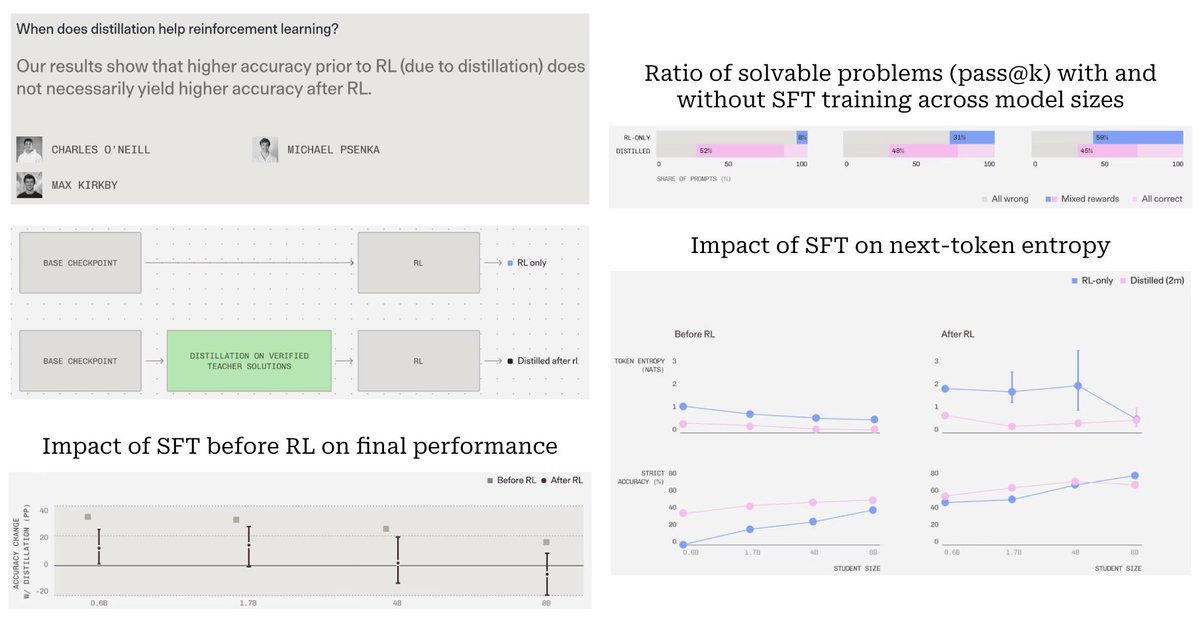
Base Labs trained 0.6B, 1.7B, 4B, and 8B Qwen models with either SFT plus RL or RL alone, using GPT-5.6-Sol-generated reasoning traces and 16 synthetic Reasoning Gym tasks. SFT improved pre-RL accuracy at all model sizes, but only 0.6B and 1.7B models benefited after RL, while 4B and 8B models saw little or no gain because SFT reduced next-token entropy and limited exploration. Scaling SFT data from 0.5M to 4M tokens did not change these trends.
Event version 1.
Key insights
SFT boosts pre-RL accuracy at all sizes
SFT improved base model accuracy before RL across all tested model sizes. However, improved pre-RL accuracy did not always translate into better performance after RL.
Small models benefit from SFT plus RL
The 0.6B and 1.7B models performed better with SFT plus RL. Smaller models struggle to solve many problems, and SFT teaches them to produce some correct solutions so RL can make progress.
Larger models gain little from SFT
The 4B and 8B models saw little or no benefit from SFT before RL. These models are often already capable of finding correct solutions when sampling multiple completions, and SFT measurably reduces next-token entropy, limiting exploration.
Scaling SFT data shows inconsistent impact
Varying SFT data amounts at 0.5M, 1M, 2M, and 4M tokens did not change the observed trends. The impact of scaling SFT is inconsistent across model sizes.
SFT should be run only when necessary
RL requires the model to produce a mixture of correct and incorrect responses to each prompt for GRPO to provide a useful learning signal. SFT reduces next-token entropy and can limit exploration, so larger models that already solve enough problems may achieve better final performance with RL alone.