
Claude Code and Agent-Based Coding Practices
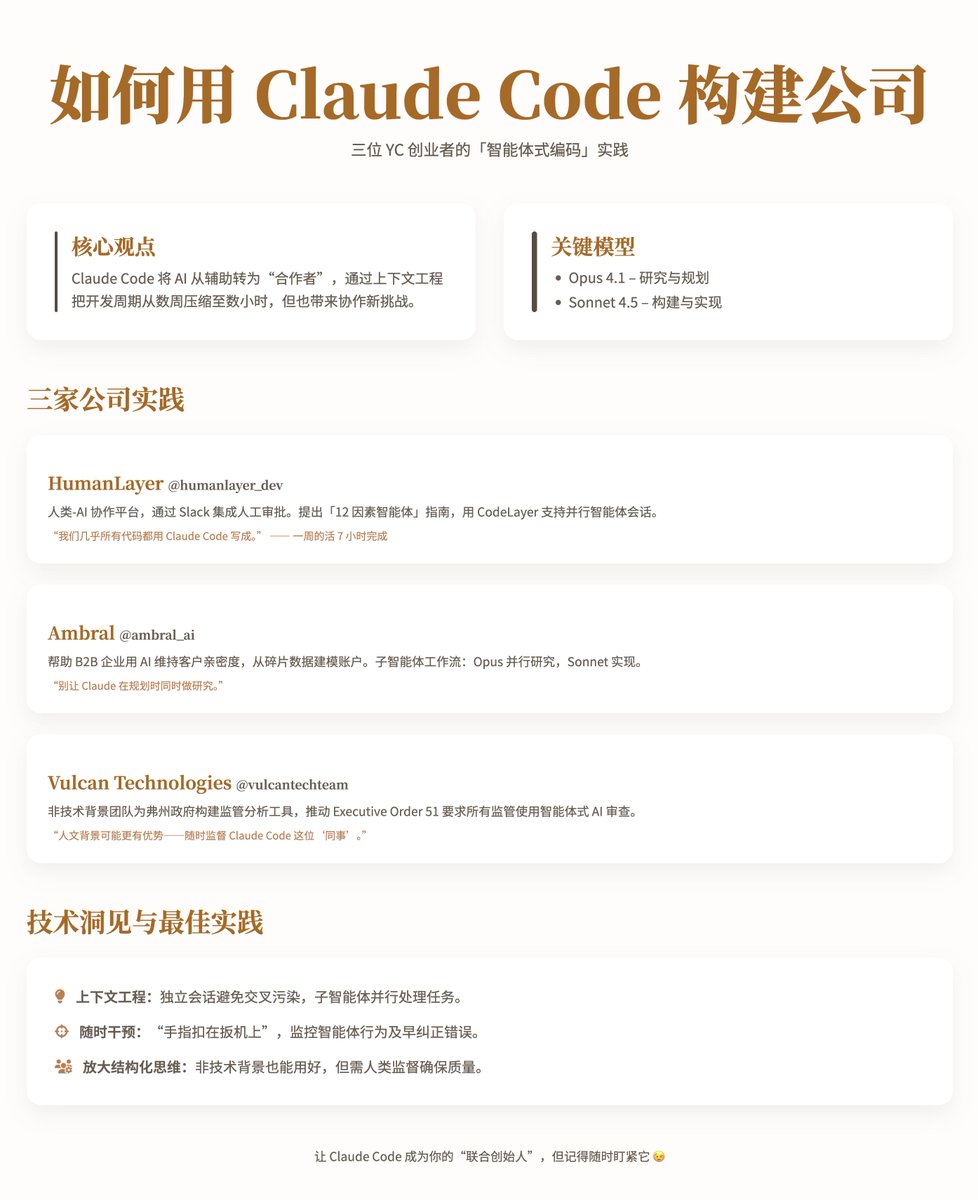
Claude Code has been utilized as a core tool for agent-based coding in several YC startups, significantly accelerating development processes and introducing principles of context engineering and supervision.
Key insights
The Accelerating Role of Claude Code in Startups
The official Claude blog highlights the case of three YC startups, demonstrating how Claude Code and agent-based coding have reduced the cycle from concept to code submission from weeks to hours or days. HumanLayer, Ambral, and Vulcan have all utilized Claude Code to build core functionalities, with HumanLayer stating that 'almost all code is written using Claude Code,' compressing a week's work into a few hours. Vulcan built a regulatory analysis tool using this method and secured significant contracts, while Ambral managed different data streams through a parallel sub-agent architecture.
Key Points of Context Engineering and Sub-Agent Practices
The blog emphasizes the importance of 'context engineering,' recommending the use of independent sessions to avoid context pollution, phased sessions to prevent confusion between planning and research, and the use of sub-agents to handle tasks in parallel (e.g., Opus 4.1 for research, Sonnet 4.5 for implementation). Founders stress the need for strict monitoring of agent behavior and the ability to interrupt abnormal operations at any time, noting that agents can shift AI from a supportive role to a collaborator, but human supervision is essential to ensure quality.
Differences in Practical Implementation Among Three Companies
HumanLayer initially developed an SQL agent but transitioned to a human-AI collaboration platform and released the '12 Factors of Agents' guide. Ambral applied Claude Code to create a parallel sub-agent workflow for managing B2B customer data with a single engineer. Vulcan transitioned from an early Claude prototype to Claude Code, building a regulatory analysis tool and securing government contracts and funding. All three companies regard Claude Code as a 'colleague,' but emphasize the need for continuous supervision to prevent errors.
Risks and Organizational Challenges in Practice
The article points out challenges in agent-based coding, including context pollution, abnormal agent behavior, and collaboration and organizational issues arising from increased productivity. Founders suggest phased management of agents, utilizing tool-based session isolation and sub-agent division of labor to mitigate risks, emphasizing that humans must maintain control over key decisions and reviews.