
Claude Code and Claude Opus 4.5 Ecosystem and Plugins
Key Event: Multiple reports focus on the performance and practical points of Claude Opus 4.5 within the engineering framework and plugin ecosystem. · Amp quickly reverted the main model from Gemini 3 back to Claude Opus 4.5. · Opus 4.5 is comparable to Gemini 3 in capabilities but is more stable, faster in response, and has lower actual costs. · Metrics comparison: Accuracy Opus 4.5 57.3% / Gemini 3 53.7% / Sonnet 4.5 37.1%. · Average thread cost: Opus 4.5 $2.05; Gemini 3 $2.04; Sonnet 4.5 $2.75. · Cost of loss control: Opus 4.5 2.4%; Gemini 3 17.8%; Sonnet 4.5 8.4%. · Opus 4.5 shows significant cost advantages for long conversations (over 200,000 tokens) and complex ambiguous tasks. · The Claude Code framework provides browser control, configuration management, sub-agent collaboration, automation execution, and Agent SDK. · The Claude Code Marketplace includes 48 command plugins, which can be installed and managed via terminal like apt/brew. · The Compounding Engineering Plugin proposes a Plan-Work-Review process, utilizing isolated worktrees and over 10 review Agents (such as security-sentinel and performance-oracle). · User feedback and practice: Peleg emphasizes the importance of model capabilities but notes that the framework determines productivity, pointing out bugs like RAM overflow during high-load multi-agent scenarios. · Relevant code/projects provide GitHub links and community-driven extension channels.
Key insights
Amp Quickly Reverted Main Model from Gemini 3 to Claude Opus 4.5
Amp initially switched the main model from Claude to Gemini 3 within a week, but quickly reverted back to Claude Opus 4.5. The reasons include that Opus 4.5 is comparable to Gemini 3 in capabilities but is more stable, faster in response, and has lower actual usage costs. Comparative data shows that Opus 4.5 has an average thread cost of about $2.05, an accuracy of 57.3%, and a loss control cost of only 2.4%. These metrics reduce manual intervention and token waste in real production environments, especially demonstrating cost advantages in long conversations and complex ambiguous tasks.
Opus 4.5's Advantages in Stability and Real Costs
Specific comparisons show that Opus 4.5 has an accuracy of 57.3%, higher than Gemini 3's 53.7%. The average thread cost is similar to Gemini 3 ($2.05 vs $2.04), but Opus's loss control cost is 2.4%, significantly lower than Gemini 3's 17.8% and Sonnet 4.5's 8.4%. In terms of speed, Opus 4.5 takes an average of 3.5 minutes, better than Gemini 3's 4.3 minutes, but slower than Sonnet 4.5's 2.4 minutes. The report indicates that these differences give Opus a cost and latency advantage in actual deployments.
Claude Code Framework Seen as a Productivity Multiplier
Claude Code provides browser control, profile management, parallel collaboration of sub-agents, automation execution, and Agent SDK, allowing a single model (like Opus 4.5) to operate as a 'full computer using agent.' Users report that the framework supports background 'send and forget' tasks, parallel processing by multiple sub-agents, and high customization. Even when using weaker models in early stages, the framework has proven indispensable. Therefore, the capabilities at the framework level are key to engineering deployment and daily workflows.
Claude Code Marketplace Gathers Third-Party Command Plugins
The open-source community-driven Claude Code Marketplace has included 48 command plugins, covering over ten categories such as code analysis, refactoring, security auditing, performance optimization, and automated testing. Plugins can be installed and managed with a single terminal command, providing an experience similar to apt or brew, including practical commands like Lyra (prompt optimization), Ultrathink (multi-agent collaboration), and automatic updates of critical files. The project continues to collect and support community submissions for plugins.
Compounding Engineering Plugin Proposes Plan-Work-Review Engineering Process
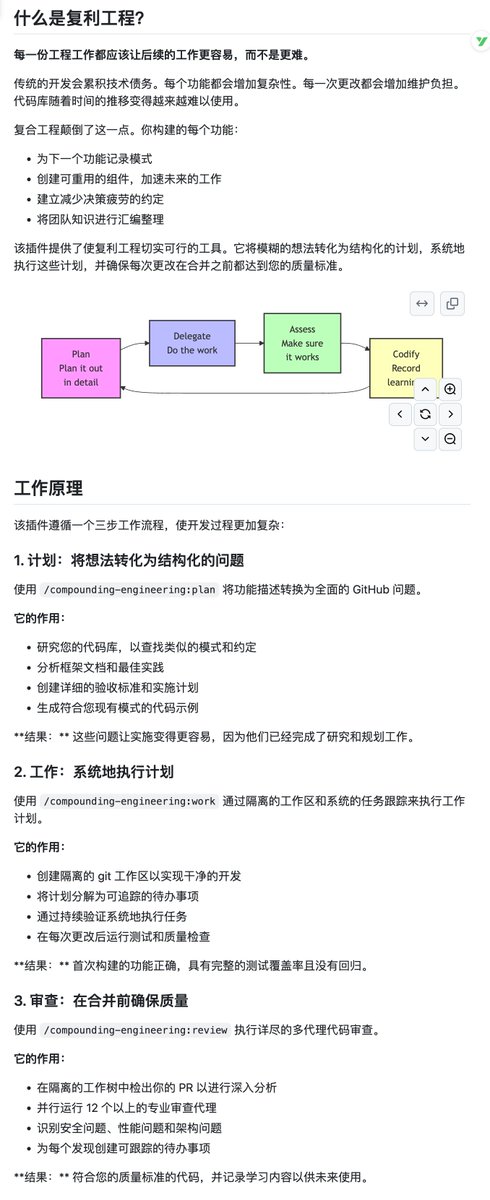
The Compounding Engineering Plugin defines a Plan-Work-Review workflow for AI-assisted coding: The Plan phase involves in-depth analysis of the codebase and generating detailed issues; the Work phase executes development in an isolated worktree; the Review phase involves parallel code reviews by over ten dedicated Agents, including built-in Agents like security-sentinel and performance-oracle, aiming to ensure AI compliance with engineering standards, reduce technical debt, and achieve self-review.
Practitioner Feedback: Excellent Model but Framework and Resource Issues Persist
Practitioner Yam Peleg stated that Opus 4.5 performs well in most coding and agent tasks, but its value is amplified by the Claude Code framework. Peleg pointed out the framework's advantages, including sub-agent collaboration and automation execution, but also reported that high loads from multiple sub-agents could exhaust 256GB of memory, leading to crashes. Peleg's workflow emphasizes manual completion of high-difficulty tasks, delegation of medium and low-difficulty tasks to agents with strict supervision, highlighting the practical operational considerations of 'framework + model' collaboration.