
Claude Code and the coding-agent ecosystem
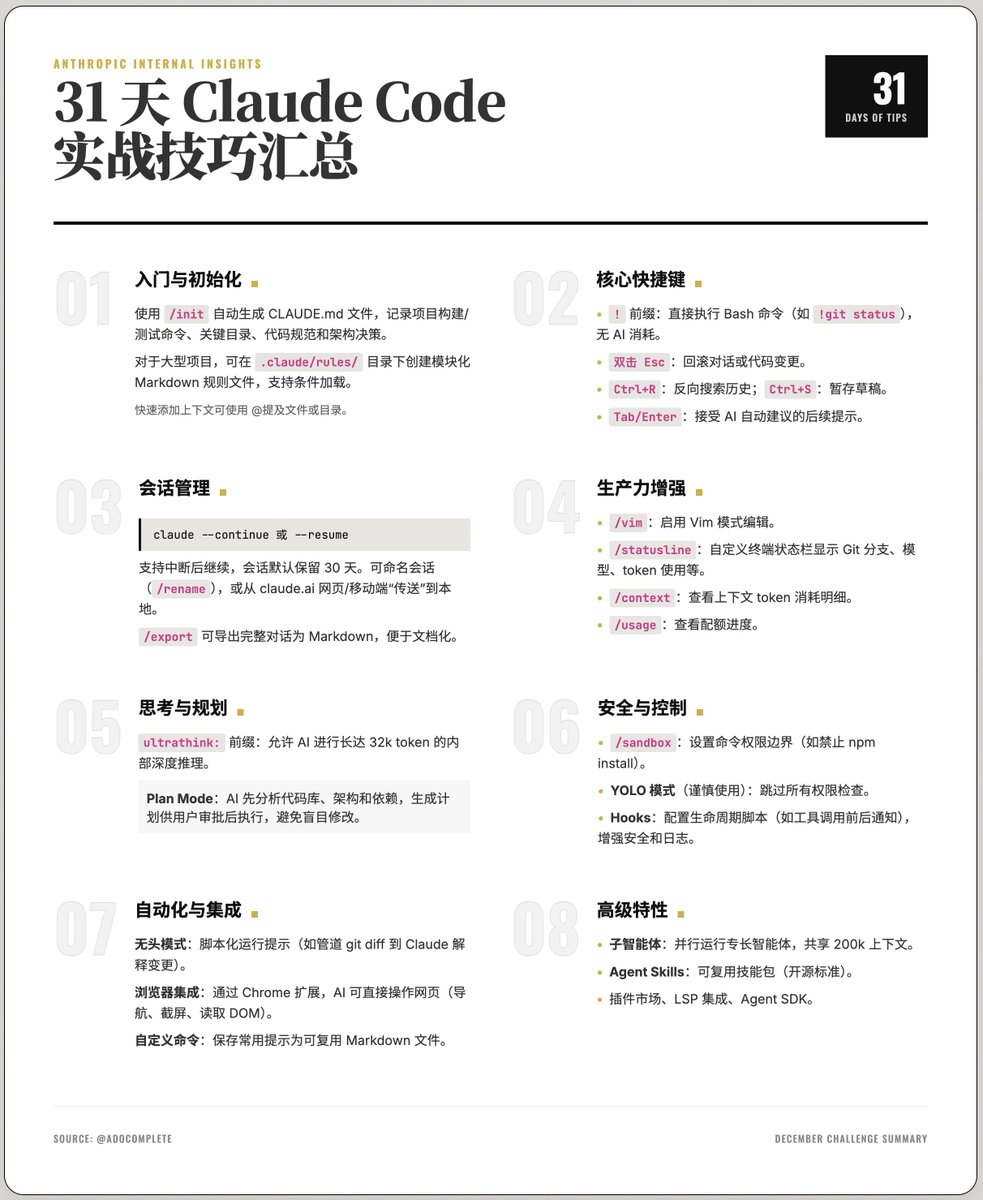
Claude Code ecosystem continues to grow with daily-practice guides, spec-driven Sub-Agent validation, Obsidian-specific Skills, a model-routing proxy, VS Code/desktop integrations, and community open-source tooling for coding agents.
Key insights
Claude Code productivity features and ergonomics
A 31-day practical guide collected Claude Code tips: /init to generate CLAUDE.md project docs; modular rule files in .claude/rules/; command shortcuts (! for direct Bash execution); session controls (resume, rename, export); productivity modes (/vim, /statusline); context and usage introspection commands (/context, /stats, /usage); ultrathink for extended internal reasoning up to 32k tokens; Plan Mode for reviewable plans; sandboxing and hooks for lifecycle control; and CLI/automation features including headless mode and browser integrations.
Spec-driven development and Sub-Agent verification for higher-quality features
Developers propose a spec-driven workflow: Claude Code begins with iterative AskUserQuestionTool prompts to refine specifications, writes specs to files, then launches Sub-Agents to automatically verify implementations against those specs. The Sub-Agent approach enables independent validation, feedback loops and auto-fixes where deviations exist, lowering manual verification burden. Community discussion notes merging with feature-dev plugins and adding static-analysis integration for cross-checks.
Ecosystem extensions: Obsidian Skills and Claude Code Router
Open-source tooling was released: obsidian-skills provides Claude with syntax and semantics for Obsidian-enhanced Markdown, Bases, and JSON Canvas formats; Claude Code Router is a local proxy that routes Claude Code requests to alternative model providers (DeepSeek, Ollama, Gemini, Groq, etc.) for cost and performance optimization while preserving Claude Code UX, with transformers, dynamic routing rules, CLI/UI management, and CI/CD integration.
Open-source plugins and alternative CLIs target model-agnostic coding agents
Community projects include OpenCode Debug Plugin for runtime instrumentation and analysis, OpenCode as a model-agnostic coding agent, and notes that existing CLIs (Codex CLI, Gemini CLI, Kimi CLI) are often model-tied. Commenters observe OpenCode fills demand for open, model-independent agent tooling while many users still use official CLIs when subscribed.
Integrations: VS Code and desktop clients widen developer access
Claude Code integrations include a VS Code plugin (allowing mixed-model usage) and Claude Desktop which exposes a Code sidebar to grant folder access for local Claude Code usage. Community tips show combining Claude Code with other models in IDEs for hybrid workflows.