
Claude Code ecosystem and tooling
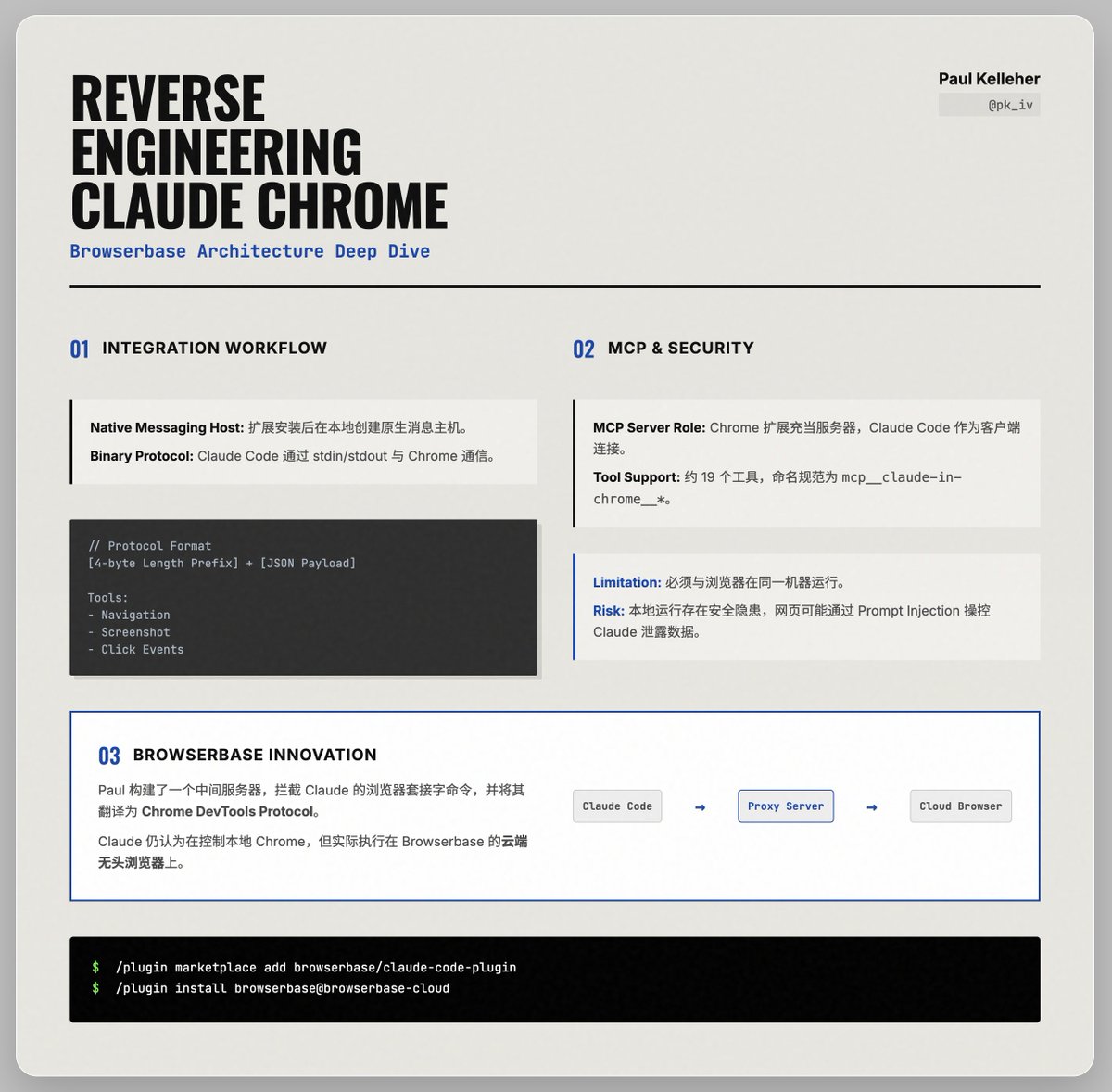
Claude Code ecosystem technical and product developments summarized. - Claude Chrome uses a native message host on the local machine. - Claude Code launches with specific params and communicates via stdin/stdout. - Browser protocol: 4-byte length prefix + JSON payload for tool calls. - Chrome extension acts as an MCP server; Claude Code is the client. - Extension exposes ~19 browser tools named mcp__claude-in-chrome__*. - Native host design restricts control to local Chrome only for security. - Security risk: webpages could prompt to inject commands and leak data. - Browserbase built a proxy server translating Claude socket commands to CDP. - Browserbase enables remote headless cloud browser automation while Claude believes it's local. - Claude Code began as an amateur project by its creator in Sept 2024. - Claude Code evolved from unreliable short tasks to long-running multi-hour agents. - Claude Code uses Claude Sonnet 4.5 and Opus 4.5 models in production. - Claude Code reportedly contributes over $1B ARR to Anthropic. - Stop hooks let sessions be intercepted when Claude attempts to stop. - Stop hook uses include re-injecting prompts and running tests to continue work. - ralph-wiggum plugin uses stop hooks to create self-referential iteration loops. - Claude Code offers a visual workflow editor supporting drag-and-drop flow design. - Claude Code skills provide versioning, small context footprint, fast loading, and built-in storage. - Many users remain in novice modes despite advanced features.
Key insights
Claude Chrome uses a local native message host with MCP protocol
Claude Chrome installs a native message host on the user's machine and communicates with Claude Code via stdin/stdout using a binary protocol consisting of a 4-byte length prefix followed by a JSON payload. The Chrome extension functions as an MCP server exposing roughly 19 browser tools with names following the mcp__claude-in-chrome__* convention. This design enforces that the native host run on the same machine as Chrome to limit remote execution risk.
Browserbase proxies Claude commands to cloud headless browsers
Browserbase implemented a middle server that intercepts Claude's browser socket commands and translates them into Chrome DevTools Protocol, enabling Claude to control cloud headless browsers while still believing it controls a local Chrome. This approach provides remote automation and avoids local security hazards tied to native host exposure.
Claude Code grew from an amateur project into a high-revenue agent
Claude Code began as a personal side project by its creator in September 2024 and evolved into a leading AI coding agent. Reports indicate Claude Code reached multi-month continuous-run stability using Claude Sonnet 4.5 and Opus 4.5, and contributed over $1 billion in ARR to Anthropic. Early instability (e.g., Bash errors) was replaced by robust, long-running agent behaviors.
Stop hooks extend Claude Code sessions for long-running workflows
Claude Code's stop hooks trigger when Claude attempts to finish a response; hooks can intercept the stop, run custom scripts, re-inject prompts, run test suites, and decide whether to allow stopping. The ralph-wiggum plugin demonstrates using stop hooks to block exits and re-feed prompts, creating iterative optimization loops until a completion signal or max iterations is reached.
Workflow and skill model design prioritize iteration and portability
Claude Code provides a visual workflow editor for drag-and-drop automation, supports skill-versioning, small context footprint, fast loading, editable skills, and built-in data storage. These features position Claude Code as an iterative prompt system and an AI-native workflow platform for document summarization, code analysis and repair, and web scraping pipelines.