
Claude Code Startup Practices and Case Study
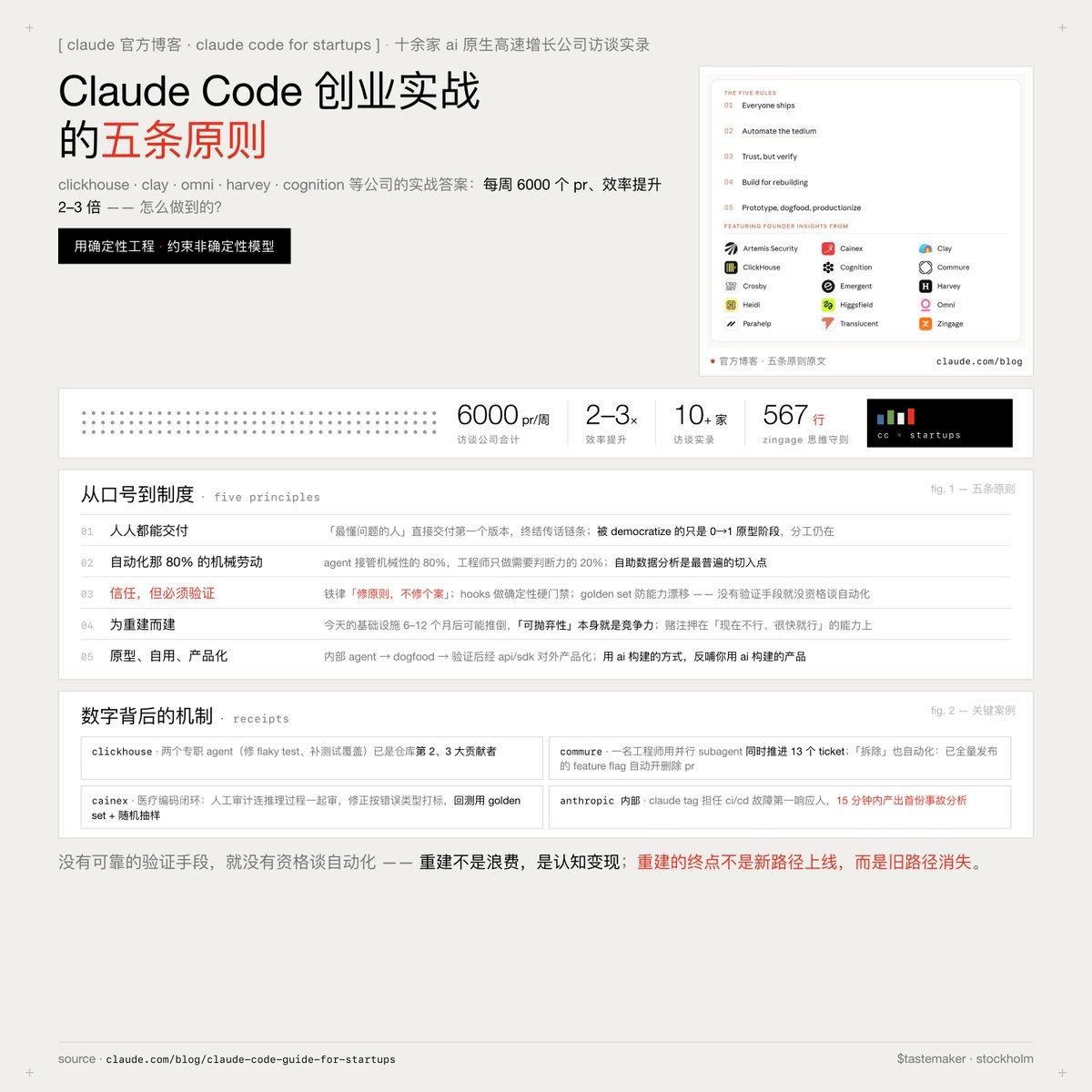
Interviews with over ten AI-native startups reveal five principles for using Claude Code, alongside Warp's self-improving agent design. • Principle 1 (Everyone can deliver): Agentic coding lets the person who knows the problem best deliver the first version, eliminating the broken telephone problem (Heidi CEO). MCP/CLI connects Claude to team tools. Clay sets quarterly prototype reviews; Omni has a dedicated Slack channel. CLAUDE.md and Skills share best practices. • Principle 2 (Automate 80% mechanical work): ClickHouse's autonomous SDLC loops made two dedicated agents (fixing flaky tests, adding coverage) the 2nd and 3rd largest repo contributors. Commure used parallel subagents for 13 tickets. Business uses include self-service analytics, legal document summarization, claims scanning, hospital alerts. Anthropic uses Claude Tag as CI/CD first responder with 15-minute incident analysis. • Principle 3 (Trust, but verify): Cainex medical coding audit loop: agent processes, human auditors review including model reasoning, errors tagged by type, Claude revises the instruction clause that caused the error. Iron rule: fix the principle, not the example. Backtesting with golden set + random sampling, semantic matching + LLM judge. Hooks enforce deterministic hard gates (lint, test, strip secrets). Zingage learned by writing 567 lines of team thinking guidelines as invariants after early autonomy caused architecture drift. • Principle 4 (Build to rebuild): Clay builds the same thing four times to get it right. Commure auto-deletes released feature flags via a skill. Harvey says each wave of model capability forces platform overhaul. Cognition states today's builds will be abandoned within a year. Git worktrees allow parallel v1/v2. • Principle 5 (Prototype, dogfood, productize): Build internal agents with Claude Code → dogfood → productize via Claude API/SDK. ClickHouse's SQL console agent and AI SRE are examples. Omni borrowed Anthropic's file-based approach to avoid RAG complexity. • Warp's self-improving agent: One-shot prompts leave 20% error noise. Warp uses a dual-loop: an inner Base Skill executes tasks, an outer Improver Skill periodically aggregates human feedback, proposes small changes to the inner Skill, and goes through standard PR review for merging.
Key insights
Agentic coding democratizes prototype creation without eliminating specialization
The first principle states that agentic coding lowers the barrier so that the person who knows the problem best can deliver the first version directly, bypassing the chain of requirement → PM → design → engineer. Heidi's CEO called this the end of the 'broken telephone problem.' However, this does not eliminate the division of labor; marketing still does marketing, engineering still does engineering. Only the 0→1 prototype phase is democratized. Implementation mechanisms include connecting Claude to team tools via MCP/CLI, setting up showcase channels like Clay's quarterly prototype reviews and Omni's dedicated Slack channel, and sharing coding standards through CLAUDE.md and Skills.
Automating the mechanical 80% of development is already practiced at scale
The second principle reveals that AI agents can take over the mechanical 80% of the development lifecycle, leaving engineers to handle the 20% requiring judgment. ClickHouse's autonomous SDLC loops have made two dedicated agents the second and third largest contributors to the repository. Commure enabled one engineer to advance 13 tickets simultaneously using parallel subagents. Business processes are also automated: self-service data analysis, legal document summarization, claims anomaly scanning, and hospital financial alerts. Anthropic's internal use of Claude Tag as the first responder for CI/CD incidents, delivering a first analysis within 15 minutes, serves as a credibility endorsement.
Verification infrastructure is the prerequisite for safe AI automation
The third principle emphasizes that trust must be verified. The Cainex medical coding case demonstrates a rigorous audit loop: agent batch processing, human auditor review including model reasoning, error tagging by type, and Claude revising the instruction clause that caused the error. The iron rule is 'fix the principle, not the example' to prevent overfitting. Backtesting uses golden sets and random sampling with semantic matching and an LLM judge to distinguish true errors from alternative reasonable paths. Engineering measures include immutable architecture red lines in CLAUDE.md, Hooks for deterministic hard gates (lint, test, key stripping), and regular golden set updates. Zingage's early experience of giving Claude full autonomy led to code that looked correct but deviated from architecture, resulting in a 567-line team guidelines document.
Disposability and constant rebuilding are necessary due to model capability leaps
The fourth principle states that today's infrastructure may be obsolete in 6–12 months, so 'disposability' is competitiveness. Clay builds the same thing four times, treating rebuilding as monetization of cognitive learning. Commure automates the removal of fully released feature flags via a dedicated skill, emphasizing that the end of rebuilding is the old path disappearing. Harvey admits that each wave of model reasoning, agent automation, and planning/orchestration forces a complete platform overhaul. Cognition is more blunt: what is built today will likely be abandoned within a year, so bets should be placed on capabilities that 'don't work now but will soon.' Git worktrees enable parallel v1/v2 execution and evaluation before merging.
Internal dogfooding to productize AI tools creates a learning flywheel
The fifth principle describes a flywheel: use Claude Code to build internal agents, dogfood them internally, and then productize them externally via the Claude API/SDK. ClickHouse's SQL console agent and AI SRE were built this way. An additional benefit is that the team stays at the forefront of model capability and harness design understanding. Omni borrowed Anthropic's file-based approach to avoid the complexity of RAG, and Emergent can quickly distinguish whether product issues stem from model behavior or harness defects.
Self-improving agent loops reduce error noise from one-shot prompts
Warp's approach addresses the problem that one-shot prompts can only complete 80% of a task, leaving persistent 20% error noise. They implemented a minimal dual-loop: an inner loop 'Base Skill' executes the task, and an outer loop 'Improver Skill' periodically aggregates human feedback, proposes small modifications to the inner Skill, and submits them through a standard PR process for human review and merging.