
Claude Opus 5.5 Launch and Usage Guidance
Anthropic released Claude Opus 5.5, matching Fable 5.1 on most work tasks at 40% lower cost per task. It costs $4 and $20 per million input and output tokens, cache reads fell 60% to $0.2, and output speed rose over 30%. It is live on Claude apps, AWS, Google Cloud and Azure.
Key insights
Terminal-Bench 4.0 Parity With GPT-6 Astra at Roughly 40 Percent of the Cost
Anthropic's own comparisons position Opus 5.5 as matching OpenAI's GPT-6 Astra on Terminal-Bench 4.0, a multi-step command-line benchmark, at roughly 40 percent of the cost. The company states that at this capability level, benchmark score gaps no longer reflect differences in practical use. On a research-style test requiring the model to write a company quarterly earnings report using only web retrieval, with any fabricated number or quote counting as failure, Opus 5.5 passed 16 of 18 reports, while Fable 5.1 and Opus 5 passed none.
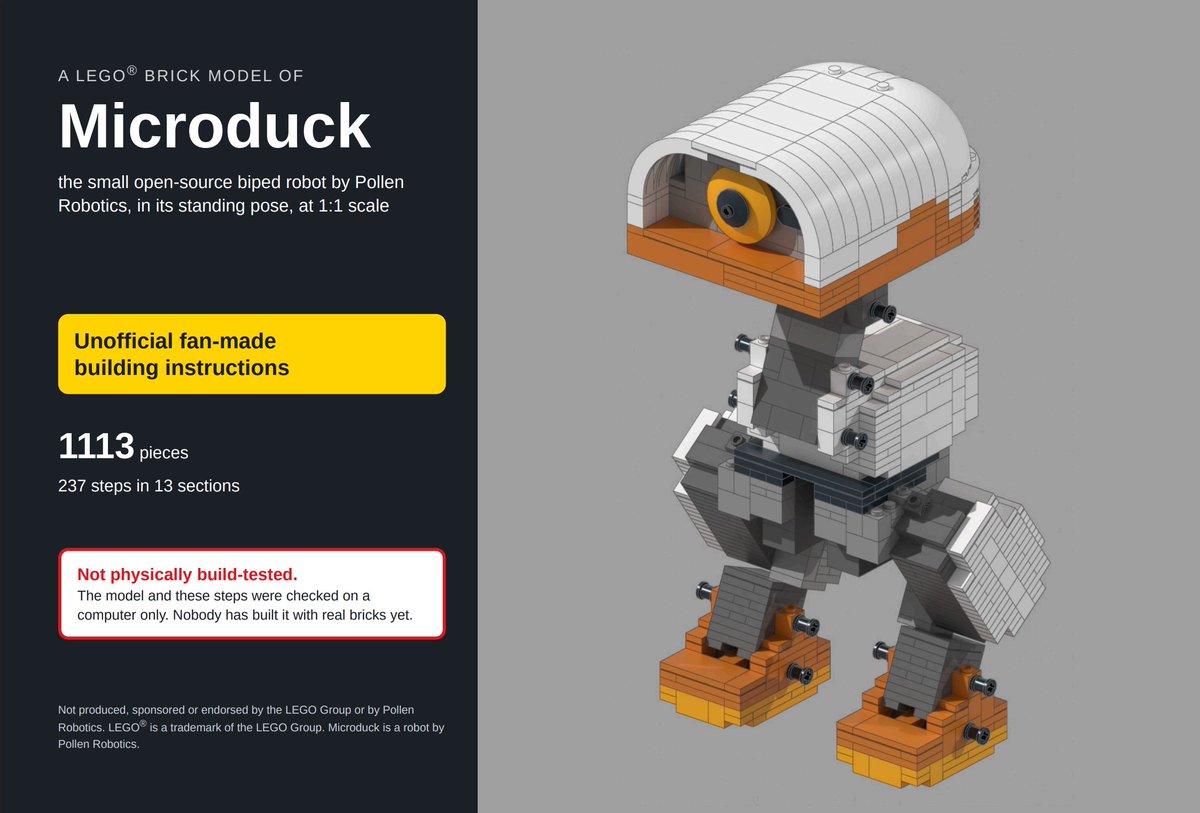
LEGO Microduck Build Demonstrates Physical Design Capability
A HuggingFace team member had Claude Opus 5.5 design a Microduck, the team's sold-out duck robot, buildable from real LEGO bricks. The model produced a design using 1,113 real LEGO parts in six colors at 1:1 scale, with all 3,204 part connections matched in 3D, zero collisions, each step's new part insertable along the assembly direction without passing through existing parts, and an estimated center of mass inside the two-foot support range. Deliverables included a 141-page, 237-step, 13-chapter official-style building manual, LDraw model files, a CSV parts list, a BrickLink wanted-list XML, and per-piece price checks in a browser with an order prepared.
Internal Tests Show Large Gains Over Opus 5 in Coding and Agentic Tasks
An early tester used Opus 5.5 to audit and fix a 200,000-line codebase in under 3 hours; Opus 5 took over 20 hours for the same work and consumed 2.5 times the tokens. Anthropic internally had Opus 5.5 and Fable 5.1 rewrite the load-balancing software HAProxy from C to Rust: both nearly passed all regression tests, with Opus 5.5 finishing in 9.5 hours versus 12 hours and costing 51 percent less.
Cyber and Bio Restrictions Ship Alongside the New Model
Opus 5.5's cybersecurity and biology capabilities approach Mythos 5.1 levels, so it inherits Fable 5.1's safeguards: fixing vulnerabilities in its own code is allowed, but most cybersecurity tasks are automatically routed to the older Opus 4.8, and biology research work is restricted, with universities and pharmaceutical companies able to apply to the Life Sciences Verification Program for lifting limits. Two developer-facing changes: thinking mode can no longer be disabled, and API accounts registered after August 31 cannot extract the model's reasoning by modifying historical context, an anti-distillation measure. Anthropic advises existing integrations to check official documentation.
Anthropic Issues 11 Prompting and Harness Adjustments for Opus 5.5
Anthropic published 11 adjustment directions specific to Opus 5.5. Key points: effort is the primary control knob and tiers are not comparable across models, with 5.5's medium at or above Opus 5's high; max_tokens must be generous, with 128k recommended for agentic coding; harnesses must treat pure-text end_turn progress reports as reports only, using checklists and re-prompting to prevent false completion; progress updates live in thinking blocks, so clients should set display to updates or add a messaging tool; one line of elapsed-time signaling per message drives parallel acceleration; pasted content should be wrapped in tagged blocks with instructions resisting injection; old vision toolchains should be retested; and frontend prompts should ban specific AI-style elements rather than asking generically to avoid an AI look.
Capability Profile Highlights Code Review, Knowledge Work, and Vision
The guidance describes four prompting-relevant strengths. In agentic coding and code review, medium effort approaches or exceeds Opus 5's high tier with fewer steps and fewer tokens, supporting hours of unattended audits and migrations, with fewer missed and fewer false findings. In knowledge work, numeric and citation error rates drop significantly, with strength in financial modeling and spotting hidden inconsistencies in long documents, such as mismatched dates or charts conflicting with underlying data. Progress reporting is more direct about what was done, what was found, and what is needed. In visual understanding, even lowest-effort reads of dense charts are more accurate than Opus 5 at highest effort with a fraction of the tokens, more reliable for cases where position carries meaning, such as flowchart arrows and calendar screenshots.
Cache Economics Drive Real-World Savings of About 31 Percent per Session
Because each turn resends prior context, cache read pricing dominates bills, and Opus 5.5's cache read cut from $0.5 to $0.2 makes an average session about 31 percent cheaper. In a 44-customer-support-ticket test, switching from Opus 4.8 cut costs about 18 percent, and adding a prompt review brought the total to about 25 percent below baseline. Pro, Max and Team subscribers' quotas convert to roughly 25 percent more usage. Practical tips include /clear for unrelated tasks, /compact before cache expiry, and awareness that API caches last only 5 minutes versus 1 hour for subscribers, while switching models, toggling MCP servers, or first-time fast mode triggers full-price cache writes.
Recommended Effort Settings and Multi-Model Division of Labor
Opus 5.5 defaults to medium effort, one step below Opus 5's default high, but thinks more at the same tier, so settings tuned for Opus 5 should not be carried over. The recommended pattern is medium for daily work, high when stuck, and low for mechanical tasks such as batch renaming. For model division of labor, the guidance suggests running daily work on Opus 5.5, escalating to the more expensive Fable 5.1 only if a problem stalls twice even at xhigh effort, then switching back, while delegating code search and log-reading subagents to Sonnet or Haiku and keeping code writing on Opus 5.5.