
Claude Opus 5 Launch and Performance Comparison
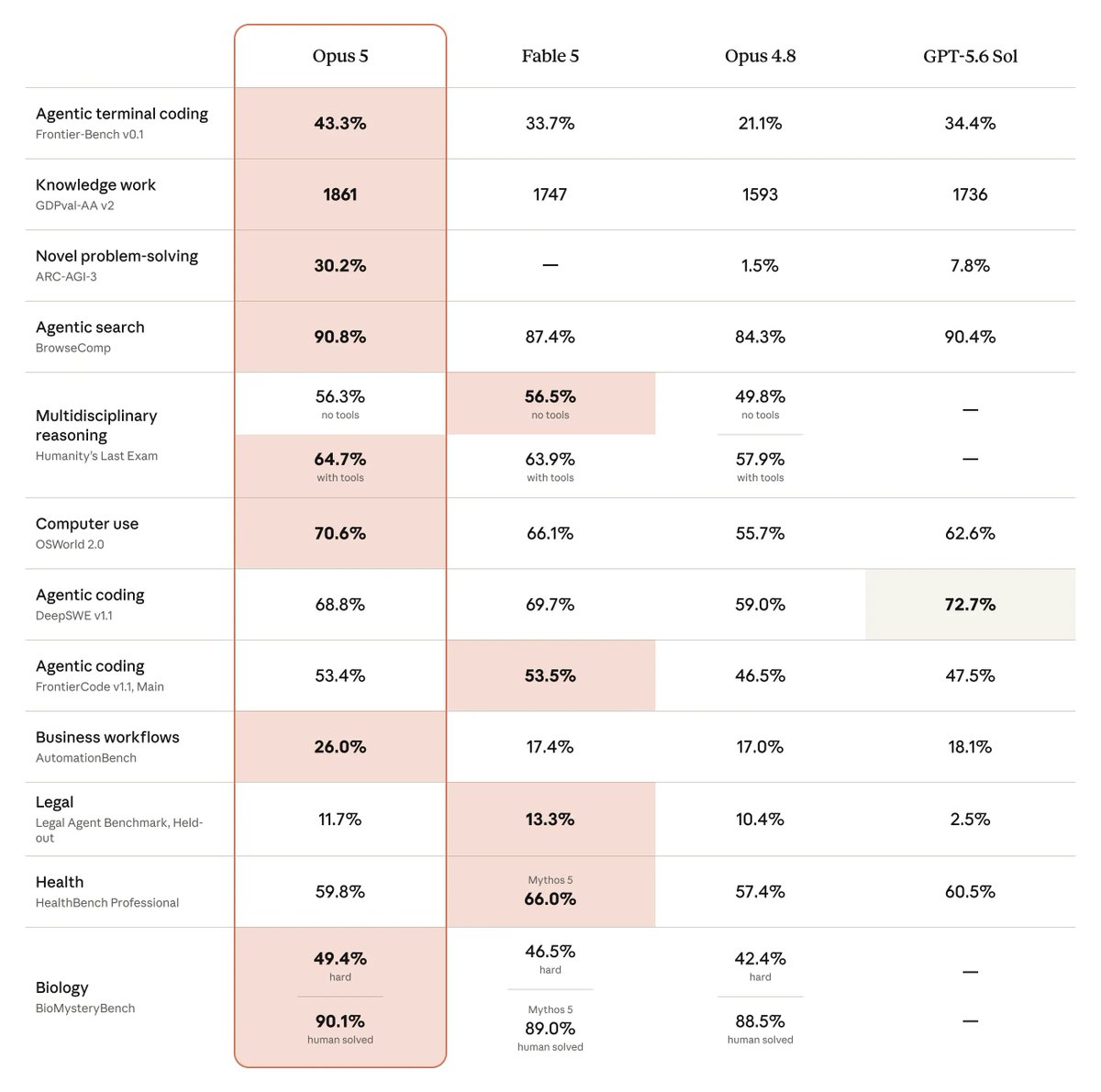
Anthropic released Claude Opus 5 on July 24–25, 2026, positioning it as a high-end daily-use model priced identically to Opus 4.8 at $5/M input tokens and $25/M output tokens—half the cost of Fable 5. Performance highlights: Frontier-Bench v0.1 new SOTA, doubling Opus 4.8 scores at lower cost; ARC-AGI-3 score 3x the second-place model; OSWorld 2.0 surpassed Fable 5 at roughly one-third cost; CursorBench 3.2 matched Fable 5 peak within 0.5% at half cost. Efficiency gains emphasized cost-per-task: financial modeling accuracy up 9 points with 60% less time; trading scenario used ~1/7 the reasoning tokens of Opus 4.8. Behavioral improvements include self-tool creation, root-cause analysis, self-verification, and questioning user designs. Fast mode offers 2.5x speed at 2x price. API auto-fallback routes safety-blocked requests to other models. Safety: alignment score 2.3, lowest deception rate; vulnerability discovery near Mythos 5 but exploit writing lags. Claude Max defaults to Opus 5; Pro users get it as strongest model. One commentary noted open-source models had already surpassed Opus 4.8, framing Opus 5 as catching up.
Key insights
Opus 5 delivers near-frontier intelligence at unchanged pricing
Anthropic set Opus 5 at the same API price as Opus 4.8 ($5/$25 per million tokens), exactly half of Fable 5, while achieving performance close to Fable 5 on multiple benchmarks. This positions it as a high-capability model designed for frequent daily use rather than an expensive experimental tier.
Benchmark gains span coding, reasoning, computer use, and science
Opus 5 set a new SOTA on Frontier-Bench v0.1 with more than double Opus 4.8's score at lower cost. It scored 3x the second-place model on ARC-AGI-3, exceeded Fable 5 on OSWorld 2.0 at one-third cost, and improved organic chemistry by 10.2 points and protein tasks by 7.7 points over Opus 4.8.
Cost-per-task efficiency is a central design goal
Anthropic emphasized cost per completed task rather than per token. Examples: CursorBench 3.2 matched Fable 5 peak within 0.5% at half cost; a financial modeling task saw 9-point accuracy gain with 60% time reduction; a trading task used one-seventh the reasoning tokens of Opus 4.8 with less than half the latency.
Opus 5 exhibits more proactive, self-correcting behavior
The model built its own CV pipeline when denied direct image access, found root-cause bugs missed by community patches, self-verified frontend changes across viewports, and pushed back on flawed user designs. These behaviors indicate stronger agency and long-horizon consistency.
Safety alignment is improved, but exploit capability remains limited
Opus 5 achieved an alignment score of 2.3 with the lowest deception rate among compared models. It approaches Mythos 5 in vulnerability discovery but is far behind in writing exploits. Safety classifiers intercept binary-level scans and exploit generation, with 85% fewer blocks than Fable 5. Biological restrictions were relaxed, routing previously blocked requests to Opus 5.
Open-source progress pressures proprietary models to accelerate
One observer noted that open-source models had already surpassed Opus 4.8, making Opus 5 a necessary catch-up. The commentary framed all current models, including Fable 5, as temporary waves in an open-source tide, suggesting no single proprietary model holds a lasting advantage.