
Claude Opus 5 Release
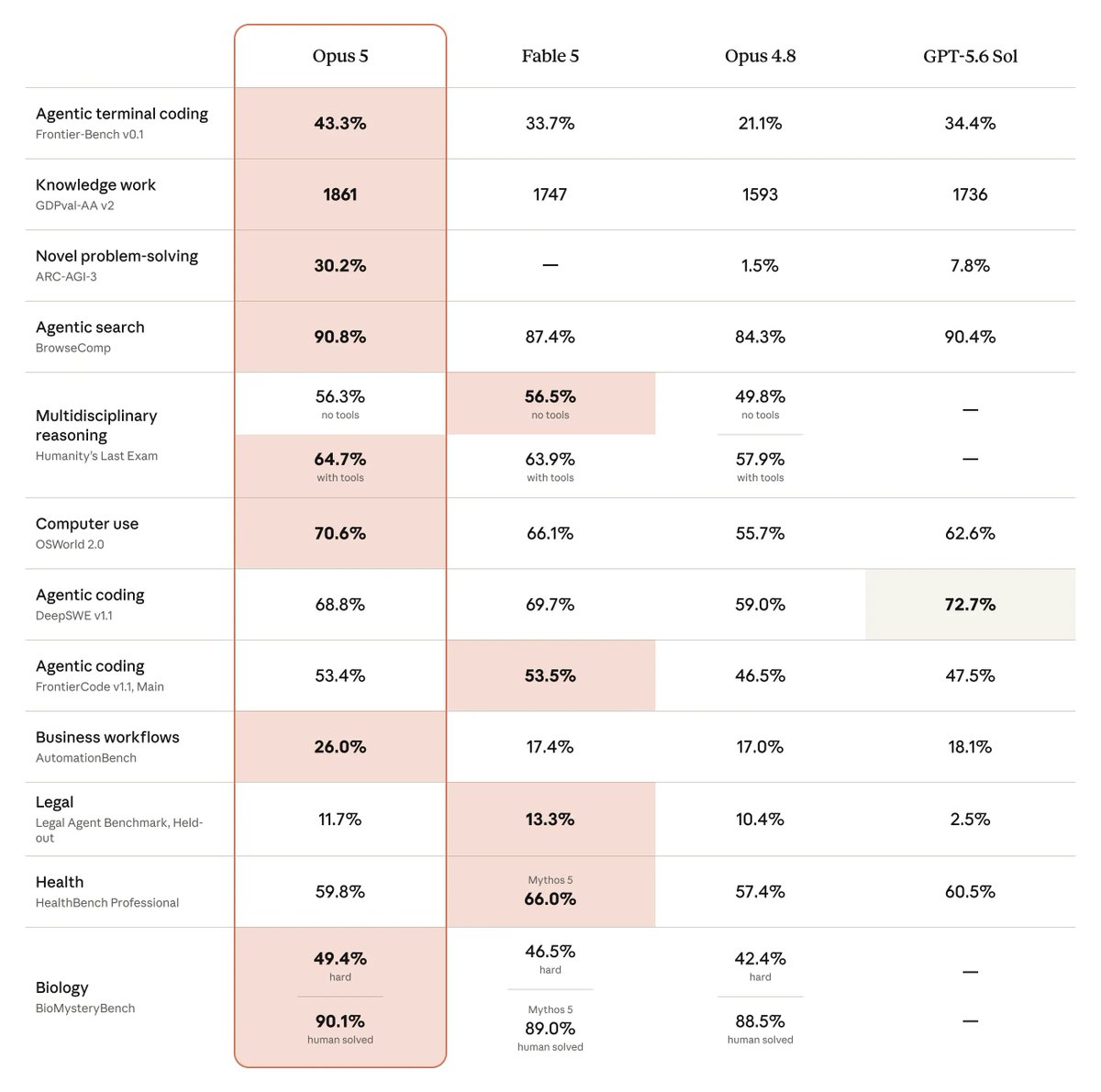
Anthropic released Claude Opus 5 on July 24, 2026, positioning it as a high-end model designed for everyday use across Claude Max and Pro. Priced identically to Opus 4.8 at $5/$25 per million input/output tokens—half the cost of Fable 5—it delivers significant performance gains. - Frontier-Bench v0.1: more than double Opus 4.8 score, lower per-task cost. - ARC-AGI-3: score is 3x the second-place model. - OSWorld 2.0: surpasses Fable 5 best result at just over one-third the cost. - CursorBench 3.2: max-effort score within 0.5% of Fable 5 peak, half the cost. - Cybersecurity: vulnerability discovery near Mythos 5, exploit-writing still behind. - Efficiency: up to 60% time reduction, ~1/7 inference tokens vs Opus 4.8 in finance tasks. - Fast mode: 2.5x speed for 2x price; API auto-fallback for safety-refused requests. - Agentic behavior: creates its own tools (e.g., CV pipeline), root-cause debugging, self-verification, questioning user designs. - Safety: lowest misalignment score (2.3) among Claude models; biological restrictions eased for research, network attack generation still intercepted.
Key insights
Opus 5 Matches Opus 4.8 Pricing While Doubling Frontier-Bench Performance
Anthropic kept Opus 5 at the same API prices as Opus 4.8 ($5/$25 per million input/output tokens) while delivering more than double the score on Frontier-Bench v0.1 with lower per-task cost. On CursorBench 3.2 with maximum effort, it came within 0.5% of Fable 5's peak at half the cost. This pricing strategy directly challenges the trade-off between intelligence and affordability, making daily use of a near-frontier model economically viable for heavy users.
Efficiency Gains Measured per Task, Not per Token
Anthropic emphasizes 'cost per task' rather than cost per token. In a finance modeling scenario, Opus 5 improved average accuracy by 9 percentage points while reducing turns/tool calls by a third and cutting time by 60%. In a trading workflow, inference tokens were roughly one-seventh of Opus 4.8 and latency less than half. These efficiency improvements mean enterprise users get better results with lower total spending, shifting the competitive metric away from raw token pricing.
Agentic Behavior and Self-Correction Set Opus 5 Apart
Opus 5 exhibited novel autonomous behaviors: when denied direct image viewing, it built a computer vision pipeline from pixels to extract geometry for 3D CAD reconstruction. It performed root-cause analysis on an open-source package manager bug, fixing a missed edge case that the community patch overlooked. It also self-verified by opening pages in desktop/mobile views like a front-end developer and questioned user designs when they were flawed, proposing compromises. These examples suggest a model more capable of long-range autonomous problem-solving.
Safety Alignment Improved but Asymmetric in Cybersecurity
Anthropic reported Opus 5 as its most aligned model with a misalignment score of 2.3, lower than Opus 4.8, Sonnet 5, and Fable 5, and the lowest deception percentage. On cybersecurity, the model was not trained on offensive tasks, yet its vulnerability discovery capabilities rose near Mythos 5; exploit generation remained significantly behind. Safety classifiers block binary scans, pentest, and exploit generation but allow source-code vulnerability review. Refused requests can auto-fallback to Opus 4.8 via API.
Developer Workflow Improvements: Tool Change Cache Persistence and Model Fallback
Two beta features address real-world agent development pain points: (1) Tool definitions can now be changed mid-conversation without invalidating the entire prompt cache, reducing costs; (2) API automatic fallback reroutes safety-classifier-intercepted requests to another model instead of failing, avoiding broken workflows. Additionally, a Fast mode offers 2.5x speed at 2x the price, and for biological research, previously blocked requests on Fable 5 are now rerouted to Opus 5.