
Claude Opus 5 Release
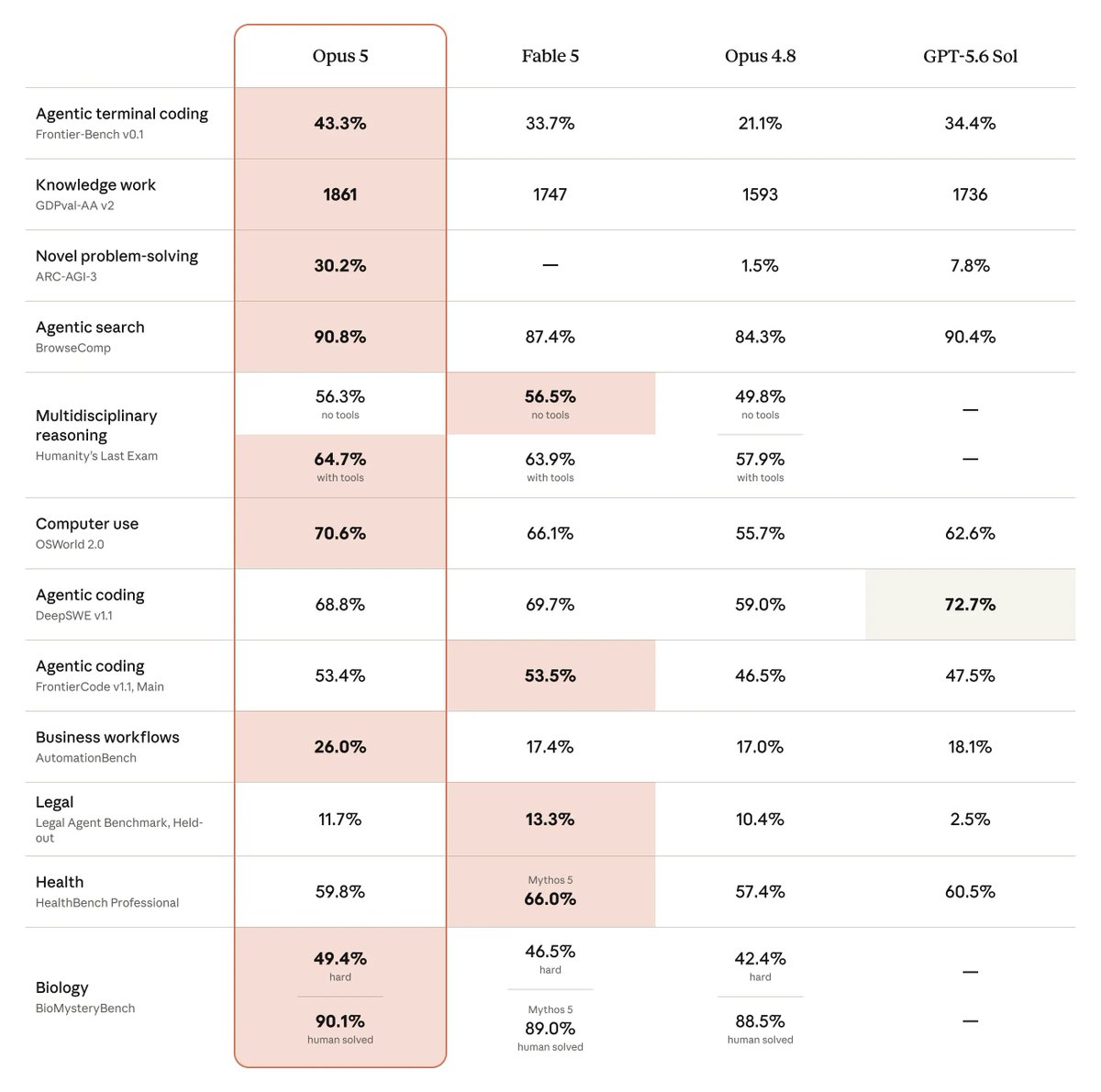
Anthropic released Claude Opus 5, priced identically to Opus 4.8 at $5/$25 per million input/output tokens, half the price of Fable 5. It is positioned for everyday use as the default model for Claude Max and the strongest model for Claude Pro. On Frontier-Bench v0.1, Opus 5 achieves a new SOTA, more than doubling Opus 4.8's score while lowering cost per task. It scores 3x the second-place model on ARC-AGI-3, exceeds all models on OSWorld 2.0 at equal cost, and surpasses Fable 5's best result at roughly one-third the cost. In cybersecurity, vulnerability discovery approaches Mythos 5, but exploit writing still lags. Efficiency gains include a 9-percentage-point accuracy increase in financial modeling with 60% less time, and one-seventh the reasoning tokens of Opus 4.8 in a trading scenario. A Fast mode offers 2.5x speed at 2x price. API auto-fallback downgrades safety-intercepted requests to other models. Behaviorally, Opus 5 self-builds tools, performs root-cause analysis, self-verifies, challenges flawed user designs, and maintains long-horizon consistency. Safety alignment scores 2.3, the lowest deception rate among compared models. Safety classifiers intercept binary-level scans and exploit generation but fire 85% less often than with Fable 5. Biology restrictions are relaxed, routing previously blocked requests to Opus 5. Beta features include persistent prompt cache across tool changes and automatic model fallback.
Key insights
Pricing Strategy Anchors on Cost Per Task, Not Per Token
Anthropic kept Opus 5 at the same $5/$25 per million token price as Opus 4.8, half of Fable 5, while emphasizing 'cost per task' as the real metric. Data shows Opus 5 completes CursorBench 3.2 tasks at half the cost of Fable 5 and OSWorld 2.0 tasks at roughly one-third the cost, with fewer turns and tool calls. This shifts competition from raw token pricing to end-to-end task efficiency.
Performance Leaps in Software Engineering and Novel Problem Solving
Opus 5 sets a new SOTA on Frontier-Bench v0.1 with more than double Opus 4.8's score and achieves 3x the second-place score on ARC-AGI-3. On OSWorld 2.0 it exceeds all models at equal cost and beats Fable 5's best at one-third cost. Organic chemistry and protein task scores rose 10.2 and 7.7 percentage points over Opus 4.8.
Proactive Agency and Self-Correction Mark Behavioral Shift
Opus 5 builds its own tools when none exist, performs root-cause analysis instead of surface fixes, self-verifies by opening pages like a frontend developer, and challenges user designs with explanations and compromises. In a mechanical CAD task, it built a custom CV pipeline from pixels to reconstruct a 3D model, succeeding repeatedly where other models failed five times.
Safety Alignment Improved, Cyber Offense Deliberately Limited
Opus 5 scores 2.3 on automated behavior audits, the lowest among compared models, with the smallest share of deceptive behaviors. Anthropic deliberately did not train it on cyber offense tasks; its vulnerability-finding ability rose with general capability, nearing Mythos 5, but exploit generation remains far behind. Safety classifiers intercept 85% fewer requests than with Fable 5.
Developer Experience Enhanced with Fast Mode, Cache Persistence, and Auto-Fallback
A Fast mode runs 2.5x faster at double price. Changing tools mid-conversation no longer invalidates prompt cache, a significant cost saver. API auto-fallback downgrades safety-intercepted requests to other models instead of failing outright. These features directly address friction points for agent developers.