
Claude Opus 5 Release and Performance Benchmarks
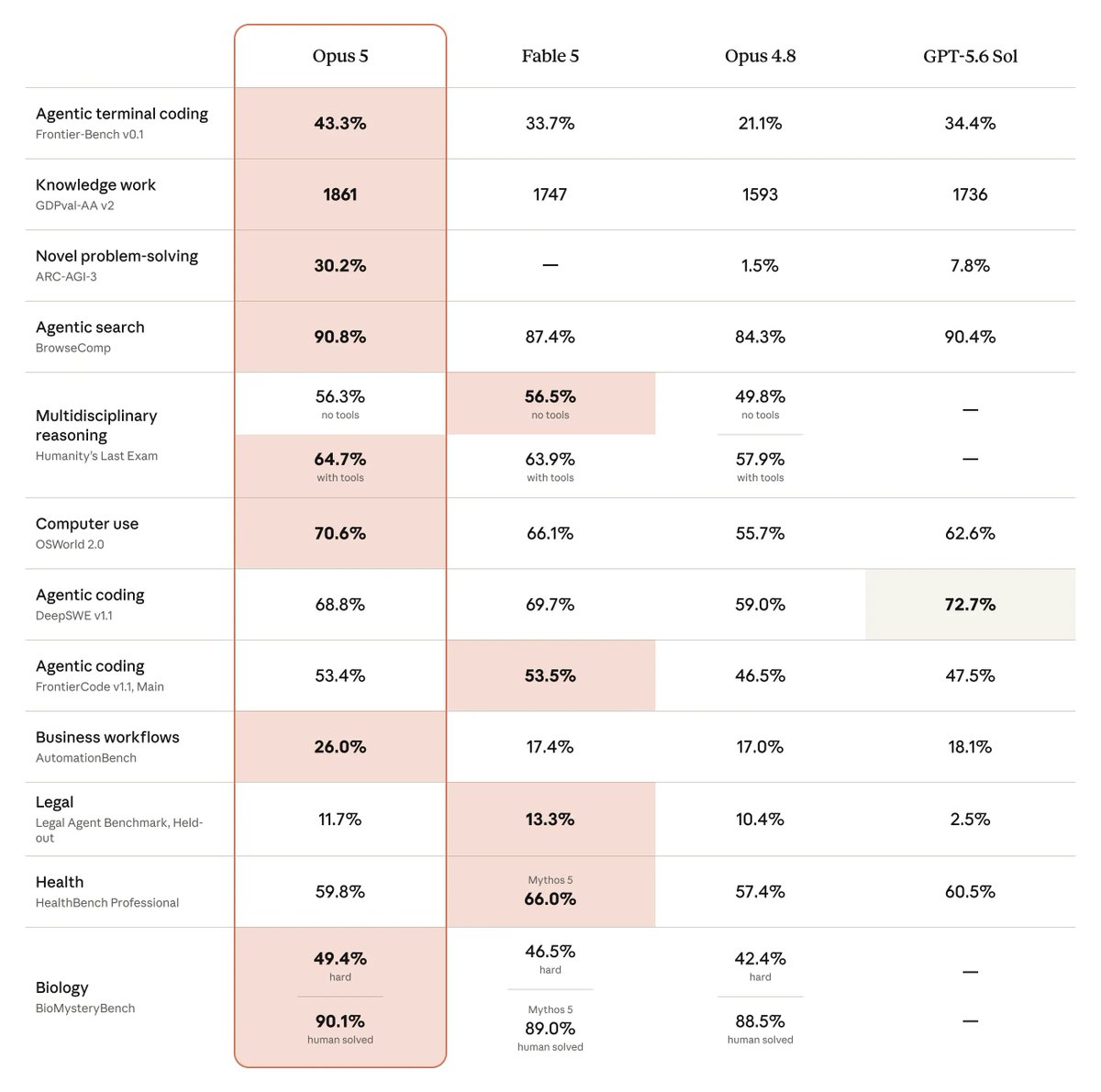
Anthropic launched Claude Opus 5 on July 25, 2026, matching Opus 4.8 pricing at $5/M input and $25/M output tokens, while reaching intelligence near Fable 5 at half the cost. Positioned as a daily-use model, it becomes the default for Claude Max and the strongest option for Claude Pro. Key performance details: - Software engineering: Frontier-Bench v0.1 new SOTA, over 2x improvement vs Opus 4.8 with lower cost. - General knowledge work: SOTA on GDPval-AA, Frontier-Bench. - Novel problem solving: ARC-AGI-3 score 3x second-place model. - Computer use: OSWorld 2.0 outperforms all models at equal cost, beats Fable 5 at one-third cost. - Cybersecurity: vulnerability discovery approaches Mythos 5; exploit writing still lags significantly. - CursorBench 3.2 max effort nearly matches Fable 5 peak at half cost; financial modeling scenario shows 9pp accuracy gain, one-third fewer turns/tool calls, 60% time reduction; trading scenario uses ~1/7 Opus 4.8 reasoning tokens, latency less than half. - Fast mode: 2.5x speed for 2x price. - API auto fallback: safety-blocked requests can downgrade to other models. - Behavioral traits: autonomously builds missing tools, performs root cause analysis, self-verifies via browser inspection, challenges flawed user designs, and maintains long-horizon consistency in finance, genomics, legal tasks. A user comment noted Opus 5 slightly exceeds a reduced-intelligence Fable 5, confirming price parity, and remarked that open-source models have now surpassed Opus 4.8, making proprietary series less unique.
Key insights
Opus 5 Price Locks In Value: Same Cost, Near Fable 5 Performance
Anthropic positions Opus 5 as a high-end yet affordable daily-use model by keeping input/output pricing identical to Opus 4.8 ($5/$25 per M tokens) while delivering intelligence that meets or slightly exceeds Fable 5 in key benchmarks. The model is explicitly designed for frequent invocation, serving as the default for Claude Max and the top-tier choice for Claude Pro. This breaks the usual pattern of charging more for flagship capability, making near-frontier performance economically accessible for routine workloads.
Benchmark Sweep: Opus 5 Sets New SOTAs in Coding, Knowledge, Novel Problems, and Computer Use
Claude Opus 5 posts new state-of-the-art scores on Frontier-Bench v0.1 (coding, doubling Opus 4.8 performance at lower cost), general knowledge benchmarks GDPval-AA and Frontier-Bench, OSWorld 2.0 (computer use, outperforming all models at equal cost and beating Fable 5 at one-third cost), and ARC-AGI-3 (3x the second-place score). Cybersecurity vulnerability discovery nears Mythos 5, though exploit writing remains far behind. These results span software engineering, novel reasoning, and agentic tasks.
Cost Per Task, Not Per Token: Real-World Efficiency Gains Across Scenarios
Anthropic emphasizes cost per completed task rather than per token. In CursorBench 3.2, Opus 5 reaches near Fable 5 peak performance at half the cost. A financial modeling use case shows 9 percentage point accuracy improvement and a one-third reduction in turns and tool calls, with 60% less time spent. In a trading scenario, Opus 5 generates about one-seventh the reasoning tokens of Opus 4.8 and achieves under half the latency. These efficiency leaps lower the total expense for enterprise task completion.
Opus 5 Exhibits More Proactive Agency and Self-Correction Behaviors
The model demonstrates autonomous problem-solving: it builds its own tools when none exist (e.g., a CV pipeline from pixels), finds root causes instead of surface fixes (in an open-source package manager bug), self-verifies outputs by opening pages like a front-end developer, and challenges flawed user designs with explanations and compromises. It also maintains higher consistency over long-horizon tasks in finance, genomics, and legal domains, reducing drift.
Fast Mode and API Safety Fallback Improve Production Reliability
Anthropic introduces a Fast mode that delivers 2.5x speed at 2x price, and an API auto-fallback mechanism: when the safety classifier blocks an Opus 5 or Fable 5 request, it can automatically downgrade to a less restricted model instead of failing. These features target enterprise API users needing both responsiveness and uninterrupted service.
Open-Source Models Have Caught Up, Eroding Proprietary Differentiation
A user reflection notes that open-source models had already surpassed Opus 4.8 before Opus 5, forcing the Opus 4 series to retire. The comment frames Opus, Fable, and other proprietary models as temporary waves in the larger open-source tide, suggesting that even flagship releases may not sustain long-term distinctiveness.