
Claude Opus 5 Release: Half Price, Near Fable 5 Intelligence
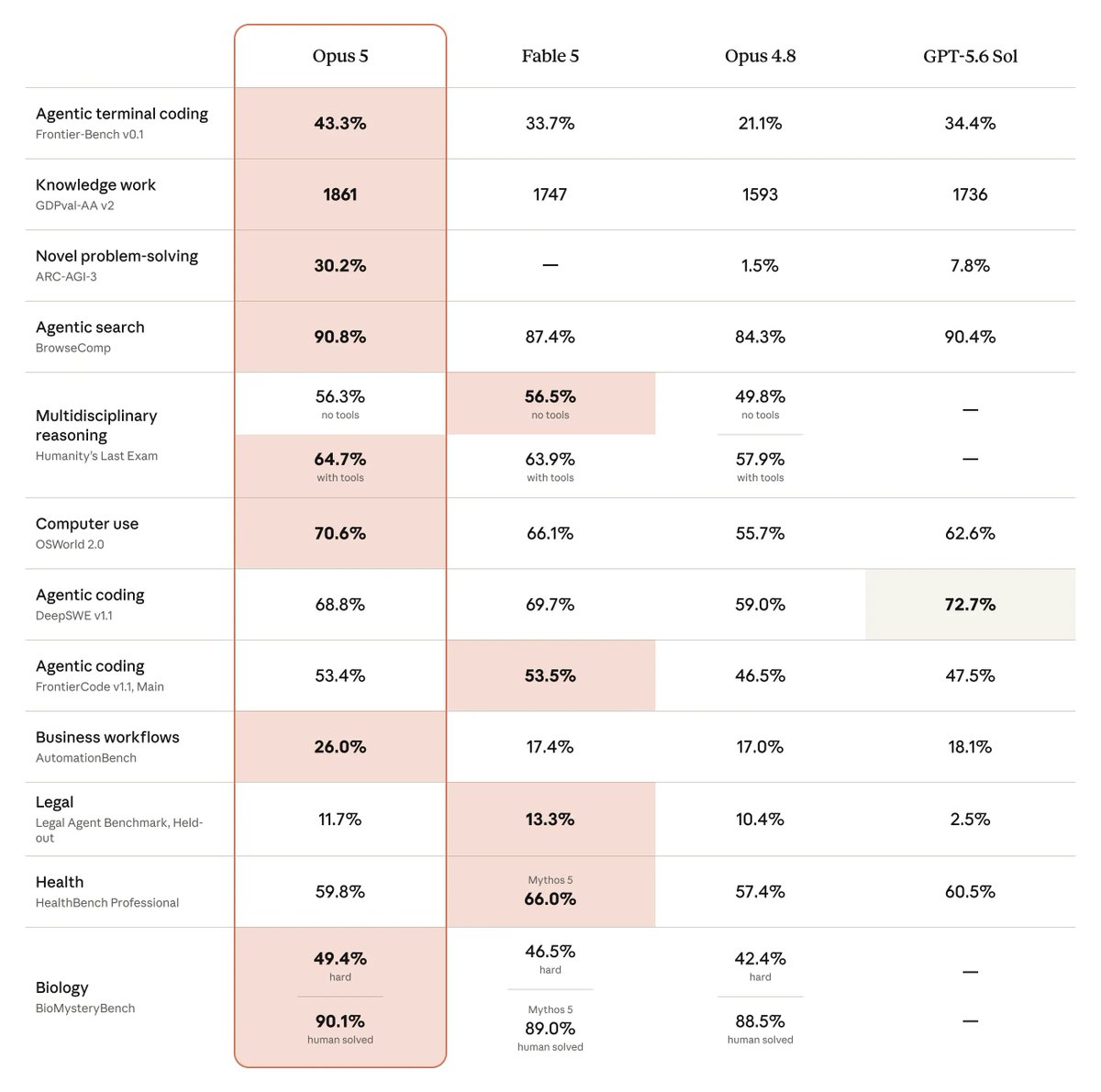
Anthropic released Claude Opus 5 on July 24-25, 2026, positioning it as a high-end daily-use model with near-Fable 5 intelligence at half the price, keeping the same $5/$25 per million input/output tokens as Opus 4.8. It becomes the default model for Claude Max and the strongest for Claude Pro. - Frontier-Bench v0.1: new SOTA, over double Opus 4.8 score, lower cost per task. - ARC-AGI 3: 3x the second-place model's score. - OSWorld 2.0: exceeds Fable 5's best at just over one-third the cost. - CursorBench 3.2: within 0.5% of Fable 5 peak at half the cost. - Cybersecurity: vulnerability finding close to Mythos 5, exploit writing still far behind. - Efficiency: reasoning tokens ~1/7 of Opus 4.8 in a trading scenario, latency less than half; financial modeling accuracy +9pp, time -60%. - Fast mode: 2.5x speed at 2x price. API auto-fallback for safety-classifier blocked requests. - Behavior: self-builds tools when none exist, performs root-cause analysis, self-verifies, questions user designs, maintains long-range consistency. - Safety: lowest misalignment score (2.3) and deception rate among Anthropic models; safety classifier intercepts 85% less often than Fable 5; biology restrictions relaxed, blocked bio requests now go to Opus 5. - Beta features: tool changes mid-conversation no longer invalidate prompt cache; automatic model fallback on safety blocks. - One observer noted Opus 5 slightly exceeds a downgraded Fable 5 and that even open-source models had surpassed Opus 4.8, making the release a catch-up move in a broader open-source tide.
Key insights
Opus 5 delivers near-Fable 5 performance at half the cost with unchanged pricing
Anthropic positions Opus 5 as a high-end but affordable daily driver, matching Opus 4.8's $5/$25 per million token pricing while approaching Fable 5's intelligence. Benchmarks show Frontier-Bench v0.1 SOTA, ARC-AGI 3 score triple the runner-up, and OSWorld 2.0 exceeding Fable 5 at one-third the cost. The model becomes the default for Claude Max and the strongest option for Claude Pro, emphasizing practical high-frequency use over experimental top-tier capability.
Efficiency gains come from reduced reasoning tokens and faster task completion, not just raw performance
Anthropic highlights 'cost per task' over 'cost per token,' citing a trading scenario where Opus 5 used about one-seventh the reasoning tokens of Opus 4.8 with less than half the latency, and a financial modeling task where accuracy rose 9 percentage points while time dropped 60% and tool calls fell by a third. This suggests architectural optimizations that lower operational costs for enterprise users.
Safety and alignment are improved, with lower misalignment scores and reduced over-blocking
Opus 5 achieved a composite misalignment score of 2.3, lower than Opus 4.8, Sonnet 5, and Fable 5, with the lowest deception rate. The safety classifier intercepts requests about 85% less frequently than with Fable 5, and previously blocked biology research requests are now routed to Opus 5 instead of Opus 4.8. However, cybersecurity exploit-writing capability remains far behind Mythos 5, as the model was deliberately not trained on offensive cyber tasks.
The model's proactive behavior and self-correction mark a shift toward more autonomous agents
Examples include Opus 5 building its own computer vision pipeline to extract geometry from raw pixels when direct image access was blocked, finding the root cause of an open-source package manager bug that a community patch missed, and self-verifying frontend changes by opening pages in desktop and mobile views. These behaviors indicate a model that can independently navigate obstacles and correct its own work.
Despite the leap, some view Opus 5 as just another step in an increasingly competitive open-source landscape
One commentary notes that Opus 5 slightly exceeds a 'downgraded' Fable 5 and that even open-source models had already surpassed Opus 4.8, framing the release as Anthropic catching up. The perspective suggests that in the long run, neither Opus nor Fable will be special, as open-source models continue to rise.