
Claude Opus 5 Release: Performance, Pricing, and Features
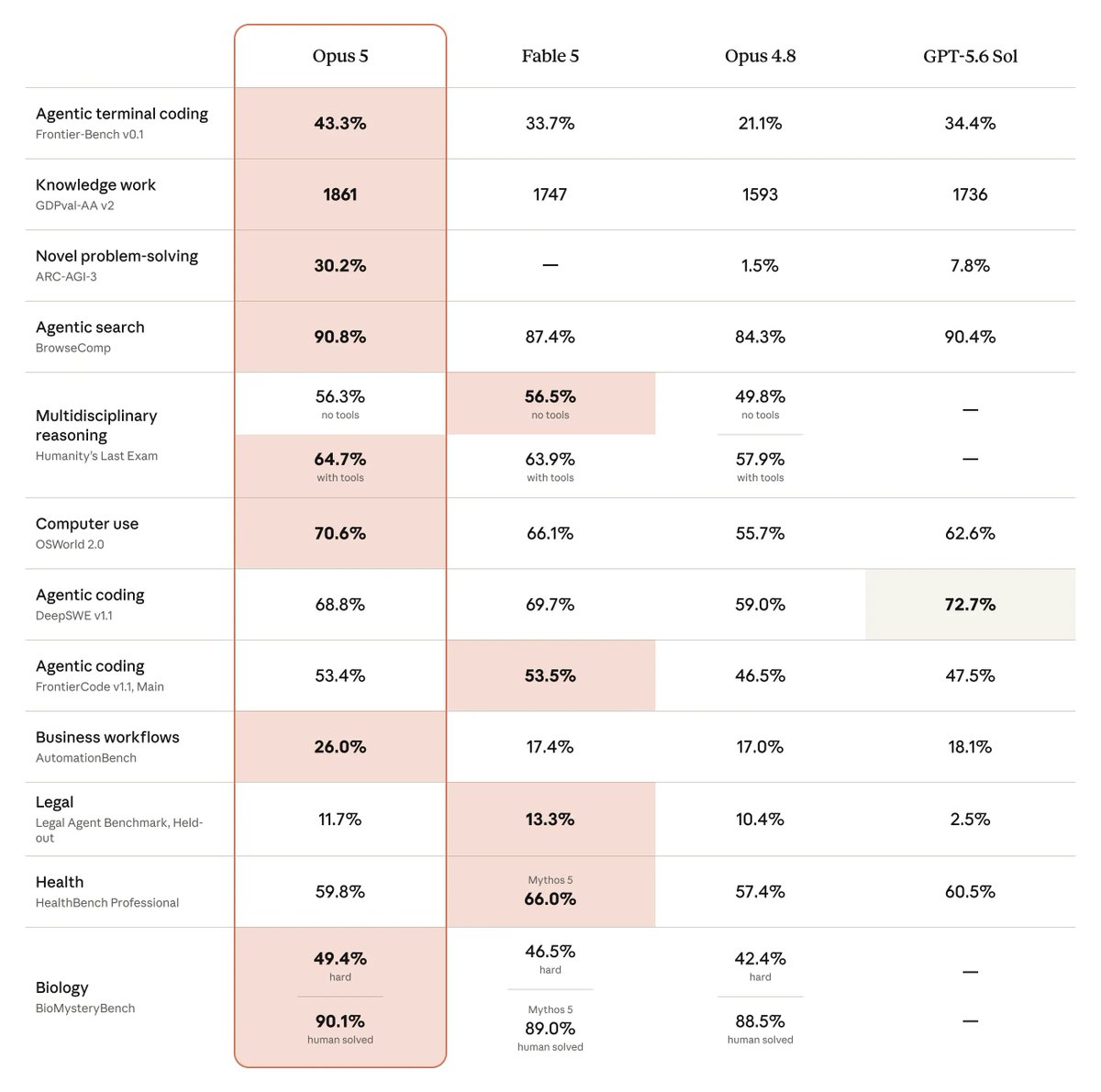
Anthropic released Claude Opus 5, priced at $5/M input and $25/M output tokens—identical to Opus 4.8 and half of Fable 5. It is positioned as a high-end daily-use model, becoming the default for Claude Max and the strongest for Pro. Performance highlights: Frontier-Bench v0.1 SOTA (2x Opus 4.8), CursorBench 3.2 near Fable 5 peak at half cost, ARC-AGI 3 score 3x the second-place model, OSWorld 2.0 surpasses Fable 5 at ~1/3 cost. Efficiency gains include 1/7 reasoning tokens vs. Opus 4.8 in a trading scenario and 60% time reduction in financial modeling. New behaviors: autonomous tool creation (CV pipeline), root-cause bug fixing, self-verification, and questioning flawed user designs. Fast mode offers 2.5x speed at 2x price. API auto-fallback reroutes safety-blocked requests. Safety: alignment score 2.3 (lowest), deception minimal. Cybersecurity: vulnerability discovery near Mythos 5 but exploit writing lags; safety classifier blocks binary-level scans. Biological restrictions relaxed, now falling back to Opus 5 instead of Opus 4.8. Beta features: tool changes no longer invalidate prompt cache; automatic model downgrade on safety intercepts.
Key insights
Pricing Strategy Emphasizes Cost Per Task Over Cost Per Token
Anthropic kept Opus 5 at the same token price as Opus 4.8 while delivering near-Fable 5 intelligence, explicitly framing value around 'cost per task' rather than per-token cost. Examples include CursorBench tasks at half the cost of Fable 5 and OSWorld exceeding Fable 5's best at one-third the cost. This shifts competition to total task expenditure, making frontier intelligence more accessible for frequent use.
Performance Leaps Across Benchmarks and Domains
Opus 5 achieves state-of-the-art on Frontier-Bench v0.1 (more than double Opus 4.8), near-parity with Fable 5 on CursorBench 3.2 at half cost, and 3x the second-place score on ARC-AGI 3. It also shows gains in organic chemistry (+10.2 pp) and protein tasks (+7.7 pp). These results span coding, novel problem-solving, computer use, and scientific domains.
Agentic Behavior Marked by Autonomy and Self-Correction
Opus 5 demonstrates proactive problem-solving: it built a CV pipeline to extract geometry from pixels when direct image access was blocked, found a root-cause bug missed by a community patch, and self-verified frontend changes by opening pages in desktop/mobile views. It also questions user designs and offers compromises, showing long-range consistency in finance, genomics, and law.
Efficiency Improvements Reduce Real-World Costs
In a trading scenario, Opus 5 used about 1/7 the reasoning tokens of Opus 4.8 with less than half the latency. A financial modeling task saw 9 pp accuracy gain, one-third fewer turns/tool calls, and 60% time reduction. These efficiency gains lower enterprise costs without sacrificing quality.
Safety and Alignment Achieve New Lows in Misalignment
Anthropic reports Opus 5 as its most aligned model, with a composite misalignment score of 2.3—lower than Opus 4.8, Sonnet 5, and Fable 5—and the lowest deception rate. Cybersecurity capabilities were not deliberately trained, yet vulnerability discovery nears Mythos 5; exploit generation remains far behind. Safety classifiers intercept binary-level scans but allow source-code vulnerability finding.
Availability and Developer-Friendly Beta Features
Opus 5 is the default model for Claude Max and the strongest for Pro users. API access via claude-opus-5. Fast mode runs 2.5x faster at double price. Two beta features aid agent development: tool changes mid-conversation no longer break prompt cache, and API auto-fallback reroutes safety-blocked requests to other models instead of failing.
Biological Research Restrictions Relaxed
Previously blocked biological requests on Fable 5 now fall back to Opus 5 instead of Opus 4.8, reflecting increased trust in Opus 5's safety for research. Anthropic states Opus 5 is its most capable public model for scientific work, though it still has limits on long autonomous research tasks.