
Code Models and Agents (Paper Interpretation and Practice)
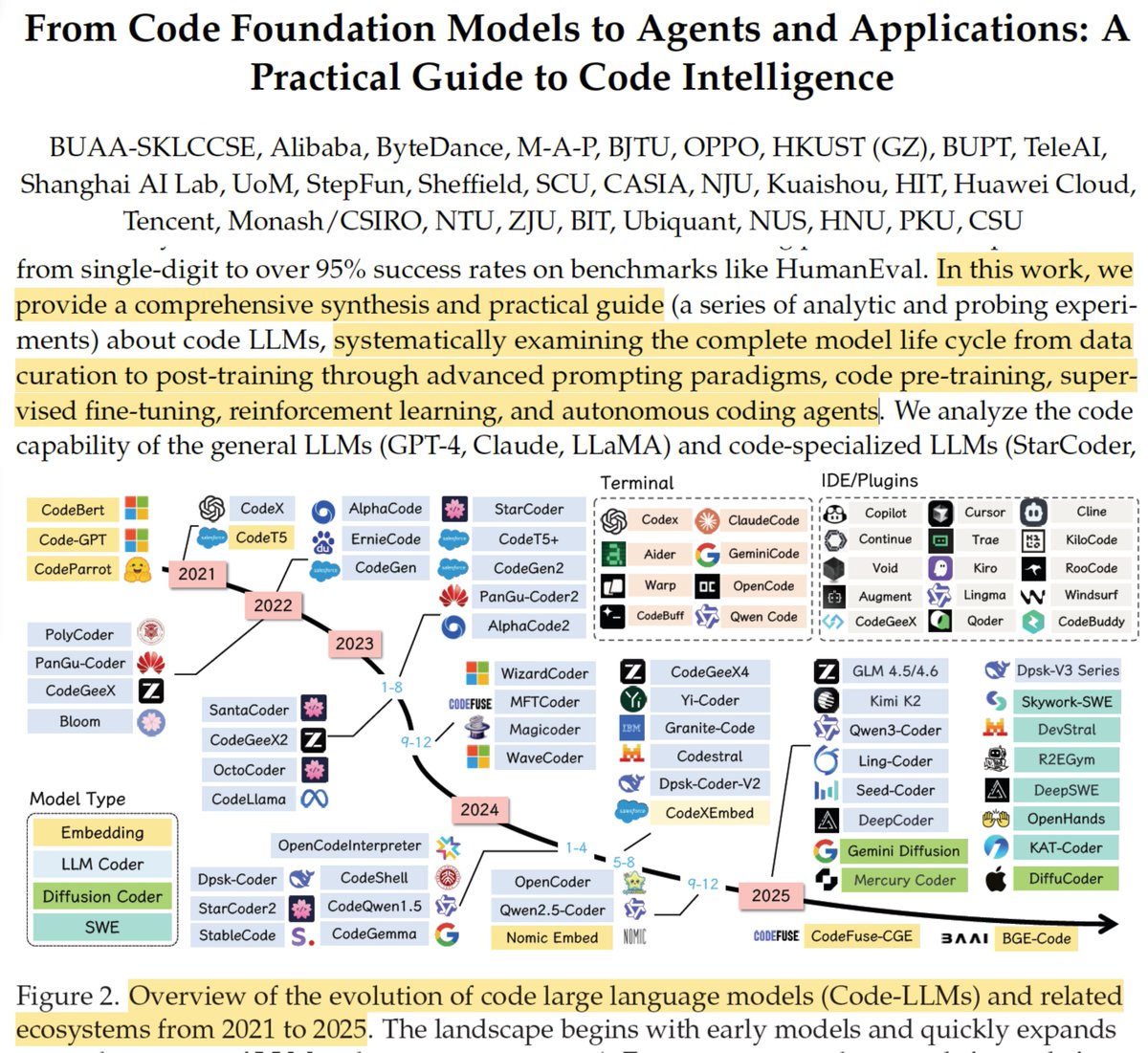
Multiple papers and engineering reports summarize the practical experiences and comparative conclusions of code models and agents. - 50 researchers published a 300-page paper, indicating that RL (especially RLVR) enables small models to outperform proprietary models from large companies in inference tasks. - A 14B model trained with RLVR can compete with OpenAI's o3; small models show significant effects on inference capability delegation (16216). - There are language differences in code learning: C# and Java are easier to learn, while Python and JavaScript are more challenging (16216). - MoE models have large capacity but are fragile during SFT, while Dense models are more stable; MoE is more sensitive to hyperparameters (16216). - Public code training leads to the spread of insecure coding patterns, and the effects of safety fine-tuning are limited (16216). - Structure (inference templates) is more important than facts, and the decomposition of templates in CoT fine-tuning has a greater impact (16216). - OpenAI's automated code review system emphasizes high precision, full repository context, and executable validation, with about 53% of review suggestions being adopted (16114). - Multi-model practical comparisons: Claude Opus 4.5 performs better in frontend and design, Gemini 3 Pro excels in backend and online logic, while Codex Max 5.1 shows balanced performance (16117). - The paper provides a comprehensive lifecycle guide from data preparation to autonomous agents, pointing towards the evolution from Copilot to Agent (16121).
Key insights
RLVR and Small Models Achieve Competitiveness in Inference Tasks
The paper written by 50 researchers points out that through RL (especially RLVR) training, small open-source models (such as 14B) can match large proprietary models (like OpenAI o3) on high-quality validation problems, thereby decentralizing deep inference capabilities to small models that can be deployed at the edge, changing the previous paradigm where only ultra-large models could handle complex reasoning.
Programming Language Features Affect Model Learning Difficulty and Generalization
The paper indicates that different programming languages present varying levels of difficulty for model learning: C# and Java are easier to learn, while Python and JavaScript are more challenging; in mixed training corpora, an excess of dynamically typed languages (like Python) may interfere with the model's learning of statically typed languages, impacting the training strategy choices for code models.
Trade-offs Between MoE and Dense in Capability and Stability
Research shows that while MoE models have large capacity, they are more fragile during SFT and sensitive to hyperparameters and routing stability; Dense models are more stable and exhibit better robustness to training hyperparameters, while MoE requires continuous adjustments to learning rates and routing strategies to avoid instability.
Engineering Practice: Real Experiences with Automated Code Review and Multi-Model Collaboration
OpenAI's automated code review system emphasizes high signal-to-noise ratio, full repository context, and executable validation in engineering practice, with about 53% of suggestions being adopted; in model comparison tests, Claude excels in frontend and design, Gemini excels in backend and online logic, while Codex shows balanced performance, highlighting the distinct value of different models in engineering tasks.