
Coding agents and retrieval improvements (Mistral Vibe & WarpGrep)
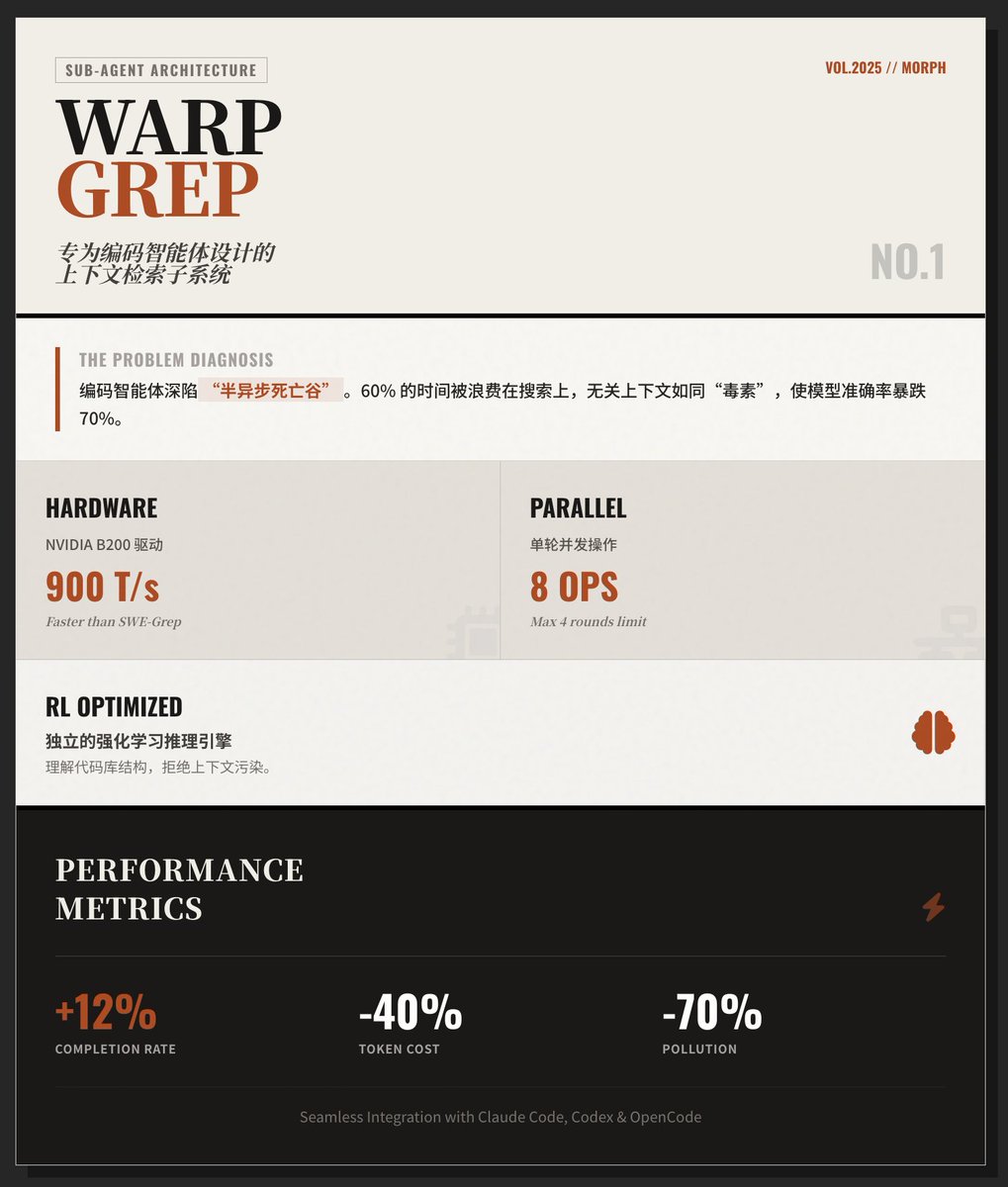
Two developer-focused releases: Morph published WarpGrep, a retriever sub-agent optimized for coding agents; Mistral open-sourced Devstral 2 models and the Mistral Vibe CLI coding agent.
Key insights
WarpGrep isolates retrieval as an RL-optimized subagent
Morph released WarpGrep, a retrieval sub-agent for coding agents that treats context retrieval as an independent component optimized with reinforcement learning. WarpGrep performs grep, glob, and file reads with a reward function prioritizing correct file/line retrieval and speed. It supports up to eight parallel tool calls per round, completes retrieval within four rounds, and is designed to reduce context pollution in large codebases.
Measured gains: WarpGrep improves completion and reduces costs
Integration of WarpGrep with leading models reportedly raises task completion rates by 5–12%, speeds retrieval by 40%, cuts token usage by 40%, and reduces context pollution by 70%. Benchmark hardware performance cited: 900 tokens/sec on NVIDIA B200 versus 650 tokens/sec for a referenced competitor (Cognition SWE-Grep).
WarpGrep integrates with common code models and SDKs
WarpGrep is designed to plug into coding agent stacks like Claude Code, Codex, and OpenCode via Morph MCP Server or SDKs. The design emphasizes task-specific inference engines, parallel tool calls, and hardware-optimized implementations using CUDA in partnership with NVIDIA.
Mistral open-sources Devstral 2 family and CLI agent Vibe
Mistral released Devstral 2 models—Devstral 2 (123B) and Devstral Small 2 (24B)—and open-sourced Mistral Vibe, a local CLI coding assistant backed by Devstral. Devstral 2 is available via Mistral's API for free access at launch and achieved ~72.2 on SWE-bench Verified, near Deepseek v3.2.
Mistral Vibe: file-aware CLI agent with structured tool calling
Mistral Vibe constructs structured prompts including system instructions, a trimmed file-tree mapping, active file window contents, and compressed history summaries. Vibe uses function-calling to emit structured JSON for atomic tool actions (view/read/edit/replace/bash), supports persistent history, automatic file scanning, @ referencing for autocomplete, and an error-feedback loop for self-correction.