
Context Engineering & AI Agents
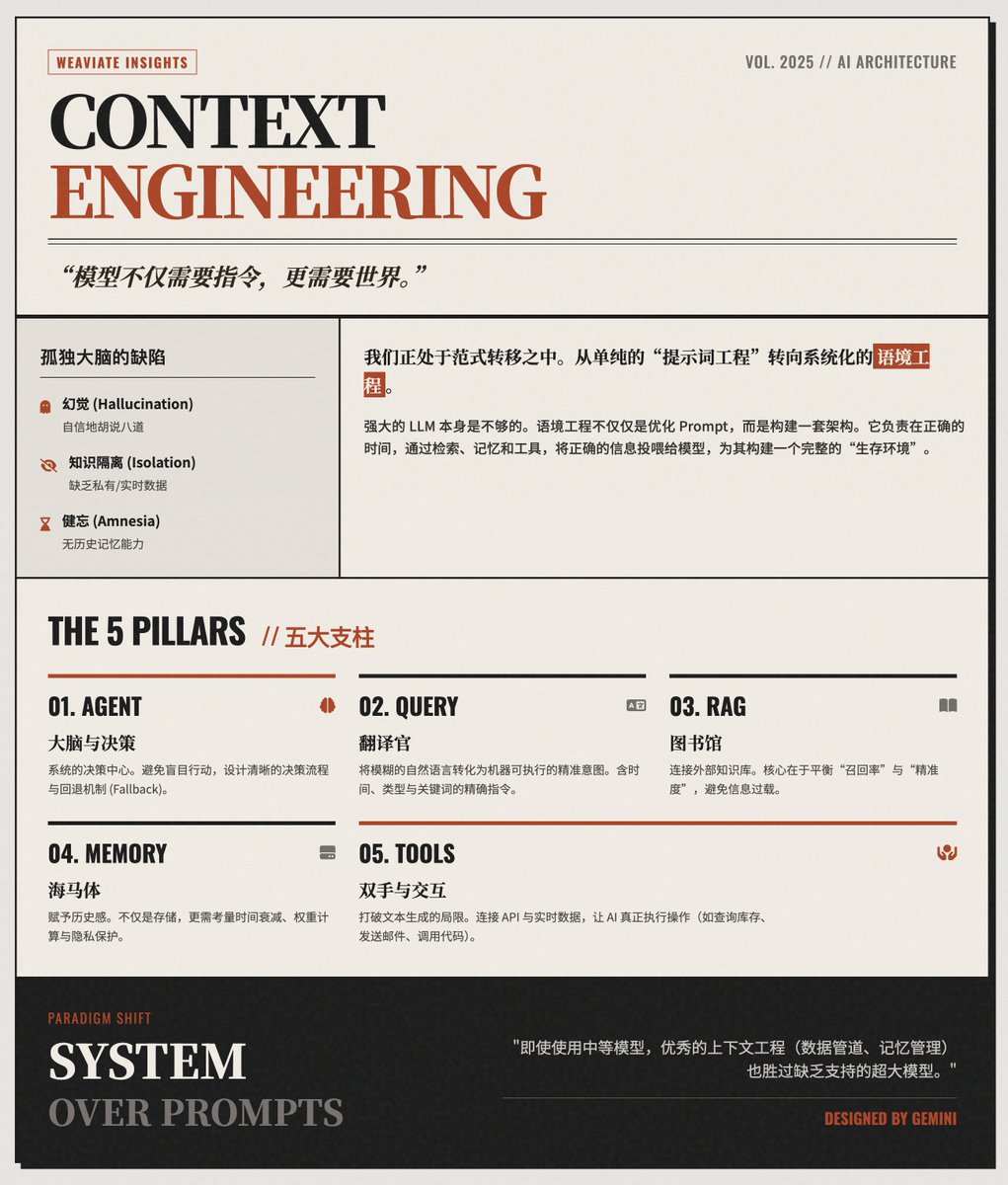
Context engineering reframes agent design. - Strong LLMs alone are insufficient: hallucination, knowledge isolation, and no memory are inherent defects (posts 17374,17331). - Context engineering builds an environment that feeds the right information at the right time to models (17374). - Five pillars: Agent (decision center), Query Augmentation, Retrieval, Memory, Tools; each pillar has specific design goals (17374). - Agent design needs clear decision flows and fallback mechanisms to avoid blind actions (17374,17331). - Query Augmentation translates fuzzy user requests into precise machine intents with time/type/keyword signals (17374). - Retrieval must balance recall vs. precision to avoid overload or omission (17374). - Memory requires time decay, importance weighting and privacy controls; Git and external storage used as anchors (17374,17331). - Tools enable execution (APIs, live data) so agents can act beyond text generation (17374). - Shift from prompt engineering to system-level context engineering improves medium models when pipelines and retrieval are strong (17338,17374). - Patterns to combat context pollution: dynamic tool loading (tool search), programmatic tool calling, and isolating raw data via code execution (17331). - Long-running tasks: initializer/coding agent split and external anchors (progress files, git commits) maintain state across sessions (17331). - Developer workflow guidance: spec-driven development, dynamic context assembly, chain-of-thought and role-based constraints, CLI agents and multi-agent orchestration (17338). - Tooling practices: deterministic wrappers, backpressure to compress logs to concise success/failure signals, quick-fail strategies and noise filtering to save tokens (17373).
Key insights
LLMs Are Not Self-Sufficient; Context Is Required
Large language models exhibit three core defects cited in multiple posts: hallucination, knowledge isolation (lack of private or up-to-date data), and absence of persistent memory (posts 17374, 17331). Context engineering is presented as the architectural response: it does not merely refine prompts but constructs a runtime environment — including memory stores, retrieval layers, and tool interfaces — that supplies models with timely, relevant information during reasoning. The argument states that even highly capable LLMs behave as an isolated 'brain' unless connected to world-facing data and persistence mechanisms (17374,17331).
Five Pillars Define Production Context Engineering
A concrete five-pillar blueprint is proposed for production AI: Agent (decision center), Query Augmentation (intent translator), Retrieval (knowledge library), Memory (historical context with decay and privacy), and Tools (APIs and actions) (post 17374). Each pillar has operational recommendations: agents require explicit decision flows and fallbacks; query augmentation must convert vague user queries into precise retrieval instructions; retrieval systems must tune recall versus precision; memory requires weighting and expiration policies; tools must be exposed as callable interfaces to enable real-world actions (17374).
Paradigm Shift from Prompt Engineering to System Design
The material repeatedly frames a methodological shift: prior emphasis on prompt wording is replaced by system-level context engineering (post 17338,17374). Guidance includes 'plan before coding' (spec-driven development), dynamic assembly of relevant code/docs into the model context rather than static pasting, and role-based or constraint-based prompting for higher-safety outputs. The claim is that well-architected context pipelines can make medium-scale models outperform larger models lacking context design (17338,17374).
Technical Patterns to Prevent Context Pollution
Engineering patterns to combat context noise include: tool search (dynamic loading of tool definitions instead of embedding all tools in the system prompt), programmatic tool calling (execute code privately and expose only summarized results), and isolating large raw inputs from the model to avoid token pollution (post 17331). These practices trade compute for cleaner context and preserve the model's attention on salient information (17331).
Agent Architecture for Long-Running Tasks Uses Anchors
A two-agent harness is recommended for long tasks: an Initializer Agent creates global planning artifacts (e.g., feature_list.json, progress.txt), and subsequent Coding Agents read only those anchors instead of long chat logs (17331). External storage (files, Git commits) is recommended as the durable memory medium; forcing agents to commit changes (git commit) provides a reliable, queryable project memory (17331).
Developer Workflow: Spec-Driven, Test-First, Multi-Agent Orchestration
Recommended software engineering practices for AI-assisted development include creating mini-PRDs/specs before coding, requiring AI to propose plans, having AI write tests before code (red-green-refactor), and running multi-agent pipelines with sandboxing and rollback points (post 17338). Command-line resident agents and orchestrated agent roles (planner, coder, tester, documenter) are described as the future dev environment (17338).
Tooling: Deterministic Output, Backpressure, and Noise Filtering
Operational tooling suggestions include wrappers that default to concise deterministic outputs (e.g., a single checkmark on success), expose full logs only on failure, use quick-fail/testing-bail options to handle one error at a time, and filter logs to only the failing assertion lines (post 17373). These measures reduce token waste, prevent context window overflow, and keep models within their optimal token 'intelligence zone' (17373).