
Context Engineering for AI Agents
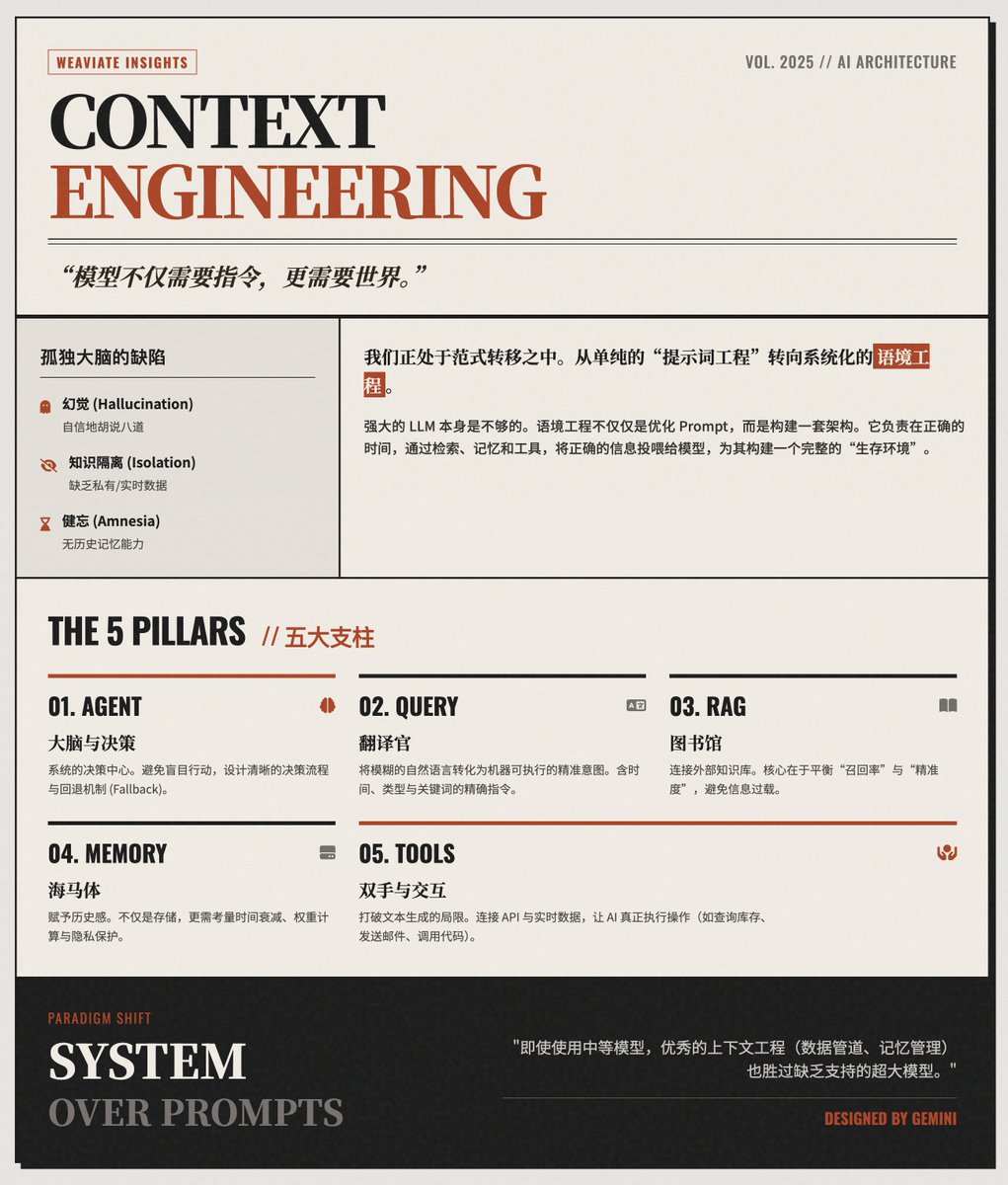
Context Engineering addresses model blindness and connects LLMs to the world. - LLMs suffer hallucination, knowledge isolation, no memory - Context Engineering feeds models correct info at the right time - Five pillars: Agent, Query Augmentation, Retrieval, Memory, Tools - Agent is decision center with clear flows and fallback - Query Augmentation converts vague requests to precise intents - Retrieval balances recall and precision to avoid overload - Memory needs decay, importance weighting, privacy controls - Tools enable real-world actions (APIs, live data, operations) - Shift from prompt engineering to system-level context design - Coding agents waste tokens on verbose logs and lose "intelligent zone" - Backpressure wrapper: swallow outputs by default, show ✓ on success - On failure emit full logs; use quick-fail and filter noise - Avoid blind truncation; prefer deterministic tooling-level filters
Key insights
Context Engineering is required to connect LLMs to real world
Context Engineering is presented as a system-level solution to three inherent LLM deficits: hallucination, knowledge isolation (lack of private or realtime data), and the absence of persistent memory. The approach emphasizes supplying the model with the correct external information at decision time rather than relying solely on larger model capacity. It positions an engineered context — including retrieval, memory and tools — as necessary infrastructure so the model reasons with a richer, externalized environment rather than as a standalone 'brain'.
Five architectural pillars define production context engineering
The article enumerates five core patterns for production AI applications: Agent (decision center with defined flows and fallbacks); Query Augmentation (translate vague natural language into precise retrieval/execution intents, e.g., add time/type/keywords); Retrieval (connect to knowledge stores with recall/precision tradeoffs); Memory (historical context with time decay, importance weighting and privacy controls); and Tools (APIs and actions allowing the agent to execute operations beyond text generation). Each pillar has concrete responsibilities and constraints.
Engineering context beats raw model scale for system performance
The post contrasts older prompt-engineering approaches with modern context engineering: investing in data pipelines, retrieval quality and memory management often yields better system outcomes than simply using larger models. The recommendation is to design for end-to-end context delivery so even mid-sized models can outperform oversized models that lack context integration. This reframes effort from prompt wording to architecture (data flow, retrievers, memory policies, tool integration).
Backpressure and deterministic filtering cut token waste in coding agents
A separate analysis recommends tooling-level, deterministic controls to reduce token waste from verbose tool outputs (e.g., test logs). The pattern is a wrapper that swallows default output, emits a concise success marker (✓ with label) when tests pass, and only forwards full logs on failure. Additional tactics include quick-fail flags (stop on first failure), extracting only failing assertions, stripping stack traces/timestamps, and avoiding blind truncation which can force re-runs. The guidance emphasizes toolchain noise reduction rather than relying on model heuristics to ignore irrelevant tokens.