
Context Engineering & Long-Running AI Agents
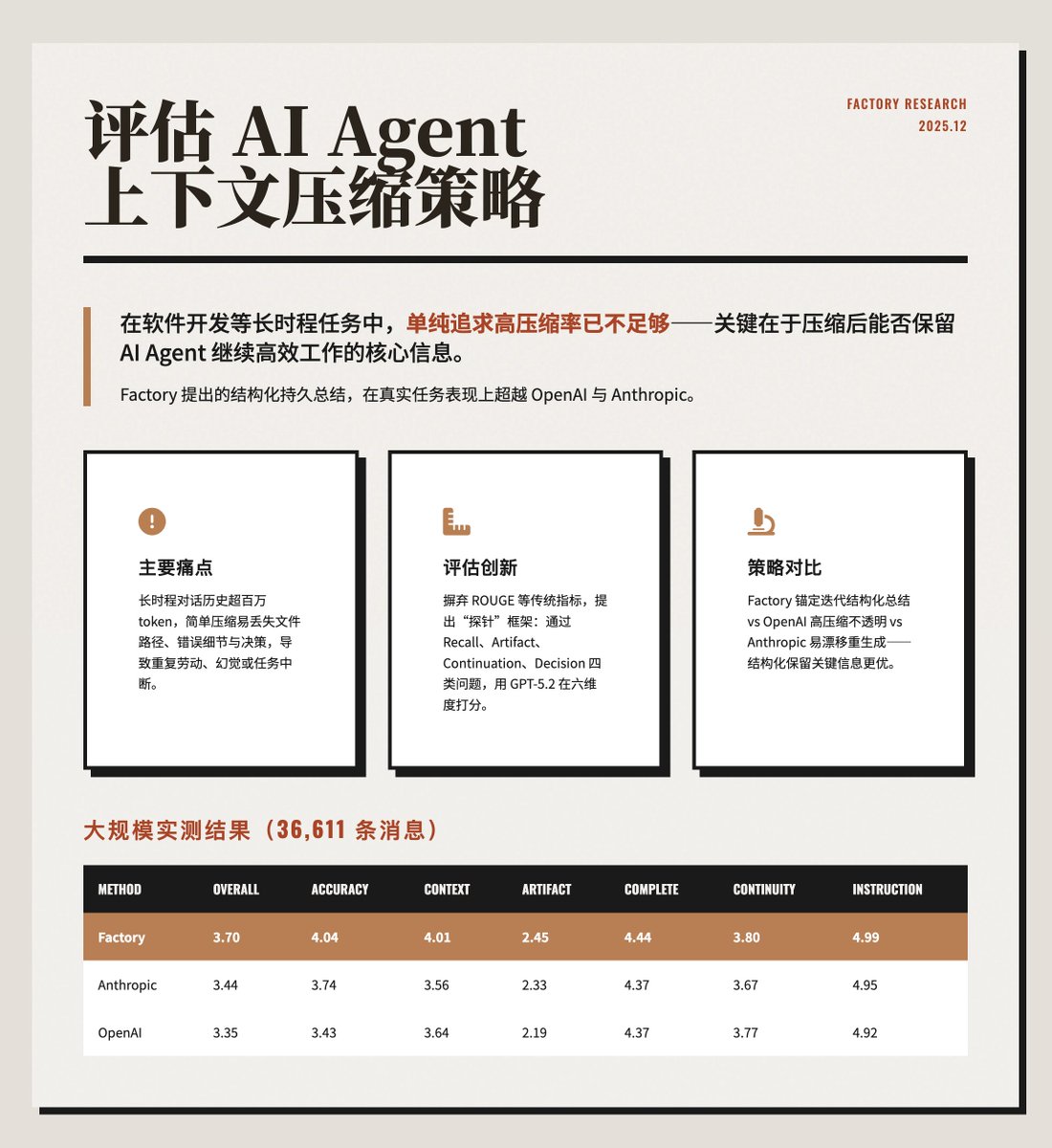
Multiple posts document techniques and standards for preserving actionable context in long-running AI agents and RAG systems.
Key insights
Context compression must preserve task-critical details
An evaluation of AI agent context-compression strategies finds that extreme compression often discards low-entropy but critical artifacts (file paths, error logs). The proposed 'anchored iterative summarization' (Factory approach) maintains structured persistent summaries (intent, file changes, decisions, next steps) and outperforms opaque high-compression methods from OpenAI and Anthropic on task continuity.
Context engineering becomes the core system moat
Box CEO Levie frames the shift: agent failures will move from logic limitations to information asymmetry. 'Context engineering' must supply the precise dimensions and density of data a cross-domain expert needs. Levie enumerates technical pillars: retrieval, heuristic ranking, system prompts, and state-space optimization, and emphasizes compute-driven information processing as a competitive barrier.
Agentic RAG production patterns are maturing
A GitHub project 'Agentic RAG for Dummies' is highlighted as a production-ready approach: it uses dialog memory, hierarchical indexes, small-slice search with large-slice callbacks, multi-agent parallelism, and active clarification questions. The project includes Gradio UI, PDF→Markdown pipelines, Docker deployment, and notebooks for quick local deployment.
Open standard 'Agent Skills' accelerates interoperability
Agent Skills is introduced as an open, file-system-based skill format (SKILL.md with YAML frontmatter). Skills load incrementally: agents load metadata at startup and fetch full content when task matches. Anthropic, Claude/Claude Code, Microsoft VS Code/GitHub Copilot, and other products are adopting Skills, enabling reusable skill packages, incremental loading, and enterprise knowledge capture.
Frontend agent case study shifts focus from technical success to product fit
A FEDay case study recounts a team moving from technical agent implementation to product failure, then upgrading their cognitive framework. The narrative emphasizes product-level metrics, human-in-loop points, and user experience adjustments required to move an agent from demo to production.