
Context, Memory & Long-Context Strategies for Chatbots
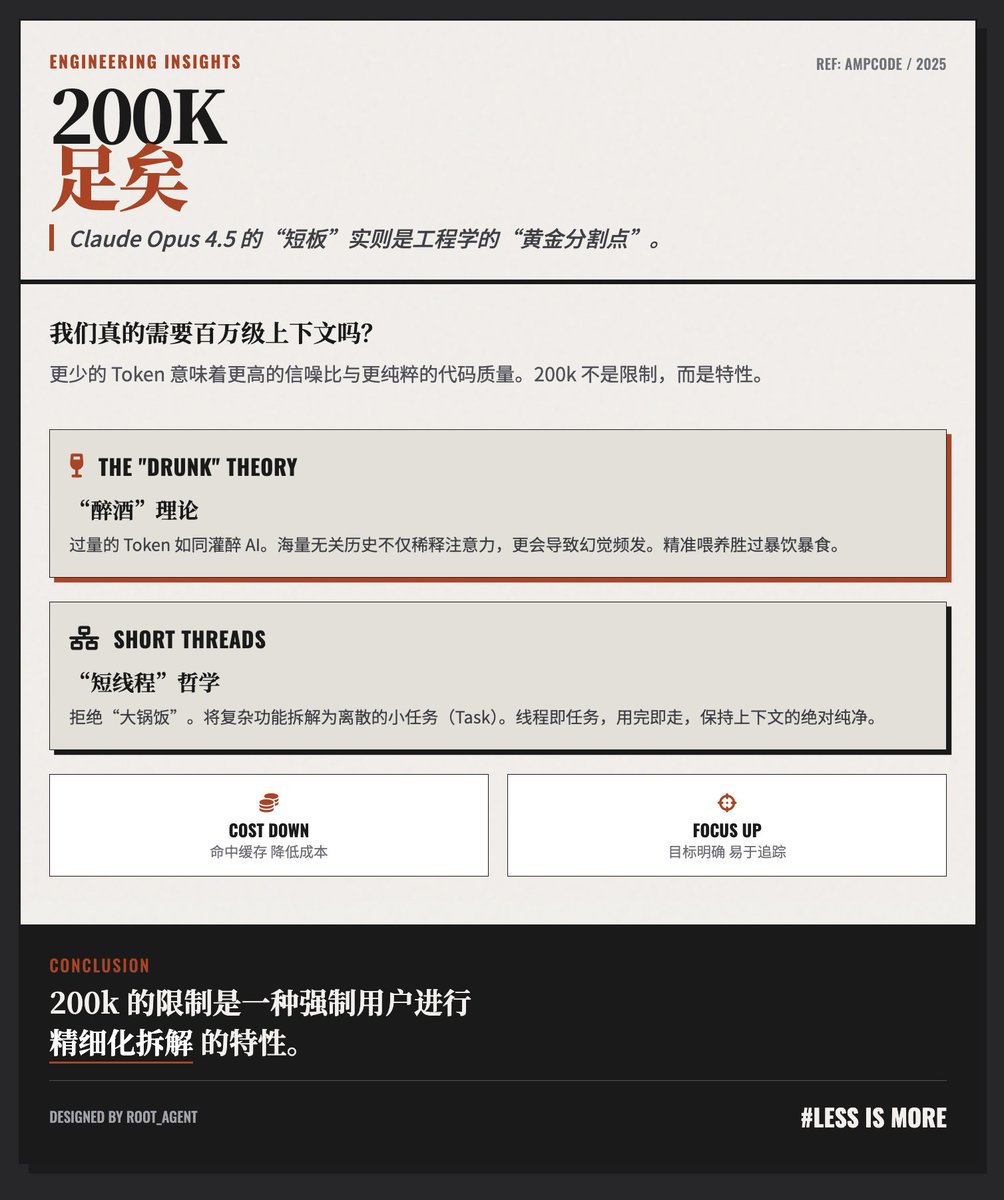
Debates on optimal context window and memory architectures for chat models. - AmpCode argues 200k tokens is sufficient and often preferable; excessive context reduces signal-to-noise and causes 'drunken' agent behavior. - Recommendation: decompose complex tasks into short, interconnected threads; pass context between threads rather than accumulate long history. - ChatGPT memory approach: full injection of user facts and precomputed lightweight recent-dialogue summaries (10–15 sessions), plus session metadata; system injects these into prompts each session. - Claude memory approach: on-demand retrieval via tools (conversation_search, recent_chats); default is not to load history unless model/tool invokes retrieval. - ChatGPT pros: seamless continuity and speed; cons: coarse summaries and possible irrelevant interference. Claude pros: precise retrieval and cleaner context; cons: slower and potentially less proactive. - Practical prompt pattern: 'connected search + synthesis' (internet search, then overview/summary) yields better, near-deep-research results within minutes; recommended to store outputs as structured personal notes.
Key insights
Short-thread workflows and 200k token windows can yield better outcomes
An engineering blog argues that very long context windows (beyond 200k tokens) can harm model performance by lowering signal-to-noise; 200k tokens are often sufficient. The recommended workflow is to decompose large tasks into multiple short threads, each with a focused objective, and pass essential context between threads rather than retaining an ever-growing dialogue history.
ChatGPT uses precomputed injection and light summaries to maintain continuity
ChatGPT's memory system injects session metadata, explicit user memories (editable), and precomputed lightweight summaries of the most recent 10–15 user dialogues into the prompt each session. This design favors continuity and speed by providing the model a compact recent-history map on each interaction.
Claude uses on-demand retrieval tools for high-fidelity memory access
Claude's approach defaults to not including prior dialogue; instead, it has dedicated retrieval tools (conversation_search, recent_chats) the model can call when it determines historical context is needed. This approach provides higher-fidelity recall of past details but requires the model to choose to invoke search and can be slower.
'Internet search + summary' is a high-yield prompt pattern
A compact prompt routine—explicitly ask the model to perform internet search and produce a synthesis/overview—delivers near 'deep research' results in minutes. Users are advised to store these summarized outputs as structured notes (e.g., in Logseq) to build personal knowledge bricks.