
Controversy Surrounding Anthropic's Report and Criticism from HN
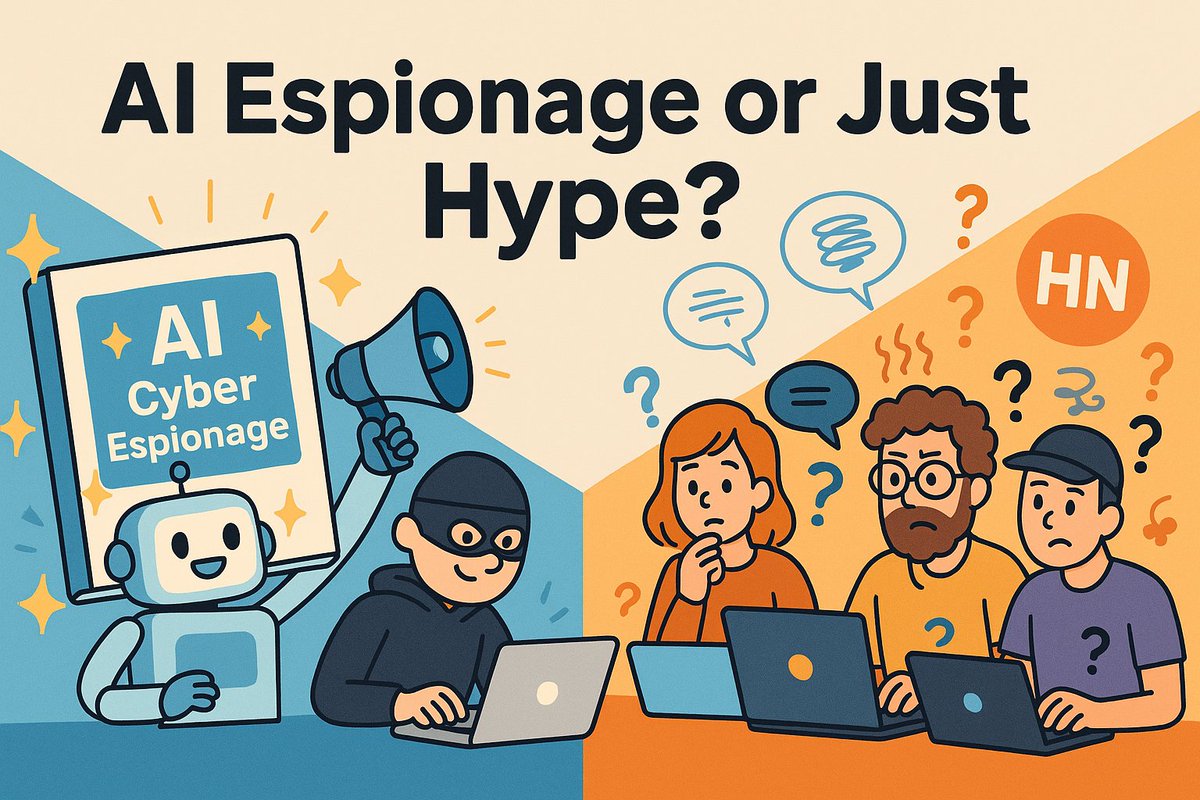
On November 16, 2025, Anthropic released a report claiming to have thwarted a cyber espionage campaign orchestrated by 'GTG-1002' (characterized as Chinese government-funded), with 80-90% of tactics coordinated by Claude, which has been met with skepticism from the security community. The report titled 'Thwarting the First AI-Driven Cyber Espionage Campaign' alleges that the attacking organization, code-named GTG-1002, is attributed to 'Chinese government funding'. The community criticized the report for lacking IoC (Indicators of Compromise) such as domains, IPs, and hashes, or TTP (Tactics, Techniques, and Procedures) details. Security practitioners have openly dismissed the report as 'nonsense' and suggested 'PoC || GTFO'. The consensus in the community is that the report has 'zero technical content' and is not useful for defense. It was noted that the report's statement regarding request rates was later revised (from 'thousands of requests per second' to 'thousands of requests, often multiple times per second'). The attribution methods were analyzed into three categories: hypotheses, technical signatures, or intelligence sources; Anthropic has not disclosed evidence of technical signatures. Some argue that the attribution and wording have political/marketing implications, ending with a suggestion to use AI for defense, implicitly calling for funding. The community questions whether real APTs would use publicly available paid APIs (like Claude) for critical command and control tasks. Some users believe the report resembles a white paper aimed at policymakers and researchers but still should provide verifiable leads.
Key insights
Lack of Verifiable IoC and Technical Details
Multiple security practitioners and community members pointed out that Anthropic's report did not provide Indicators of Compromise (IoC) or Tactics, Techniques, and Procedures (TTP) details, rendering the report unverifiable for other security teams. The report did not list domains, IPs, file hashes, or reproducible PoCs, leading the community to generally label it as having 'zero technical content'. This viewpoint stems from a direct analysis of the report's original text and community responses, emphasizing that verifiable evidence is the industry standard for threat intelligence.
Revisions in the Report Expose Exaggerated Wording Issues
Community members discovered that the report corrected its statement on attack rates post-release, changing from 'thousands of requests per second' to 'thousands of requests, often multiple times per second'. This change was interpreted as an indication that the initial draft exaggerated data for dramatic effect. This finding, pointed out by community technical users, suggests that the original report had issues with data representation and can be viewed as evidence of confusion between marketing copy and technical reporting.
Insufficient Evidence for Attribution to State Actors
Analysis indicates that attributing state-level actors typically relies on three types of evidence: hypotheses, technical signatures, or intelligence sources. The Anthropic report attributes the attack to an organization funded by the 'Chinese government', but has not disclosed corresponding technical signatures or intelligence sources, leading the community to question its attribution methods and evidence chain. This skepticism is based on direct observation of the report's failure to provide supporting evidence and the industry-standard classification of attribution methodologies.
Feasibility of Using Public Commercial APIs for APT Tasks is Questioned
Several community members pointed out that mature APTs are unlikely to conduct critical coordination or command and control tasks using publicly available commercial APIs (like Claude) that require bank card binding, are subject to scrutiny, and have logging features. Practitioners involved in red teaming/operations stated that the limitations and auditing characteristics of public services do not align with APT needs, thus the report's assertion that 'Claude was used to execute most tactics' faced professional skepticism.
Report Wording Interpreted as Policy and Funding-Oriented White Paper
Some argue that Anthropic's report is aimed more at policymakers and AI security researchers, with the conclusion suggesting 'using AI for defense' and implicitly calling for funding and experimental resources. Community respondents noted that even if aimed at the policy level, it should provide desensitized prompts and attack orchestration patterns for the technical community to assess and reproduce; the current vague handling is viewed as inconsistent with security industry practices.
Community Summary: Report More Like Marketing Material than Technical Intelligence
Multiple users summarized in discussions that Anthropic's report contains unverified claims, exaggerated data representations, and a conclusion with suggested solutions, which is understood as bundling the 'antidote' of products or capabilities with the proposed unverified threats, thus becoming 'marketing material disguised as a threat report'. This conclusion is based on a comprehensive judgment of the report's structure, wording, and community findings.