
Cost-efficient harness design for Claude Fable 5: three distribution patterns and four design rules
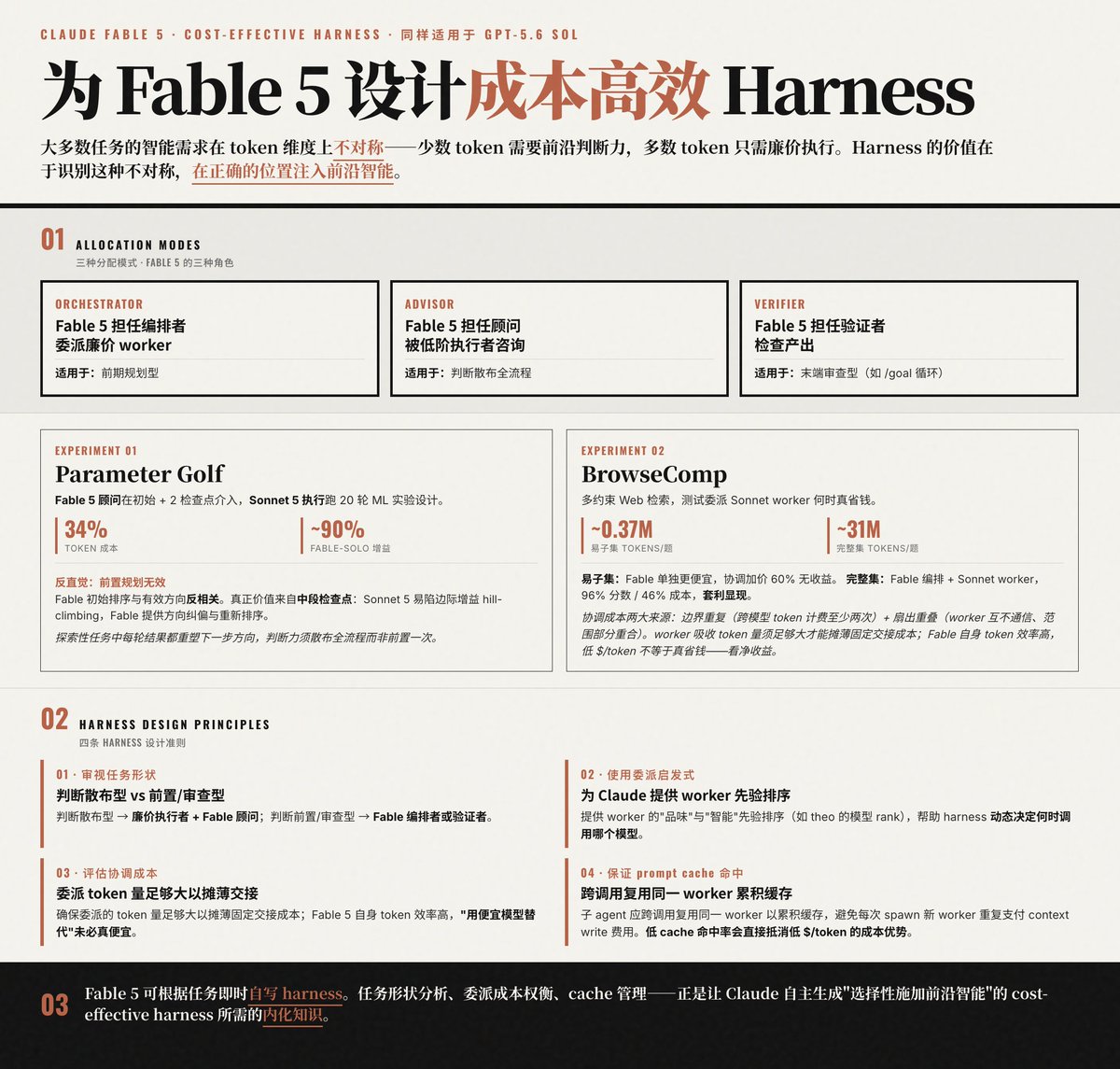
A framework for cost-efficient use of Claude Fable 5 leverages the insight that intelligence needs are asymmetric across tokens: a few tokens require frontier judgment, most only need cheap execution. Three harness patterns: Orchestrator (Fable delegates to cheap workers, good for upfront planning tasks), Advisor (Fable consulted by lower-tier executors, suits tasks where judgment is spread throughout), Verifier (Fable checks outputs, fits endpoint review loops). Experiments: In Parameter Golf, Fable as advisor at initial plus two checkpoints with Sonnet 5 executor achieved ~90% of Fable-solo gains at 34% token cost; mid-stream checkpoints were critical because upfront planning alone was anti-correlated with effective direction. In BrowseComp, on harder full-set tasks (~31M tokens), Fable orchestration + Sonnet worker achieved 96% of the score at 46% cost; coordination overhead from boundary duplication and fan-out overlap means worker token volume must be large enough to amortize handoff costs. Four design rules: examine task shape to pick harness type; use delegation heuristics (model rank priors); evaluate coordination cost and ensure sufficient token volume; maximize prompt cache hits by reusing the same worker across calls. The ultimate direction is for Fable 5 to auto-write its own harness using this knowledge.