
Developer quality, agent evaluation and career impact
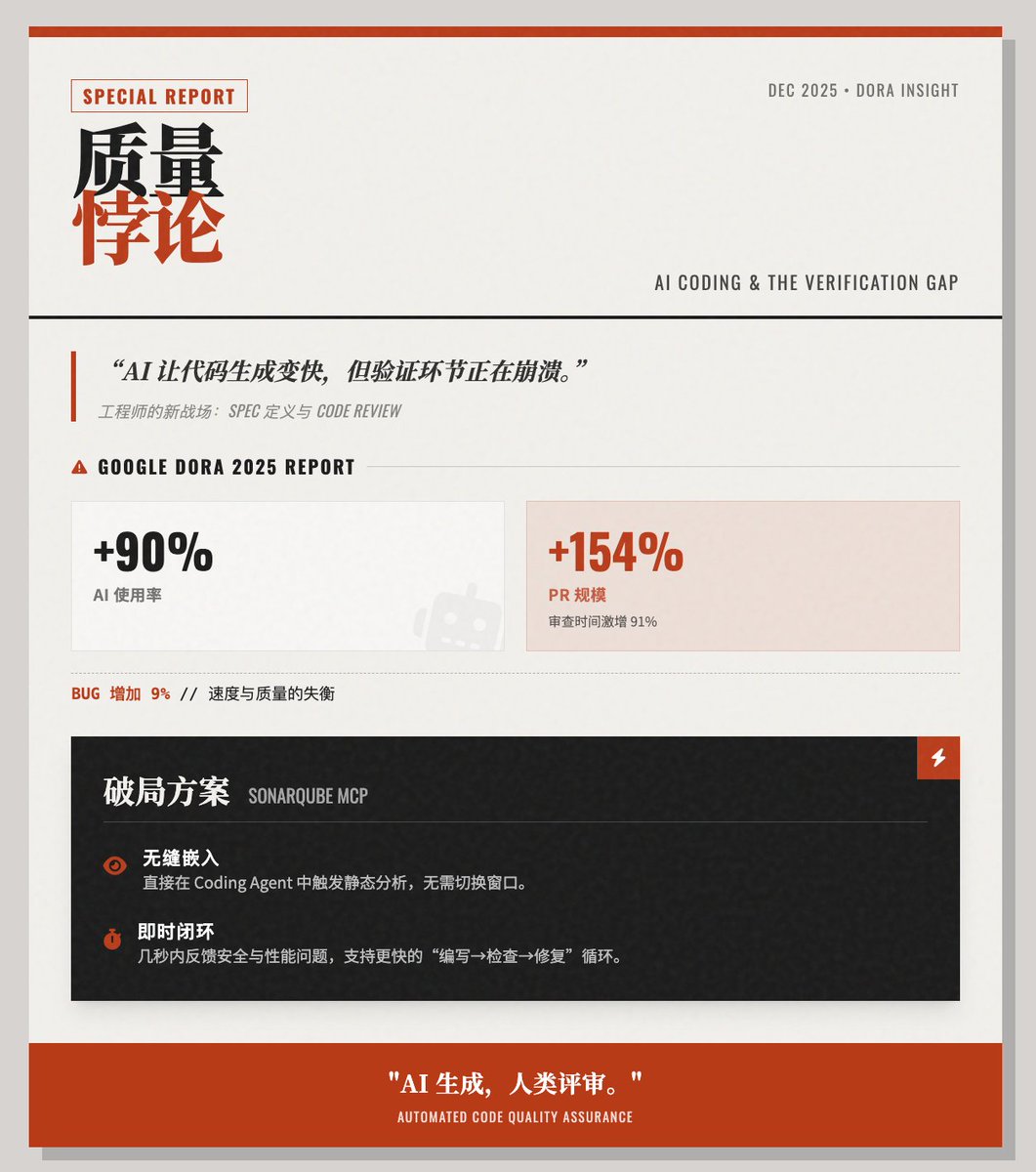
Posts detail developer tooling, agent evaluation methods and career guidance in an AI-first engineering landscape. - SonarQube integrated MCP Server embeds static analysis into AI agent workflows. - DORA 2025 data cited: AI usage +90%; bugs +9%; code review time +91%; PR size +154%. - Integration enables in-IDE, real-time scanning and immediate feedback. - Proposed agent evaluation methodology: expert scoring, model scoring, comparative scoring, expert-user scoring. - Recommendation: avoid lay-user scoring for technical agent evaluation; use expert user NPS for product iteration. - 2026 career guidance: junior roles decline, need for T-shaped engineers (broad knowledge + deep specialty). - Suggested high-value career tracks: AI engineer (application-level), cloud engineer, mobile developer. - Advice: shift from memorizing syntax to improving architectural decision-making and AI orchestration skills.
Key insights
Embed static analysis into AI coding workflows to catch regressions
SonarQube's MCP Server integrates static code analysis directly into AI coding agents, providing in-IDE, near-real-time security and maintainability checks that align static rules with AI-generated code. The integration aims to reduce context switching and accelerate the write-check-fix loop.
AI usage increases productivity but raises review costs and defect surface
Cited DORA figures report a 90% increase in AI use, accompanied by a 9% rise in bugs, 91% longer code review times and 154% larger pull requests. These metrics indicate faster code generation with greater verification overhead.
Structured agent evaluation recommended using expert-driven scoring pipelines
A proposed evaluation workflow for AI agents includes designing an expert-derived scoring rubric, collecting expert-graded datasets, running multiple models to benchmark performance, comparative evaluation against competitors and soliciting expert-user scores and NPS for iteration; it warns against relying on lay-user technical scoring.
Career guidance: engineers must become T-shaped with higher-order decision skills
Guidance for 2026 recommends engineers develop broad technical awareness plus deep specialty expertise. Suggested high-value tracks include AI application engineers, cloud infrastructure engineers and mobile developers. Emphasis shifts from rote coding to architecture, prompt engineering, system design and AI orchestration.